$1,000 invested at a 7% annual return becomes roughly $1,967 in 10 years, $3,870 in 20 years, and $7,612 in 30 years — modest in absolute terms, but the same math scaled to larger amounts is how every long-term portfolio is built. This guide walks through the mechanics.
A thousand dollars is the cleanest amount for learning compound interest mechanics. It's small enough that anyone can imagine investing it, large enough that the percentages translate to recognizable dollar amounts, and round enough that the math is easy to do in your head. Once you understand what $1,000 becomes over 10, 20, or 30 years, the same logic scales linearly to $10,000, $100,000, or any other amount. This guide is the beginner walkthrough.
The Quick Answer
$1,000 invested today at three common annual return rates:
| Years | At 5% APY (conservative) | At 7% APY (typical real return) | At 10% APY (S&P historical) |
|---|---|---|---|
| 1 | $1,050 | $1,070 | $1,100 |
| 5 | $1,276 | $1,403 | $1,611 |
| 10 | $1,629 | $1,967 | $2,594 |
| 15 | $2,079 | $2,759 | $4,177 |
| 20 | $2,653 | $3,870 | $6,727 |
| 25 | $3,386 | $5,427 | $10,835 |
| 30 | $4,322 | $7,612 | $17,449 |
| 40 | $7,040 | $14,974 | $45,259 |
At first glance, the numbers may underwhelm. $1,000 growing to $7,612 over 30 years sounds small. But two reframings change the picture:
Scale it up. The same math on $10,000 produces $76,120. On $100,000, $761,200. The percentage gain is identical regardless of starting amount — $1,000 is just the easiest unit for understanding the mechanics.
Compare to the alternative. $1,000 sitting in cash (zero return) for 30 years has the nominal value of $1,000 and the inflation-adjusted purchasing power of approximately $412 in today's dollars (at 3% historical inflation). The compound investor has 18× the purchasing power.
For specific calculations, use the Compound Interest Calculator with your own amounts and time horizons.
The Formula
Compound interest for a lump sum follows a simple formula:
A = P × (1 + r)ⁿ
Where:
- A = final amount
- P = principal (your initial $1,000)
- r = annual rate as a decimal (7% = 0.07)
- n = number of years
For $1,000 at 7% over 30 years: A = $1,000 × (1.07)³⁰ A = $1,000 × 7.6123 A = $7,612
The multiplier (the "(1+r)ⁿ" part) is the part worth memorizing. It's the same for any starting amount:
| Years | At 5% | At 7% | At 10% |
|---|---|---|---|
| 10 | 1.629 | 1.967 | 2.594 |
| 20 | 2.653 | 3.870 | 6.727 |
| 30 | 4.322 | 7.612 | 17.449 |
Whatever amount you start with, multiply by the relevant cell to see what you'd end up with. $5,000 at 7% over 20 years = $5,000 × 3.870 = $19,350. $25,000 at 10% over 30 years = $25,000 × 17.449 = $436,225.
Year-by-Year: Tracing $1,000 at 7%
Watching the balance year by year is the clearest way to see compounding's character. The math:
| Year | Starting Balance | Interest at 7% | Ending Balance |
|---|---|---|---|
| 1 | $1,000 | $70 | $1,070 |
| 2 | $1,070 | $75 | $1,145 |
| 3 | $1,145 | $80 | $1,225 |
| 5 | $1,311 | $92 | $1,403 |
| 10 | $1,838 | $129 | $1,967 |
| 15 | $2,579 | $180 | $2,759 |
| 20 | $3,617 | $253 | $3,870 |
| 25 | $5,072 | $355 | $5,427 |
| 30 | $7,114 | $498 | $7,612 |
Three observations.
Year 1 interest = $70. Year 30 interest = $498. Same percentage, dramatically different absolute dollars. By year 30, each year's interest alone is half the original principal.
The first decade adds $967. The second decade adds $1,903. The third decade adds $3,742. Each decade roughly doubles the gain of the prior one. This is the geometric pattern of compounding.
The "interest on interest" effect. In year 30, you earn $498 of interest. About $70 of that is interest on the original $1,000 (the same as year 1). The remaining $428 is interest on the interest that accumulated over the prior 29 years. The interest-on-interest effect dwarfs the original principal's direct contribution.
The Rule of 72 Applied to $1,000
The Rule of 72 is the simplest mental shortcut for compound interest: divide 72 by your annual rate to estimate the years required to double.
For $1,000:
| Rate | Doubles in ~ | Years to $2,000 | Years to $4,000 | Years to $8,000 |
|---|---|---|---|---|
| 4% | 18 years | 18 | 36 | 54 |
| 6% | 12 years | 12 | 24 | 36 |
| 7% | 10.3 years | 10.3 | 20.6 | 30.9 |
| 8% | 9 years | 9 | 18 | 27 |
| 10% | 7.2 years | 7.2 | 14.4 | 21.6 |
| 12% | 6 years | 6 | 12 | 18 |
At 7%, the rule of doubling produces this useful sequence for $1,000:
- Year 0: $1,000
- Year 10: $2,000
- Year 20: $4,000
- Year 30: $8,000
- Year 40: $16,000
A few percentage points of difference become enormous over decades. At 10%, the sequence is roughly:
- Year 0: $1,000
- Year 7.2: $2,000
- Year 14.4: $4,000
- Year 21.6: $8,000
- Year 28.8: $16,000
- Year 36: $32,000
The 10% investor reaches $32,000 in roughly the same time the 7% investor reaches $8,000 — a 4× difference for a 3-percentage-point return difference. This is the case for low-cost index investing (where fees consume less of your return) and for tolerating equity volatility over long horizons.
Scaling to Real Amounts
The whole point of understanding $1,000 mechanics is to internalize the percentages and then scale.
| Starting Amount | At 7% Over 30 Years |
|---|---|
| $1,000 | $7,612 |
| $5,000 | $38,061 |
| $10,000 | $76,123 |
| $25,000 | $190,306 |
| $50,000 | $380,613 |
| $100,000 | $761,225 |
| $250,000 | $1,903,063 |
| $500,000 | $3,806,125 |
Notice the pattern: a $1,000 investment becomes $7,612 (7.6×). A $100,000 investment becomes $761,200 (7.6×). Same multiplier. The math doesn't care about absolute amount; only about rate and time.
This is the practical reason it's worth understanding compound interest with small amounts. The same intuition that tells you $1,000 at 7% over 30 years is $7,600 tells you instantly that $50,000 at 7% over 30 years is $380,000 — same math, just scaled up.
What Beats Compound Interest
Almost nothing, in the long run. But a few things sometimes do:
Adding regular contributions on top of the lump sum. $1,000 invested today PLUS $50/month for 30 years at 7% produces $66,500, not $7,600. Even tiny monthly additions transform the outcome over decades.
A much higher rate of return. $1,000 at 7% for 30 years = $7,612. $1,000 at 12% for 30 years = $29,960. The 12% return is hard to achieve consistently, but the math reward is dramatic. Most experts would not plan around 12% as a long-term average; 7-10% is more defensible.
A much longer time horizon. $1,000 at 7% for 50 years = $29,457. The Rule of 72 doublings keep working: 5 doublings of $1,000 = $32,000 in roughly the same period. Time is the most accessible variable for most investors.
Tax-advantaged accounts. $1,000 invested in a Roth IRA grows to $7,612 (at 7% over 30 years) and is tax-free at withdrawal. The same $1,000 in a taxable account, after capital gains tax at 15-20%, lands at $6,500-$6,900. Tax shelter is "free" return for using the right account.
What Stops Compound Interest From Working
A few realistic scenarios:
Selling during a market crash. The 7% long-term return assumes you stay invested through bear markets. Selling at the bottom of 2008 and re-entering in 2012 produced losses, not compound growth.
High fees. A 1% annual expense ratio fund returning 7% net is actually returning 6% to you. Over 30 years, the difference between 6% and 7% on $1,000 is $1,900 ($5,743 vs $7,612 final balance). Low-cost index funds (under 0.10% expense ratio) are the standard recommendation.
Inflation. A 7% nominal return is approximately a 4% real return after 3% inflation. The $7,612 at year 30 has the purchasing power of about $3,140 in today's dollars. Real (after-inflation) compounding is positive but slower than nominal.
Taxes. In a taxable account, capital gains and dividends are taxed annually or at sale, reducing the effective compounding rate. Tax-advantaged accounts (Roth IRA, 401k) bypass this drag.
A Real Example to Anchor the Concept
Imagine two siblings — Sam and Alex — born in 1996, both about to turn 30.
Sam, age 22, received a $1,000 gift from a grandparent and immediately invested it in a low-cost index fund inside a Roth IRA. Sam never added another dollar to this specific investment.
Alex, also age 22 at the time, used the same $1,000 gift to upgrade a phone. Alex still has a phone, but not the $1,000.
At age 30, Sam's $1,000 has grown to roughly $1,720 (at 7% over 8 years). Modest. But by age 65, with 43 years of growth at 7%, Sam's original $1,000 has become approximately $18,000 — without a single additional contribution.
Alex's phone, by age 65, is worth $0. The original $1,000 has the inflation-adjusted purchasing power of about $250 in 2069 dollars, but Alex never had the $1,000 to lose; it was spent.
The lesson is not "don't buy phones." It's that small amounts of money, invested early, become meaningful amounts of money decades later — and the cost of not investing is invisible at the time and dramatic in hindsight.
Frequently Asked Questions
Is $1,000 enough to start investing? Yes. Most US brokerages (Vanguard, Fidelity, Schwab) have no minimum to open an account. Some index funds have $1-$1,000 minimums; many fractional-share platforms have no minimum. $1,000 is well above the practical threshold.
Where should I invest a $1,000 lump sum? For a long-term (10+ years) investment, the standard recommendation is a low-cost broad-market index fund inside a tax-advantaged account (Roth IRA being the most flexible for most readers). A fee-only CFP from letsmakeaplan.org can advise on the specific account.
Should I wait to have more before investing? No. The math strongly favors investing what you have, when you have it, rather than waiting. A $1,000 investment now grows for the full time horizon; a $1,000 investment in 5 years grows for the time horizon minus 5 years. The 5 years of lost compounding are not recoverable.
What's the difference between simple and compound interest? Simple interest pays only on the original principal — $1,000 at 7% simple interest is $70/year, $2,100 total after 30 years. Compound interest pays on the principal plus accumulated interest — $1,000 at 7% compound is $7,612 after 30 years. The difference is the entire point of long-term investing.
What if interest rates change over time? They will. Investment returns are not fixed; they vary year to year. The "7%" in this article is a long-term average for a diversified stock portfolio. Any single year might return -30%, +25%, or something in between. The long-term average is the result of those swings averaged out over decades.
Can I add to the $1,000 over time? Absolutely — and you should. Combining a $1,000 starter with $50-$100/month contributions transforms the long-term result. See What Happens If You Invest $100 a Month for 30 Years? for the math.
Next Steps
If you have $1,000 you could invest:
- Open a Roth IRA at a major broker (Vanguard, Fidelity, Schwab) if you don't already have one. Setup takes ~30 minutes.
- Invest the $1,000 in a low-cost total-market index fund. Don't overthink the fund choice; the discipline matters more.
- Set up an automatic $50/month or $100/month contribution to add to it over time.
Compound interest on $1,000 is the smallest, cleanest version of the same math that builds every long-term portfolio. Once you internalize how the $1,000 grows over 30 years, scaling to $10,000 or $100,000 is just multiplication. Run the Compound Interest Calculator with your own numbers to see what the math produces for your specific situation, and see The Power of Compound Interest Explained for the broader framework.
Run the numbers
Everything below came out of this site's own Savings Goal Calculator. The figures are not quoted from anywhere else: each row is one run of the same calculation the tool page performs, using August 2026 rules. Put the same inputs in and you will get the same output.
How the result moves with goal
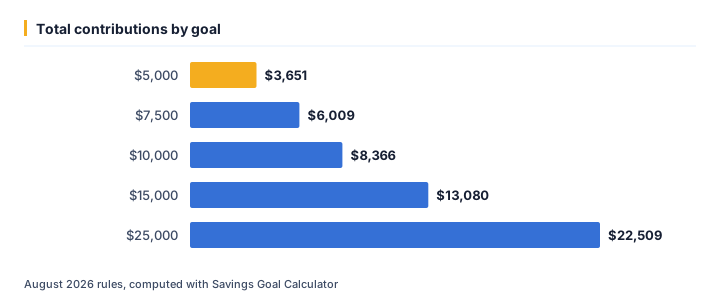
We ran 5 values of goal through the calculator and left every other input at its default. As of August 2026, the output was:
| Goal ($) | Total contributions ($) | Interest earned ($) | Needed ($) |
|---|---|---|---|
| 5,000 | 3,651.45 | 348.55 | 4,000 |
| 7,500 | 6,008.61 | 491.39 | 6,500 |
| 10,000 | 8,365.77 | 634.23 | 9,000 |
| 15,000 | 13,080.09 | 919.91 | 14,000 |
| 25,000 | 22,508.72 | 1,491.28 | 24,000 |
Running goal from $5,000 up to $25,000 moves total contributions from $3,651 to $22,509 — a spread of $18,857. That gap is the part a single headline rate never shows.
The same runs seen through interest earned
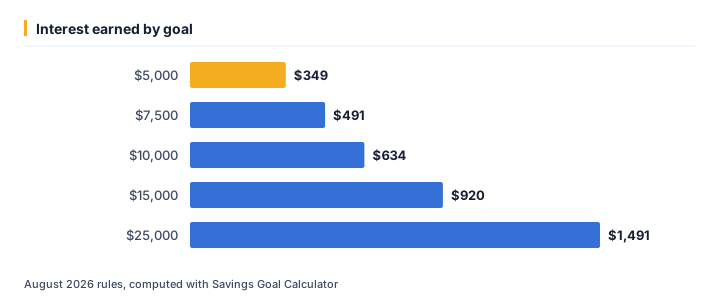
At $5,000, interest earned works out to $349; at $25,000 it is $1,491. Looking only at total contributions tends to understate how much the outcome shifts across that range.
One example, straight from the API
The middle row above (goal = $10,000) is not a rounded illustration — it is exactly what /api/v1/tools/savings-goal-calculator/calculate returns for that input, August 2026 rules:
{
    "tool": "savings-goal-calculator",
    "inputs": {
        "goal": 10000,
        "current": 1000,
        "years": 3,
        "rate": 4
    },
    "result": {
        "months": 36,
        "needed": 9000,
        "monthly_savings_required": 232.38,
        "total_contributions": 8365.77,
        "interest_earned": 634.23
    }
}
Assumptions behind these figures
| Input | Value |
|---|---|
| Goal | $10,000 |
| Current | $1,000 |
| Years | 3 years |
| Rate | 4% |
| As of | August 2026 |
| Method | identical to /tools/savings-goal-calculator |
Rates, thresholds and typical costs change over time; the numbers above are accurate as of August 2026, not a permanent guarantee. For your own situation, open the Savings Goal Calculator and enter your real numbers — the calculator runs the same code that produced every figure on this page.
Ready to crunch your numbers?
Open the Compound Interest Calculator and get an answer in seconds.
Editorial Team
We write plain-English money guides and build the free calculators behind them.