A calm look back at the personal finance trends that shaped 2026 — what changed for normal households, what stuck, and what to do about it heading into 2027.
This is a trend overview, not financial advice. The goal is to step back from the noisy day-to-day of 2026 and name the shifts that actually changed how ordinary US households handled money this year. Some are durable. Some are noise. Telling the two apart is most of the job.
If you want personalized strategy, a fee-only Certified Financial Planner is the right person to talk to — find one near you through letsmakeaplan.org. What follows is the broad-strokes version that can help you frame a conversation with that planner, or with yourself, as you set up 2027.
A framing note: we mention rates, contribution limits, and tax thresholds in general terms. These numbers move every year. Before you act on anything here, verify with an official source — IRS publications, your account custodian, or your bank's own disclosures.
The macro backdrop
Three broad threads ran through 2026 and shaped almost every other trend we will cover.
Inflation broadly eased from its 2022 peak, but did not return to the unusually quiet decade of the 2010s. Households still felt prices for groceries, services, and shelter as higher than they "remember." That memory effect matters more than any single CPI print — it changes how people budget, how they value savings rates, and how comfortable they are taking on new debt.
Interest rates remained elevated relative to the 2010s. For anyone who grew up assuming a savings account paid effectively zero and a mortgage was always available in the 3s, the new normal is genuinely new. It is not extreme by historical standards, but it is a different planning environment than the post-2008 decade trained most of us to expect.
The labor market normalized. The wild swings of the early-2020s job market — record quits, signing bonuses for ordinary roles, the sense that any job could be replaced next week with a 20% raise — settled down through 2025 and into 2026. Wage growth is positive but no longer outpacing inflation by wide margins for most workers. Raises require the more familiar mix of patience and explicit negotiation.
Hold those three threads in mind. They are the soil everything else in this article grew out of.
Trend 1: AI in personal finance
AI-assisted personal finance tools moved from novelty to default in 2026. Budgeting apps now ship with transaction categorization that is, for most users, materially better than the rule-based systems of five years ago. Some banks rolled out conversational interfaces for routine account questions, and a growing number of tax prep tools embed AI assistants for plain-English questions about deductions and forms.
Used carefully, these tools save real time. A budget you actually keep up to date is worth far more than a perfect budget you abandon by March.
The cautions are also real:
- Data sharing. An AI budgeting tool sees every transaction you make. Read the privacy policy. Understand whether your data is used to train models, whether it is shared with affiliates, and whether you can delete it.
- Hallucinated tax and legal advice. Generative AI tools confidently produce wrong answers about deductions, withholding, contribution limits, and filing status. Treat AI tax advice as a starting point for a question to a human, not as a final answer.
- Subscription creep. "AI-powered" became a price-tier marketing label this year. A free spreadsheet and the Budget Calculator still cover the same core ground that a $15-per-month premium app does, for most households.
The durable trend is that AI has lowered the floor for "good enough" personal finance tooling. The ceiling — judgment about your specific situation — is still firmly human.
Trend 2: High-yield cash sticks around
The behavior shift that started in 2023, when savers first noticed they could earn meaningful interest on idle cash, became fully normalized in 2026. High-yield savings accounts and short-term CDs are no longer a niche topic — they are the default conversation when someone asks where to park an emergency fund.
The reason this trend matters is not the headline yield. It is that an entire generation of adults relearned a habit that had atrophied during the 2010s: comparing rates and moving money. A checking account paying effectively nothing is no longer a passive default — it is a visible cost. That recognition does not vanish the next time rates fall.
For your own planning, the takeaways are unchanged from earlier years, just more consequential:
- Idle cash belongs in a high-yield savings account or a money market fund, not in a checking account, unless you are actively spending it.
- For money you do not need for 6 to 24 months, a CD or Treasury ladder is worth comparing against a savings account.
- For longer time horizons, cash yields are still lower than the long-run real returns on a diversified stock portfolio. Run the math both ways — the Compound Interest Calculator will show you the difference over 10, 20, and 30 years and it is large.
The savings-rate comparisons are easy to find. The discipline to actually move the money is the part that takes effort.
Trend 3: Student loan landscape
Federal student loan repayment is fully back. The pause-and-restart cycle of the early 2020s is in the rearview mirror, and millions of borrowers spent 2026 integrating their monthly payment back into the household budget for the first time in years. Income-driven repayment plans went through another round of changes, and the calculus of consolidation, forgiveness, and aggressive payoff shifted accordingly.
We will not name specific plan rules or eligibility thresholds — those are exactly the details that change in ways an evergreen article cannot keep up with. The trend is unmistakable: a large cohort of borrowers is budgeting around a loan-repayment line item that, for some, is the largest single bill after rent or mortgage.
A few broad observations worth carrying into 2027:
- The "minimum payment forever" approach is rarely optimal. Modest extra payments shorten the loan dramatically when the rate is in the 6–8% range.
- IDR plans are not free money. Lower payments today usually mean more interest over the life of the loan. They are the right tool when cash flow is tight, not a default to pick blindly.
- Refinancing federal into private debt is irreversible in important ways — it permanently gives up federal protections and forgiveness paths. The interest savings have to be substantial to justify that one-way door.
If student loans are reshaping your budget, stress-test the rest of the budget against that monthly number. The Budget Calculator helps you see what else needs to flex.
Trend 4: Housing affordability and the rent-vs-buy math
The rent-versus-buy decision tilted further toward "rent, for now" for many households in 2026. The combination of elevated mortgage rates and price levels that never meaningfully retreated from their pandemic-era highs means that, in many metro areas, the monthly cost of owning a comparable home exceeds the monthly cost of renting it by a wider margin than at any point in the last decade.
This is not a forever-rule. The math is local. In some markets the gap is small or reversed; in others it is enormous. The cultural assumption that buying is always financially superior to renting got a serious stress test this year, and renting came out looking more reasonable than the conventional wisdom of 2010–2020 suggested.
When you run the comparison for yourself, three questions matter more than they did five years ago:
- How long will you actually live in the home? Transaction costs on a purchase are large. Below roughly five years, renting is often cheaper even when the monthly numbers favor buying.
- What is the opportunity cost of the down payment? The Compound Interest Calculator will show you what that capital could do invested over the same horizon.
- How will both rent and ownership costs change in real terms? Rents rise; so do property taxes, insurance, and maintenance. Use the Inflation Calculator to compare cost-of-living scenarios across cities or over time.
The honest answer for many households in 2026 was: keep renting, save the difference aggressively, and revisit in a year or two. That is a reasonable response to a market that has gotten harder to underwrite.
Trend 5: Side income normalization
Side income kept moving from "extra" to "expected" through 2026. Gig work, creator income, freelance contracting, small online stores, and reselling all continued to mainstream. Picking up a second income stream is now a common, unremarkable thing — somewhere between renting out a spare room and getting a part-time job.
The financial consequence is that more households are receiving 1099 income alongside W-2 wages, and the tax mechanics have not gotten simpler. A few practical patterns that became more common in 2026:
- Quarterly estimated taxes. If a meaningful share of your income is untaxed at the source, the IRS expects payments four times a year, not once at filing. Missing these triggers penalties.
- Sinking funds for taxes. A separate account that you transfer roughly 25–35% of each gig payment into, then leave alone until the quarter ends, is the simplest way to avoid an April surprise.
- Tracking deductible expenses. Home office, mileage, supplies, software. Without records, those deductions evaporate at filing time.
- Self-employment tax. Side income is hit with both the employee and employer portion of payroll tax — genuinely larger than the income tax most beginners expect. Build it into your withholding plan.
If side income is moving from "fun money" to "rent money" in your household, treat it like the small business it is: a separate bank account, a bookkeeping habit, and at least one annual conversation with a tax professional.
Trend 6: Retirement account contribution awareness
Annual contribution limits for 401(k) plans and IRAs continued to drift upward in 2026, in step with the broader trend of inflation-indexing on tax-advantaged accounts. Verify the current limit with the IRS before acting — but the directional story is consistent: the headroom in your tax-advantaged accounts grew again, modestly, and is likely to grow again next year.
What actually shifted in 2026 was not the limits themselves but the default advice everyone converged on. "Max your employer match, then fund a Roth IRA, then return to the 401(k)" became the entry-level prescription almost every personal finance writer repeats. The limit numbers vary; the priority order does not.
Three practical filters that survived 2026 intact:
- Capture every dollar of employer match. This is the closest thing to a guaranteed return in personal finance. A 50% match on the first 6% of salary is a 50% pre-tax return in year one. Nothing else available to most households is competitive.
- Decide Roth versus traditional based on your bracket today versus expected in retirement. Early-career and lower-bracket usually means Roth. Higher earners in peak years often lean traditional. Neither is universally correct.
- Automate the contribution. Money you have to decide to save every month gets saved less reliably than money that moves on payday before you see it.
The Compound Interest Calculator is the right place to see what a fully funded retirement account does over 20 to 40 years. The number is usually larger than people expect — not optimism, just arithmetic.
What this means for your money in the coming year
Six calm things worth doing in the first quarter of 2027, in roughly this order:
- Revisit your savings rate. If you are saving the same dollar amount you saved in 2024, you are saving a smaller percentage of your income today. Recalibrate against current take-home pay. The Budget Calculator is the starting point.
- Stress-test your emergency fund against current expenses, not old ones. A three-month fund that felt sufficient in 2023 may be closer to two months today. Run the numbers with the Emergency Fund Calculator.
- If you carry debt above roughly 8%, make a paydown plan. Anything above 8% — most credit cards, some private student loans, some auto loans — almost certainly beats the return on cash savings.
- Re-check retirement contributions against the new limits. Even a small increase, automated now, compounds quietly for the rest of your career. See our beginner's wealth-building guide for the broader framing.
- Run an inflation gut-check on long-term goals. Use the Inflation Calculator to see what an old target dollar amount means in today's purchasing power.
- Decide one thing about side income. Either you are leaning in and treating it like a small business, or you are not. Drifting between the two — collecting 1099s casually without a tax plan — is the failure mode worth avoiding.
None of these are dramatic moves. They are the boring annual hygiene that compounds quietly across years.
Frequently Asked Questions
Is the personal finance landscape really that different from a few years ago? The structural pieces — earn, save, invest, repay debt — are unchanged. What shifted in 2026 is the relative attractiveness of cash, the durability of higher interest rates, and the normalization of side income and AI tooling. The fundamentals are the same; the defaults around them moved.
Should I be worried about a recession in 2027? Nobody can reliably predict the next recession, including the people whose job is to try. Build a plan that survives one regardless: an emergency fund sized to real expenses, debt at manageable levels, and an investment plan you can stick with through a 20–30% drawdown without panic-selling. See our piece on saving versus investing for how those pieces fit.
Are AI personal finance tools safe to use? Used carefully, yes. Read the privacy policy. Never act on AI-generated tax or legal advice without verifying it. Treat the AI as a faster, more patient version of a spreadsheet — useful for organizing, not for making the actual decisions about your money.
Should I prioritize paying off student loans or investing? It depends on the rate. Above roughly 8%, prioritize paydown — almost no reasonable investment beats a guaranteed 8% return. Below 5%, investing alongside the minimum payment usually wins over long horizons. Between 5% and 8% is judgment territory based on cash flow comfort.
Is now a good time to buy a house? This is local and personal. The 2026 macro tilt was toward renting in many markets, but "your market in your situation" is the only comparison that matters. Run the full rent-versus-buy math for at least a five-year horizon before deciding.
What is the single most important habit to set up for 2027? Automation. Every recurring contribution that runs on payday, before you see the money, is one fewer monthly decision you have to make correctly. See the financial independence steps guide for how that habit scales.
How do I keep up with changes to limits and rates without doom-scrolling? Once a year is enough. Block 60 minutes in January, check the current IRS contribution limits, the current rates on your savings and debt, and your own withholding. Adjust once. Then go live your life until next January.
Next Steps
- Run a 2027 budget. Use the Budget Calculator with your real current numbers, not last year's. Identify one category where the gap between intention and reality is biggest, and fix that one this quarter.
- Right-size your emergency fund. Update the Emergency Fund Calculator for current monthly expenses and decide whether the gap is something you close in 6 months or 18.
- Project one long-horizon scenario. Plug your retirement contribution and time horizon into the Compound Interest Calculator. The future-value number is grounding.
Trends are interesting; habits move the bottom line. The household finance work that mattered in 2025 still matters in 2027. The macro backdrop changed, the tools got better, the defaults shifted — but the underlying job is the same one it has always been.
This article reflects publicly observable trends as of early 2026. Specific rates, contribution limits, and tax thresholds change frequently — verify with official sources before acting.
Run the numbers
Everything below came out of this site's own Budget Calculator (50/30/20). The figures are not quoted from anywhere else: each row is one run of the same calculation the tool page performs, using August 2026 rules. Put the same inputs in and you will get the same output.
How the result moves with income
We ran 5 values of income through the calculator and left every other input at its default. As of August 2026, the output was:
| Income ($) | Savings ($) | Needs ($) | Wants ($) |
|---|---|---|---|
| 2,000 | 400 | 1,000 | 600 |
| 3,000 | 600 | 1,500 | 900 |
| 4,000 | 800 | 2,000 | 1,200 |
| 6,000 | 1,200 | 3,000 | 1,800 |
| 10,000 | 2,000 | 5,000 | 3,000 |
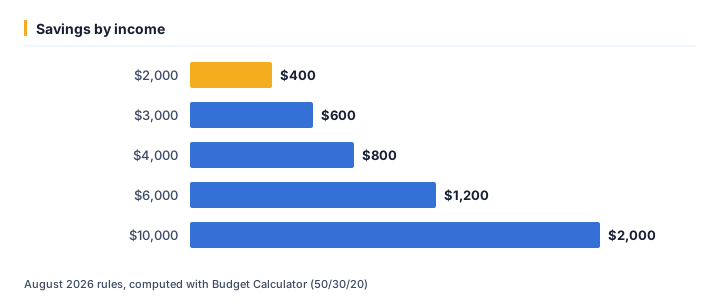
Running income from $2,000 up to $10,000 moves savings from $400 to $2,000 — a spread of $1,600. That gap is the part a single headline rate never shows.
The same runs seen through needs
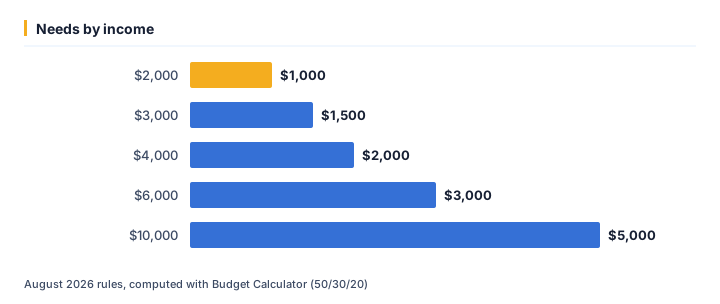
At $2,000, needs works out to $1,000; at $10,000 it is $5,000. Looking only at savings tends to understate how much the outcome shifts across that range.
One example, straight from the API
The middle row above (income = $4,000) is not a rounded illustration — it is exactly what /api/v1/tools/budget-calculator/calculate returns for that input, August 2026 rules:
{
    "tool": "budget-calculator",
    "inputs": {
        "income": 4000
    },
    "result": {
        "needs": 2000,
        "wants": 1200,
        "savings": 800
    }
}
Assumptions behind these figures
| Input | Value |
|---|---|
| Income | $4,000 |
| As of | August 2026 |
| Method | identical to /tools/budget-calculator |
Rates, thresholds and typical costs change over time; the numbers above are accurate as of August 2026, not a permanent guarantee. For your own situation, open the Budget Calculator (50/30/20) and enter your real numbers — the calculator runs the same code that produced every figure on this page.
Ready to crunch your numbers?
Open the Budget Calculator (50/30/20) and get an answer in seconds.
Editorial Team
We write plain-English money guides and build the free calculators behind them.