The classic '3 to 6 months of expenses' rule is a starting point, not a final answer. Your real target depends on income stability, household structure, and what 'essential' actually costs in your life.
Every personal finance article tells you to save "3 to 6 months of expenses" for emergencies. That is a useful default, but it is also the financial equivalent of "drink eight glasses of water a day" — a round number that hides a lot of individual variation. A single 25-year-old with stable W-2 income and good health insurance needs a very different buffer than a self-employed parent of three with a variable-income spouse.
This guide unpacks the real drivers of your emergency fund target, gives you a framework to compute your number rather than a generic one, and walks through where to keep the money and how to build it without stalling your other financial goals.
What an Emergency Fund Is For (and Isn't)
An emergency fund is a cash reserve held specifically to absorb sudden, unavoidable income or expense shocks — without triggering credit card debt, 401(k) withdrawals, or skipped rent.
It is for:
- Loss of employment (the big one — most large emergency funds exist for this).
- Major medical bills not covered by insurance.
- Sudden, large home or vehicle repairs that cannot be deferred.
- Family emergencies requiring travel or unplanned support.
- A period of reduced income (a furlough, a long disability, a sabbatical you did not choose).
It is not for:
- Predictable irregular expenses (annual car insurance premium, holiday gifts, an annual vacation). Those belong in sinking funds, separate from the emergency reserve. See Sinking Funds vs Emergency Funds.
- Investment opportunities ("there is a dip — let me put my emergency fund into the market").
- Lifestyle upgrades you would not otherwise be able to afford.
- Lending to family or friends.
The single most important mental model: the emergency fund is the financial equivalent of a parachute. You hope to never deploy it, and you accept that the money it represents earns less than it could if invested. That is the price of durability. People who chase yield on their emergency fund are the same people who eventually have a real emergency and discover their "high-yield investment" is down 22% the day they need the cash.
The Real Drivers of Your Target Number
The classic "3 to 6 months" range is calibrated for a typical W-2 employee with one income, normal job stability, and average household structure. Move along any of these axes and the target moves with you.
Income stability
The most important variable, by far.
- Stable W-2 income, recession-resistant industry (healthcare, utilities, government, education): the lower end of the range is reasonable. 3 months.
- Stable W-2 income, normal industry: the middle of the range. 4 months.
- W-2 income in a cyclical or layoff-prone industry (tech, finance, advertising, media, real estate): the upper end of the range. 6 months.
- Commission-based or bonus-heavy compensation: 6+ months, measured against your base salary alone so a slow bonus quarter does not deplete the fund.
- Self-employed, freelance, or 1099 contractor: 6 to 12 months. The lower bound for an established freelancer with a stable client roster; the upper for newer freelancers or seasonal work.
- Pre-revenue founder or bootstrapping a business: 12 to 18 months, plus a separate runway calculation for the business itself.
The reason income type dominates: emergency funds primarily exist to bridge income gaps. The longer your realistic gap could be (how many months between job loss and a replacement income stream), the larger the buffer needs to be.
Household structure
- Dual-income household, no dependents: the smaller of the two incomes can serve as a partial cushion if either job is lost. 3 months of combined essential expenses is often enough.
- Dual-income household, with dependents: 4 to 6 months. Kids add fixed costs (food, school, childcare) that do not flex with income.
- Single-income household, no dependents: 4 to 6 months. The entire income side rests on one job.
- Single-income household, with dependents: 6 to 9 months. The most exposed configuration; a longer buffer matches the genuinely larger downside.
Fixed costs vs. variable costs
Households with high fixed costs — large mortgage, leased luxury vehicles, expensive private schools — need larger buffers because their expenses cannot flex quickly with a drop in income. A renter with low monthly fixed costs can cut spending aggressively in week one of a layoff. A homeowner with a $3,500 monthly mortgage payment cannot reduce that bill quickly.
A useful rule of thumb: if your fixed costs (housing, transportation, insurance, debt payments) exceed 50% of take-home pay, add an extra month to whatever number you would otherwise target.
Insurance coverage
A robust insurance posture lowers your required emergency fund because individual shock events are absorbed by insurance rather than cash:
- Health insurance with a low out-of-pocket max
- Disability insurance (short-term and long-term)
- Adequate renter's or homeowner's insurance
- A solid auto insurance policy
- Umbrella liability if you have meaningful assets
Households with thin insurance need larger emergency funds. Households with strong coverage can often hold the lower end of the recommended range.
A Framework: Calculate Your Personal Number
The math is simple once the inputs are clear.
Step 1: Determine essential monthly expenses
This is the needs portion of your budget — what you would still have to pay for if you lost income tomorrow. Pull two months of statements and sort transactions:
- Housing (rent or mortgage, taxes, insurance, HOA)
- Utilities (electric, gas, water, basic internet, basic phone)
- Essential groceries (food eaten at home — eating out is wants and would be cut)
- Transportation (auto insurance, gas/transit, basic vehicle maintenance, car payment)
- Insurance premiums (health if paid post-tax, dental, vision, disability, life)
- Minimum debt payments (credit cards minimums, student loan minimums)
- Childcare, if needed for either parent to work
- Prescriptions and recurring medical costs
Critically, do not include 401(k) contributions, brokerage contributions, gym memberships, streaming subscriptions, or restaurant spending. Those stop in week one of an actual emergency. The number you want is the survival monthly cost — bedrock essentials — not your current discretionary lifestyle.
Most US households are surprised to find their essential monthly cost is 60-75% of their normal take-home pay, not 100%. The flexibility built into "wants" is itself a form of resilience.
Step 2: Multiply by your target months
Based on the income-stability and household-structure factors above, choose your month multiplier (3 to 12) and multiply by essential monthly expenses.
| Profile | Multiplier |
|---|---|
| Dual-income, no kids, stable jobs | 3 |
| Dual-income, kids, stable jobs | 4 |
| Single-income, no kids, stable W-2 | 4–5 |
| Single-income, kids, stable W-2 | 6 |
| Cyclical industry W-2 | 6 |
| Variable comp (commission, bonus) | 6–9 |
| Self-employed established | 9 |
| Self-employed newer | 12 |
| Pre-revenue founder | 12–18 |
Step 3: Adjust for life context
Add 1–2 months if you have:
- A mortgage exceeding 30% of take-home pay
- A child entering college within 4 years
- Aging parents who may need financial support
- A health condition with significant ongoing costs
Subtract 1 month if you have:
- A working spouse with completely separate, stable income
- Substantial liquid investments outside the retirement system (a taxable brokerage you could tap as a deeper backup)
- A short-term disability policy that replaces 60%+ of income
The Emergency Fund Calculator walks through this math interactively and lands you on a personalized target in under two minutes.
Where to Keep the Emergency Fund
The two failure modes to avoid: making it too easy to spend (checking account) and making it too hard to access in a real emergency (locked-up CDs, investments that might be down when you need them, retirement accounts with withdrawal penalties).
The right home: high-yield savings account (HYSA)
A high-yield savings account at an FDIC-insured online bank is the default. As of 2026, leading HYSAs pay rates competitive with short-term Treasury bills, with no lock-up, no minimum balances, and instant electronic transfer to your checking account. Open the account at a different bank from your checking, specifically to add psychological friction against casual withdrawals. The 1-2 day transfer delay is enough to interrupt the impulse to spend; the rate is materially better than a checking account.
Look for: no monthly fees, no minimum balance, FDIC insurance, online transfer availability.
Skip: brick-and-mortar bank savings accounts paying 0.01%. The forgone interest on a $20,000 buffer at competitive rates is hundreds of dollars a year.
Acceptable alternatives
- Money market accounts at the same kind of online bank — functionally identical to an HYSA, usually with the same insurance and rate.
- Treasury bill ladder (4-week or 13-week T-bills, rolling) — slightly higher yield, slightly less liquid, state tax exempt. Reasonable for the upper portion of a 9+ month emergency fund where some of the dollars will not be needed in the next 30 days.
- A small portion in a brokerage cash position if your fund has grown past a year of expenses — rarely useful for beginners.
Wrong places to keep it
- Checking account. Too easy to spend; rate too low. Exception: the first month of expenses can live in checking as a "float."
- Long-duration CDs. The lock-up defeats the point. Short-duration (3–6 month) CDs are acceptable for the lower-yielding portion of a large fund; longer ones are not.
- Index funds or stocks. The market is down precisely when most emergencies happen (recessions cause layoffs). Selling at a 25% loss to cover three months of rent is the worst outcome.
- Cryptocurrency. Volatility makes it unsuitable as a buffer regardless of long-term direction.
- A 401(k) "I could always tap it" mental account. Triggers taxes plus 10% penalty for early withdrawal under 59½, and damages future compounding. It is not an emergency fund; it is a retirement account.
How to Build It Without Sacrificing Other Goals
Most people building a meaningful emergency fund do it in phases, not in one heroic sprint.
Phase 1: Get to $1,000 fast
Before tackling debt or retirement contributions, get to $1,000 in a separate savings account. This is not your real target — it is the buffer that stops the next surprise from becoming credit card debt. Most households can hit this within 6–10 weeks with a focused effort: small one-time wins (selling unused items, a tax refund, a side gig) plus modest weekly transfers.
Phase 2: Match the employer 401(k) match
Capture the full match (often 50–100% return on contribution). Free money outranks emergency fund building beyond the $1,000 starter.
Phase 3: Pay down high-interest debt
Anything over 7-8% APR. The math: a 22% credit card balance is mathematically worse than not having an emergency fund, because the guaranteed 22% loss exceeds the protective value of cash.
Phase 4: Grow the emergency fund to your real target
Now, with the starter buffer and the worst debt out of the way, set a monthly transfer that lands you on your personalized target within 12–24 months. Use the Savings Goal Calculator to back into the right monthly amount from your target balance and deadline.
Common pace: $300 a month builds a $6,000 buffer in 20 months. $500 a month builds a $10,000 buffer in 20 months. The path is unglamorous; the destination is genuine financial calm.
Tactics that accelerate it
- Direct deposit splits. Many employers let you split direct deposit across multiple accounts. Route a fixed amount per paycheck directly into the HYSA — you never see it in checking.
- Bank windfalls automatically. Tax refund, work bonus, gift, side income: 100% to the emergency fund until the target is hit. This is the single fastest path to completion.
- No-spend months. Cut all wants spending for 30 days, redirect the savings. Generally yields $400–$1,500 in a single month.
- Sell stuff once. Clothes, electronics, furniture, equipment you have not used in a year. A single weekend often produces $500–$2,000.
When You Have Too Much in the Fund
It is genuinely possible to over-build an emergency fund. Past about 9 months of expenses for most households (12 for self-employed), additional dollars sitting in a savings account become a drag on long-term wealth — they earn an HYSA rate while inflation runs at 3% and the equity markets compound at 7% real.
Signs you have over-funded:
- Your fund is more than 9–12 months of essential expenses (excluding the self-employed cases above).
- You have built it at the expense of capturing the full 401(k) match.
- You have built it at the expense of paying minimums-only on >7% APR debt.
- You have built it at the expense of any retirement contribution at all (the most common error).
The right move: keep the fund at target, redirect new contributions into retirement and brokerage accounts, and periodically rebalance — once a year, anything above target moves into the investment side.
Frequently Asked Questions
Should I pay off credit card debt before building the emergency fund? After the $1,000 starter buffer, yes. A 22% credit card balance is a mathematically worse situation than a thin emergency fund — the guaranteed interest cost exceeds the protective value of cash. The exception is genuinely unstable employment, where a slightly larger buffer (say, 1.5 months) before tackling debt is prudent.
Can I keep my emergency fund in a Roth IRA? Technically, you can withdraw your contributions (not earnings) from a Roth IRA at any time, tax- and penalty-free. Some FIRE-focused households use this as a backup layer. The practical problem: once withdrawn, you cannot recontribute beyond that year's normal limit, permanently shrinking your retirement tax-advantaged space. Use a Roth as an emergency-fund-of-last-resort, not as the primary location.
What if my emergency fund earns less than inflation? Some loss to inflation is the price of having durable, accessible cash. The buffer is insurance, not investment. The right question is not "is my emergency fund beating inflation" — it is "do I have enough liquid cash to absorb a job loss without forced selling of investments." If yes, the fund is doing its job, regardless of its real return.
Should retirees keep an emergency fund? Yes, generally larger than working-age households — 12 to 24 months of expenses, often held as a mix of HYSA and short-duration Treasuries. The reason: retirees cannot absorb a market downturn by reducing 401(k) contributions or working more hours. Sequence-of-returns risk in early retirement is real, and a substantial cash buffer is the primary defense.
Is it OK to invest part of the emergency fund? For most working-age households with funds under 9 months: no. Keep it all in cash equivalents. Beyond 9 months, a portion (the dollars genuinely unlikely to be needed in the first 60 days) can move into short-duration Treasuries or money market funds, very low-risk vehicles still settling in days rather than minutes.
What happens to the fund after a real emergency? Replenishment becomes the new top priority — even before resuming brokerage contributions. Use the same direct-deposit split that built it originally, plus any windfalls, until back at target. Treat the rebuild as time-sensitive; the next emergency does not consult your calendar.
Next Steps
- Calculate your essential monthly expenses (the needs line, not your full monthly burn) — pull two months of statements and add up rent/utilities/insurance/groceries/transportation/minimum debts.
- Run the Emergency Fund Calculator with your honest income-stability and household-structure inputs. Lock in your personal target number.
- Open a high-yield savings account at an online bank (10 minutes, $0 minimum). Set up a recurring transfer the day after your next paycheck. Build the automation that will quietly do the work for you over the next two years.
The right emergency fund is the one you have actually built. A perfect target, never funded, is worth zero. A pragmatic target, automated and quietly compounding into existence over 24 months, is the financial backbone everything else in your money life rests on.
Run the numbers
Everything below came out of this site's own Budget Calculator (50/30/20). The figures are not quoted from anywhere else: each row is one run of the same calculation the tool page performs, using August 2026 rules. Put the same inputs in and you will get the same output.
How the result moves with income
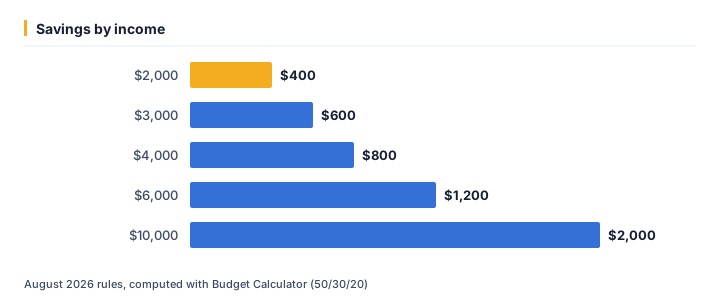
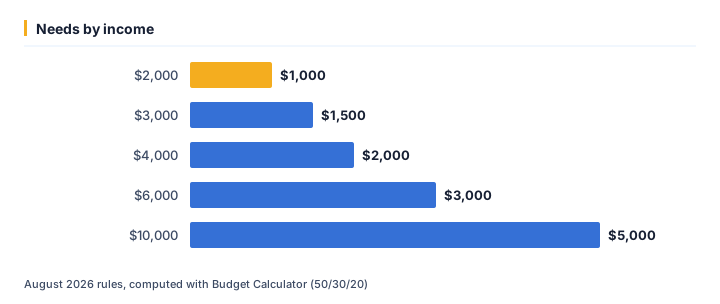
We ran 5 values of income through the calculator and left every other input at its default. As of August 2026, the output was:
| Income ($) | Savings ($) | Needs ($) | Wants ($) |
|---|---|---|---|
| 2,000 | 400 | 1,000 | 600 |
| 3,000 | 600 | 1,500 | 900 |
| 4,000 | 800 | 2,000 | 1,200 |
| 6,000 | 1,200 | 3,000 | 1,800 |
| 10,000 | 2,000 | 5,000 | 3,000 |
Running income from $2,000 up to $10,000 moves savings from $400 to $2,000 — a spread of $1,600. That gap is the part a single headline rate never shows.
The same runs seen through needs
At $2,000, needs works out to $1,000; at $10,000 it is $5,000. Looking only at savings tends to understate how much the outcome shifts across that range.
One example, straight from the API
The middle row above (income = $4,000) is not a rounded illustration — it is exactly what /api/v1/tools/budget-calculator/calculate returns for that input, August 2026 rules:
{
    "tool": "budget-calculator",
    "inputs": {
        "income": 4000
    },
    "result": {
        "needs": 2000,
        "wants": 1200,
        "savings": 800
    }
}
Assumptions behind these figures
| Input | Value |
|---|---|
| Income | $4,000 |
| As of | August 2026 |
| Method | identical to /tools/budget-calculator |
Rates, thresholds and typical costs change over time; the numbers above are accurate as of August 2026, not a permanent guarantee. For your own situation, open the Budget Calculator (50/30/20) and enter your real numbers — the calculator runs the same code that produced every figure on this page.
Ready to crunch your numbers?
Open the Budget Calculator (50/30/20) and get an answer in seconds.
Editorial Team
We write plain-English money guides and build the free calculators behind them.