Inflation has cooled from its 2022 peak, but prices are not coming back down. Here is an honest 2026 read and an eight-move playbook to protect your money.
"Is inflation over?" is the question quietly running underneath every personal finance conversation in 2026. The headline rate has cooled from the 2022 peak, the Federal Reserve has eased off the most aggressive rate hikes in a generation, and the monthly shock of 2021–2022 has — for most categories — stopped getting worse. It is tempting to file the inflation story under "handled" and move on.
The problem with that framing is that it confuses two different things: the rate of inflation and the level of prices. The rate has cooled. The level has not. Your grocery bill, your insurance premium, and your rent are not reverting to 2019. They are sitting at a permanently higher plateau, and the right financial moves for the next few years assume exactly that.
This article is the news companion to our deeper guide on understanding inflation and your money. For the "how do I actually calculate the impact on a specific dollar amount" walkthrough, see how to calculate inflation impact. What follows is the 2026 read and the calm checklist that comes out of it.
Where we are now
Inflation in the US has been gradually normalizing since the 2022 peak. After running hot enough to dominate the headlines for two straight years, the Consumer Price Index has spent recent quarters tracking somewhere in the broad neighborhood of the Federal Reserve's 2% target — closer in some prints, modestly above in others.
Two things are true at the same time, and both matter for your money:
Inflation has cooled. The dramatic year-over-year increases that defined 2021–2022 are not the current environment. Wage growth has had a chance to catch up in many sectors. Interest rates on savings have stayed meaningfully positive in nominal terms for the first time in a decade.
The price level is permanently higher. A cooler rate does not undo the cumulative price increases of the past five years. The basket of groceries, utilities, insurance, and rent that cost $1,000 in 2019 costs something closer to $1,200–$1,250 today. Even at a calm 2% inflation rate from here, that same basket will cost roughly $1,300 in five more years. The corrosion compounds whether or not the rate is making the news.
Plan as if both are true. The acute phase is behind us; the structural shift is permanent.
What "cooler inflation" doesn't fix
This is the most common misunderstanding in 2026 personal finance conversations. Lower inflation means prices are rising more slowly. It does not mean prices are falling. A return to 2% annual inflation means your $100 from 2019 — which now buys roughly $80 worth of 2019 goods — keeps losing a little more purchasing power every year, just at a gentler pace.
The only thing that would meaningfully reverse the level shift is deflation: a sustained period of falling prices. Deflation typically arrives alongside recession, rising unemployment, and falling wages. Healthy economies run on low, predictable, positive inflation. Hoping for deflation is roughly equivalent to hoping for a recession to fix grocery prices, and it would not be a good trade.
The honest framing: the inflation we already lived through is sunk cost. Your job for the next decade is not to wait for it to undo itself. Your job is to make sure your savings, income, and big-purchase decisions are calibrated to the world as it actually is.
Where inflation is still hot vs cool
Headline inflation hides large differences across categories. As of early 2026, the broad picture looks roughly like this — directional, not precise.
Still elevated:
- Shelter has been one of the stickiest categories. Lease renewals from the high-inflation years are still flowing into the index, and supply constraints in many metros have not fully relaxed. Rent inflation has historically run faster than headline CPI even in calmer environments.
- Insurance — auto, home, health — has continued to climb at a pace well above headline. Reinsurance costs, claim severity, and medical-cost trend have all pushed premiums up faster than wages in many states.
- Healthcare services broadly continue to inflate above headline. Drug pricing, hospital services, and out-of-pocket cost growth remain stubborn.
- Services generally — anything labor-intensive that cannot be automated or imported — has run hotter than goods. Restaurant pricing, personal services, and trades are the everyday face of services inflation.
Cooler than they were:
- Goods broadly. Apparel, electronics, and household items that benefited from supply chains normalizing have largely returned to a calmer trajectory.
- Energy is volatile by nature, but the acute 2022 spike is not the 2026 reality. Year-over-year energy comparisons have been mixed rather than alarming.
- Used and new vehicle prices have stabilized after the dramatic post-pandemic adjustment.
Your personal inflation rate depends on where your budget concentrates. A household paying high rent in a tight metro and carrying full-coverage auto, home, and health insurance is experiencing meaningfully higher inflation than the headline number, even in 2026. A household that owns their home outright and has stable employer health insurance is closer to the headline rate.
The eight-move playbook to protect your money
None of these moves require predicting where inflation goes next. They protect you across a reasonable range of outcomes — from a continued slow normalization to a modest re-acceleration. Treat this as a checklist; you do not need to do all eight in a weekend.
1. Right-size your emergency fund to current expenses
The single most common mistake is to leave the emergency fund target frozen at whatever number you set in 2019 or 2020. If your monthly essential expenses have climbed 20–25% since then, your three-to-six-month fund needs to climb with them. A $15,000 fund that covered six months in 2019 might only cover four months today.
Pull up your last three months of statements, total your essential spending (housing, utilities, groceries, insurance, minimum debt payments, transportation), and multiply by the number of months you want covered. The Emergency Fund Calculator walks through this in one step. Adjust the target. Then automate the top-up.
2. Move idle cash to high-yield
For most of the past 15 years, the choice between a regular savings account and a high-yield savings account barely mattered in dollar terms. That changed when short-term rates rose, and it has not fully reversed. As of 2026, leading online savings accounts and money market funds still pay rates that are meaningfully better than what most legacy checking and savings accounts offer.
If you have more than a month or two of expenses sitting in a 0.01% account, you are paying a quiet penalty. Move the excess to a high-yield account or short-term Treasury equivalent. The Compound Interest Calculator makes the multi-year difference concrete: a 4–5% yield versus a near-zero yield on a $30,000 balance is several hundred dollars per year — every year — for no additional risk.
Do not chase the absolute highest advertised rate; the spread between the top of the market and the top quartile is small, and convenience matters. Pick a reputable, FDIC-insured option and move on.
3. Renegotiate the recurring bills that creep
Inflation tends to hide inside subscriptions and policies because nobody re-reads them. Auto and home insurance premiums, mobile plans, streaming bundles, and gym memberships have all crept up across the past few years.
Block 60 minutes once a year — early in the calendar year is a clean choice — and do the following:
- Pull current premiums on auto and home insurance and request three competing quotes. Loyalty does not pay; switching often does.
- Audit streaming services and pick three to keep. Cancel the rest.
- Call your mobile carrier and ask what plans they offer at lower price points. They will tell you. They almost never volunteer this information.
- Check whether any annual subscriptions renewed at a higher price than the introductory rate.
This is unglamorous work that often produces several hundred to a couple of thousand dollars of recovered annual cash flow, which can then go into the emergency fund top-up or the high-yield account from moves 1 and 2.
4. Increase contributions in step with limit changes
The IRS adjusts retirement contribution limits roughly in line with inflation. The 401(k), IRA, and HSA limits have moved up over the past few years. A surprising number of people set their contribution percentage once, years ago, and never raised the dollar amount even when the limit climbed.
Two minutes of work: log into your retirement plan, check whether you are contributing the maximum you intended, and adjust upward. If you are using a percentage, verify that the actual dollar contribution matches your intent. If you are using a flat dollar amount, raise it. This is the rare inflation-protection move that requires no analysis and produces compounding benefits for decades.
5. Inflation-proof your savings goal targets
Any savings goal that targets a future dollar amount needs to be re-checked against today's inflation reality. A "$30,000 for the kitchen remodel in five years" target set in 2020 is no longer the right number, because the actual cost of the remodel has moved.
Use the Savings Goal Calculator to re-set each goal in current dollars, then build in a reasonable inflation assumption (3% is a defensible long-run default). The monthly contribution needed will be higher than the original plan. That is the right answer — it is what actually gets you to the goal rather than to 80% of it.
6. Don't over-anchor on TIPS or I bonds
Treasury Inflation-Protected Securities and I bonds are sometimes pitched as "the" answer to inflation. They have a real role, but they are not a cure-all. Both protect against inflation but offer modest real returns and carry their own trade-offs — tax treatment, liquidity constraints, purchase caps for I bonds, duration sensitivity for TIPS. For most working-age households, a small allocation as part of a diversified portfolio makes sense, particularly as you approach retirement. As your primary inflation hedge in your 30s or 40s, they are likely to underperform a diversified stock portfolio significantly. Use them as a complement, not a centerpiece.
7. Ask for the raise
Wages have to at least track inflation, or your real income falls. Across the past five years, wage growth has been uneven by industry and by year. The households that have come out ahead are the ones who have not been shy about renegotiating compensation when their market value rose.
If it has been more than 18 months since your last meaningful raise, you owe yourself a market-rate conversation. Our salary negotiation guide walks through the structure. A 5–10% bump preserved across the rest of a career is worth far more than any single tactical savings move.
8. Lock in big purchases thoughtfully
For large-ticket purchases that involve financing — a car, a major appliance, a home — the right framework is to compare the real interest cost (nominal rate minus expected inflation) against the alternative use of that cash. A 4% fixed-rate mortgage in a 2.5% inflation environment is a real cost of about 1.5%. That is genuinely cheap money over a 30-year horizon. A 9% auto loan in the same environment is a real cost of about 6.5%, which is not cheap.
The principle: long-duration fixed-rate debt at low rates is borrower-friendly when inflation runs above zero. Variable-rate debt and high-rate debt are not, regardless of the inflation backdrop. Run the numbers before committing.
The mental model: real vs nominal
The single most useful framing for thinking about inflation is the distinction between nominal and real dollars.
Nominal dollars are the dollar amounts you actually see — your salary, your bank balance, the sticker price on a car. They do not adjust for inflation. Real dollars are nominal dollars adjusted for changes in purchasing power. They tell you what the money actually buys.
A 4% raise sounds fine in nominal terms. If inflation is running at 3%, the real raise is closer to 1%. The same applies to investment returns: a 7% nominal return at 3% inflation is roughly a 4% real return. Long-term planning should use real numbers; current-year tax and cash-flow planning has to use nominal numbers. Switching between the two without noticing is one of the easiest ways to feel rich on paper and not in your life.
Whenever you make a multi-year financial projection, force yourself to ask: "Is this number in today's dollars, or future dollars?" A clean answer to that question prevents most planning mistakes.
What about a recession scenario?
A reasonable question, especially given how aggressively interest rates rose in 2022–2023. The honest answer is that nobody knows, and the protective playbook does not change much either way.
An emergency fund is the primary defense. A right-sized fund covers the most common recession risk for households, which is a temporary job loss. Move 1 in the playbook is also the most important recession-preparation move you can make.
High-rate variable debt is the secondary risk. Credit card balances and variable-rate debt above roughly 8% become much harder to service if income falls. Aggressive paydown of these balances is generally a higher-return move than additional investing.
Don't sell investments to "wait it out." Long-horizon investments are designed to weather recessions. The households that consistently lose money in downturns are the ones who sell during the drawdown and miss the recovery. Maintain your allocation, keep contributing, and let the time horizon do its job.
A worked example: $50,000 in cash, 2019 vs early 2026
Concrete numbers help. Suppose a household kept a $50,000 cash position in a low-yield checking or savings account from 2019 through early 2026 — a roughly seven-year stretch. The nominal balance has not changed; it still reads $50,000 on the statement.
The real picture is different. Cumulative CPI inflation across that stretch has been somewhere in the neighborhood of 23–25%, depending on exactly which months you mark off. In purchasing power terms, that $50,000 now buys roughly what $40,000–$41,000 bought in 2019. The household has experienced an invisible loss of around $9,000–$10,000 of purchasing power, while feeling perfectly prudent the whole time.
Run the same scenario in the Inflation Calculator with your own numbers and your own starting year. The output is sobering in a useful way: it makes the case for moves 1, 2, and 5 in the playbook far more concretely than any abstract argument can.
A counterfactual: that same $50,000, moved to a high-yield account paying an average of 3–4% over the same seven-year stretch, would have largely kept pace with inflation. Moved into a diversified long-horizon investment portfolio and held through the volatility, it would likely have meaningfully outpaced inflation, even after accounting for the 2022 drawdown. The cost of staying in low-yield cash was not just "less interest." It was real, compounding loss.
Frequently Asked Questions
Is inflation actually over in 2026? The dramatic acceleration of 2021–2022 is behind us, and inflation has been tracking closer to the Fed's target band. But "over" overstates it. Prices are still climbing, just more slowly, and the cumulative level shift from the high-inflation years is permanent. Plan for a normal-to-slightly-elevated environment, not for a return to 2019 prices.
Should I keep more cash now that rates are higher? Higher yields make cash less bad, not actually good. A right-sized emergency fund in a high-yield account is reasonable. Cash beyond that — money you will not need for five-plus years — still belongs in long-horizon investments where the expected real return is positive.
Are I bonds still worth buying? For households that do not already own them and have a portion of savings earmarked for the medium term, a modest I bond allocation is defensible. The variable rate has come down from the 2022 highs as inflation has cooled. Treat them as one tool among several, subject to the annual purchase cap and the early-redemption rules.
How much should I bump my emergency fund target? Compare your current essential monthly expenses to whatever they were when you originally set the target. If your essentials have climbed 20%, your target should climb roughly 20% too. Re-check this annually.
Does a fixed-rate mortgage still make sense? Yes, for most homebuyers planning to stay in the home for at least five years. The certainty of payment is itself valuable, and inflation tends to erode the real cost of fixed-rate debt over time.
Should I overpay my mortgage to "beat inflation"? Generally no, especially if the rate is locked in below current market yields. Paying down a 3.5% mortgage when you could earn more than that in a safe account or significantly more in a long-horizon portfolio is mathematically backward. The exception: paying down high-rate variable debt is almost always right.
Next Steps
- Re-check your emergency fund target against your current monthly essential expenses using the Emergency Fund Calculator. If the number you set 18+ months ago does not match the math today, raise the target and automate the top-up.
- Audit your cash positions and move anything beyond the emergency fund (and a working month or two) into a high-yield savings account or a diversified investment portfolio, depending on how soon you need the money. The Compound Interest Calculator makes the long-run difference visible.
- Pick one recurring bill — auto insurance is the most common winner — and renegotiate or replace it this week. Use the savings to fund moves 1 and 2.
A short reminder, because YMYL matters here: this article is informational and not personalized financial advice. Inflation interacts with your specific income, tax situation, debts, family circumstances, and risk tolerance in ways no general article can capture. For portfolio-level inflation hedging, retirement-income planning, or large-purchase decisions, a fee-only Certified Financial Planner is genuinely worth the conversation. You can find one near you through letsmakeaplan.org.
This article reflects general inflation trends and protective tactics as of early 2026. Specific rates, ETF performance, and contribution limits change frequently — verify with official sources before acting.
Run the numbers
Everything below came out of this site's own Savings Goal Calculator. The figures are not quoted from anywhere else: each row is one run of the same calculation the tool page performs, using August 2026 rules. Put the same inputs in and you will get the same output.
How the result moves with goal
We ran 5 values of goal through the calculator and left every other input at its default. As of August 2026, the output was:
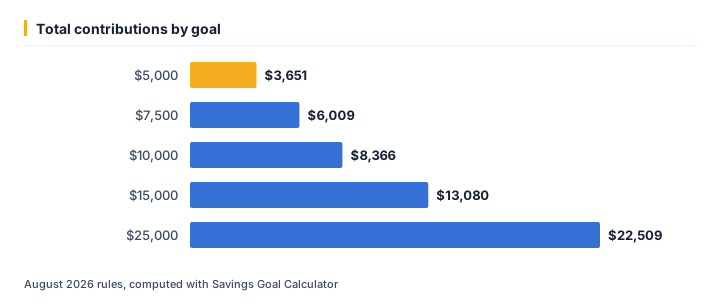
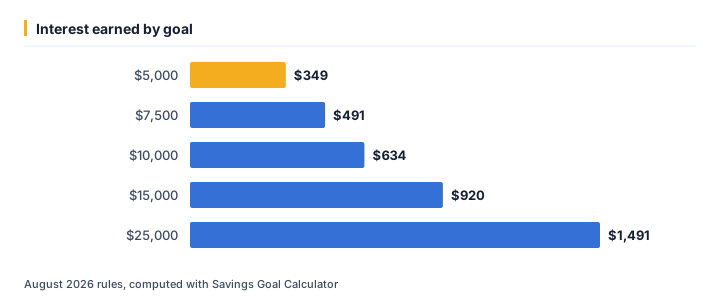
| Goal ($) | Total contributions ($) | Interest earned ($) | Needed ($) |
|---|---|---|---|
| 5,000 | 3,651.45 | 348.55 | 4,000 |
| 7,500 | 6,008.61 | 491.39 | 6,500 |
| 10,000 | 8,365.77 | 634.23 | 9,000 |
| 15,000 | 13,080.09 | 919.91 | 14,000 |
| 25,000 | 22,508.72 | 1,491.28 | 24,000 |
Running goal from $5,000 up to $25,000 moves total contributions from $3,651 to $22,509 — a spread of $18,857. That gap is the part a single headline rate never shows.
The same runs seen through interest earned
At $5,000, interest earned works out to $349; at $25,000 it is $1,491. Looking only at total contributions tends to understate how much the outcome shifts across that range.
One example, straight from the API
The middle row above (goal = $10,000) is not a rounded illustration — it is exactly what /api/v1/tools/savings-goal-calculator/calculate returns for that input, August 2026 rules:
{
    "tool": "savings-goal-calculator",
    "inputs": {
        "goal": 10000,
        "current": 1000,
        "years": 3,
        "rate": 4
    },
    "result": {
        "months": 36,
        "needed": 9000,
        "monthly_savings_required": 232.38,
        "total_contributions": 8365.77,
        "interest_earned": 634.23
    }
}
Assumptions behind these figures
| Input | Value |
|---|---|
| Goal | $10,000 |
| Current | $1,000 |
| Years | 3 years |
| Rate | 4% |
| As of | August 2026 |
| Method | identical to /tools/savings-goal-calculator |
Rates, thresholds and typical costs change over time; the numbers above are accurate as of August 2026, not a permanent guarantee. For your own situation, open the Savings Goal Calculator and enter your real numbers — the calculator runs the same code that produced every figure on this page.
Ready to crunch your numbers?
Open the Compound Interest Calculator and get an answer in seconds.
Editorial Team
We write plain-English money guides and build the free calculators behind them.