Standard US benchmarks suggest having 1× your annual salary saved by age 30, with an emergency fund of 3-6 months of expenses on top. But the right answer depends on your income, location, and career stage — not just the age number.
"How much should I have saved by 30?" is one of the most-searched personal-finance questions, and the answer is more nuanced than most listicles admit. The popular benchmark — 1× your annual salary in retirement savings by age 30 — is a reasonable starting point but treats every reader the same regardless of income, location, family situation, and career stage. This guide walks through both the standard benchmark and the situational adjustments that make it useful for your specific case.
The Quick Answer
The most widely cited US benchmark, popularized by Fidelity Investments and now used by many financial planners:
By age 30: have 1× your current annual salary saved across all retirement accounts.
For specific salary brackets:
| Annual Salary | 1× Benchmark (retirement at 30) | + Emergency Fund (3-6 months) | Combined Target |
|---|---|---|---|
| $40,000 | $40,000 | $7,500-$15,000 | $47,500-$55,000 |
| $50,000 | $50,000 | $9,000-$18,000 | $59,000-$68,000 |
| $60,000 | $60,000 | $11,000-$22,000 | $71,000-$82,000 |
| $75,000 | $75,000 | $13,500-$27,000 | $88,500-$102,000 |
| $90,000 | $90,000 | $15,000-$30,000 | $105,000-$120,000 |
| $120,000 | $120,000 | $20,000-$40,000 | $140,000-$160,000 |
| $150,000 | $150,000 | $25,000-$50,000 | $175,000-$200,000 |
The "1× salary saved" figure refers specifically to retirement savings (401(k), 403(b), IRA, Roth IRA). The emergency fund is a separate target on top of retirement savings.
For your specific calculation including non-retirement savings, home equity, and debts, use the Net Worth Calculator — it captures the full financial picture, not just retirement.
Why 1× Salary?
The 1× salary benchmark isn't arbitrary. It's derived from the math of getting to a comfortable retirement on a reasonable schedule.
The standard retirement-planning calculation assumes a person needs roughly 10× their final salary in invested retirement savings to support a 4% annual withdrawal that replaces 80% of pre-retirement income (combined with Social Security). Working backward from that target at retirement (typically age 65 or 67) with assumed annual returns of 7%, the math produces a series of age-based benchmarks:
- Age 30: 1× annual salary saved
- Age 35: 2× annual salary saved
- Age 40: 3× annual salary saved
- Age 45: 4× annual salary saved
- Age 50: 6× annual salary saved
- Age 55: 7× annual salary saved
- Age 60: 8× annual salary saved
- Age 67: 10× annual salary saved
These benchmarks assume consistent contributions (typically 15% of salary), reasonable investment returns, and steady salary growth. They are not commandments — they're a sanity check for whether your trajectory is leading toward a comfortable retirement on a reasonable schedule.
For the broader framework, see Building Wealth: The Complete Beginner's Guide.
What the Median 30-Year-Old Actually Has
Benchmarks and reality often diverge. Federal Reserve Survey of Consumer Finances data and various retirement-industry surveys provide rough numbers on what US 30-year-olds actually have:
Median net worth, age 25-34: ~$39,000 (Federal Reserve) Median retirement savings, age 25-34: ~$13,000 (various retirement-industry surveys) Percentage of 25-34 year olds with any retirement savings: ~57% Percentage with at least 1× salary saved: ~15-25%
The honest takeaway: the median 30-year-old is well below the 1× salary benchmark. This isn't a sign of widespread failure; it's a reflection of structural factors (student debt, delayed entry into career-track work, housing costs, lower starting salaries in many fields) that push down accumulated savings during the 20s.
If you're at or above the median, you're tracking with most of your cohort. If you're at the 1× salary benchmark, you're in the top quarter. If you're at 2-3× salary by 30, you're in the top 10-15% — and likely on a strong trajectory toward early financial independence.
Adjusting the Benchmark for Your Situation
The standardized 1× salary benchmark assumes a fairly average set of variables. Several situational factors reasonably adjust the target up or down.
Adjust Down (smaller target is okay)
Lower current salary, higher expected future salary. Medical residents, junior professionals at firms with steep career trajectories, and others in fields where salary doubles or triples in the next 10 years can reasonably underweight current-salary benchmarks. Your future contributions will be larger.
Significant student debt. $50,000+ of student loans is a meaningful drag on current savings rates. Catching up on contributions later is often the appropriate strategy. Don't beat yourself up for being below benchmark if you're paying down high-balance student debt aggressively.
Working in lower-cost-of-living markets. A 30-year-old earning $50,000 in a low-cost-of-living area may actually save at a higher absolute rate than someone earning $90,000 in a high-cost-of-living metro. Adjust expectations to your local cost structure.
Late start. Started professional work at 25 instead of 22? Started saving at 28 instead of 22? Your accumulated balance reflects fewer years of compounding. The benchmark assumes ~8 years of consistent saving by age 30; less than that means catching up later.
Adjust Up (larger target is appropriate)
Higher current salary, plateauing trajectory. High earners in fields with limited future salary growth (some specialized technical fields where compensation peaks early) should aim higher than 1× salary by 30 to ensure adequate retirement savings, since future contribution capacity may be limited.
Plan to retire before 65. If your goal is early retirement at 55 or 50, the standard 1×-by-30 benchmark is insufficient. FIRE (Financial Independence, Retire Early) practitioners often target 3-5× salary by 30.
Larger family / higher fixed costs. Children, a spouse who's not working, support of aging parents, or a high-cost-of-living area all push up the savings rate required to meet retirement targets. Higher benchmarks are appropriate.
Self-employed without employer match. No 401(k) match means losing 3-6% of effective compensation. To compensate, the personal savings rate (and accumulated balance) needs to be higher.
Beyond Retirement: Other 30-Year Targets
Retirement savings are one component of financial health at 30. A more complete picture includes:
Emergency fund: 3-6 months of essential expenses in a high-yield savings account. For a typical 30-year-old, this is $9,000-$25,000.
No high-interest debt: Ideally zero credit card debt and any personal loans. Mortgage and student loans are acceptable holdings; high-interest revolving debt is not.
Health insurance and basic coverage: Active health insurance (not just an emergency-only plan), renter's or homeowner's insurance, auto insurance with adequate liability limits, basic disability and (if dependents exist) term life insurance.
Some progress toward larger goals: A home down payment fund if homeownership is a goal, a relationship fund (engagement, wedding) if applicable, a planning reserve for major life transitions.
A 30-year-old who hits 1× salary in retirement, has a 3-month emergency fund, has no credit card debt, and is making progress toward one or two major life goals is on a fundamentally strong trajectory.
What to Do If You're Behind
The honest reality is that most 30-year-olds are below the 1× salary benchmark. Being behind is not a verdict — it's a data point. The recovery plan depends on the gap size.
Behind by less than 50% of benchmark (e.g., have $30,000 against a $50,000 target). Increase contributions 2-3% per year over the next 5 years to close the gap. Even small increases compound — going from 8% to 12% of salary saved over 5 years can add $30,000+ to your balance at age 35.
Behind by 50-100% of benchmark (e.g., have $10,000-$30,000 against a $50,000 target). A more deliberate plan is needed. Increase contributions to 15-20% of salary if possible. Capture every dollar of employer 401(k) match. Audit current spending for two structural cuts that can be redirected to retirement.
Far behind (no retirement savings at 30). Start now. The first year matters less than the next 10. Open a Roth IRA immediately, contribute at least to the employer 401(k) match level, and target 12% of salary saved per year going forward. Catching up by 40 is genuinely possible from a near-zero start at 30 — the math works if you start now.
A Decade-Plus Plan for 30-Year-Olds
A specific path that gets a 30-year-old earning $60,000 to a strong financial position by 40:
Year 30: Hit $60,000 in retirement savings + 3-month emergency fund ($12,000). Contribute 12% of salary annually ($600/month).
Year 31-33: Continue 12% contributions. Add $250/month to a taxable brokerage or Roth IRA. Build emergency fund to 6 months ($24,000).
Year 34-36: Bump contributions to 15% of salary as income grows. Begin tracking annual net worth.
Year 37-40: Combined retirement contributions of 15-18% of salary. Net worth growing $30,000-$50,000/year through contributions + market growth.
By Year 40: Target $300,000+ in retirement savings (5× target salary of $60,000) and net worth of $200,000+. This trajectory leads to a comfortable retirement at 65-67 without dramatic lifestyle compression in any single year.
Run the Compound Interest Calculator on your specific contribution rate to see the projected trajectory.
Frequently Asked Questions
Does my home equity count toward the savings benchmark? Home equity is part of net worth but not part of retirement savings specifically. The 1× salary benchmark refers to retirement accounts (401(k), IRA, Roth IRA). Home equity is great but doesn't substitute — you can't easily access it for retirement income without selling or refinancing.
What if I have no employer 401(k)? Open a Roth IRA at any major broker (Vanguard, Fidelity, Schwab). Annual contribution limit is $7,500 in 2026 ($625/month). For self-employed, consider a SEP-IRA or solo 401(k) with much higher limits.
Should I prioritize student loan payoff over retirement saving? Capture the employer 401(k) match first (it's free money), then pay down high-interest student loans (>7%) aggressively, then split between debt and additional retirement contributions. For lower-interest student loans (<5%), continued minimum payments while aggressively investing often produces better long-term outcomes.
Is buying a home part of the 30-year-old savings benchmark? The 1× salary benchmark doesn't include a home down payment fund. If homeownership is your goal, that's an additional savings target on top of the retirement benchmark. A $50,000 down payment fund and a $50,000 retirement balance at 30 are appropriate parallel targets.
What if I'm 32 and only have $5,000 saved? Start now. Two years behind is not a crisis. Increase contributions aggressively over the next 5 years to close the gap. The math allows for substantial catching-up in your 30s if you commit to it.
Should I include my spouse's savings? For household-level financial planning, yes — calculate combined retirement balances against combined salaries. For individual benchmarking, separate calculations make sense. Most couples should be tracking both.
Next Steps
If you're 30 or approaching it:
- Calculate your current retirement savings total across all accounts (401(k)s, IRAs, Roth IRAs).
- Calculate your current annual salary. The benchmark target is 1× this number.
- Calculate the gap (or excess). If behind, increase contribution rate immediately.
- Run the Compound Interest Calculator at your current contribution rate to see the projected balance at age 40, 50, and 65.
For the broader long-horizon plan, see Building Wealth: The Complete Beginner's Guide and How Much Should I Have Saved by 40?. For sizing the emergency fund specifically, see How Much Emergency Fund Do You Really Need?.
The 1× salary benchmark at 30 is a useful guide, not a verdict. The more important question is whether your trajectory leads to a comfortable retirement — and the answer to that depends on what you do in the next decade, not on where you stand today.
Run the numbers
Everything below came out of this site's own Savings Goal Calculator. The figures are not quoted from anywhere else: each row is one run of the same calculation the tool page performs, using August 2026 rules. Put the same inputs in and you will get the same output.
How the result moves with goal
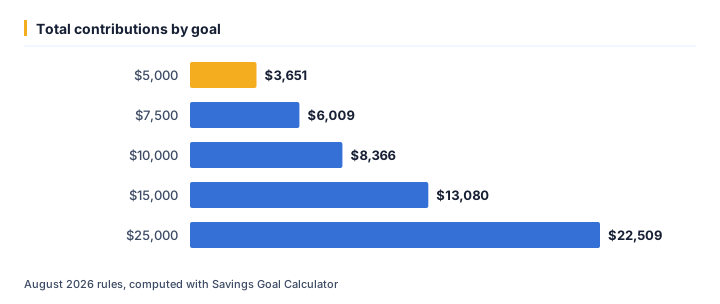
We ran 5 values of goal through the calculator and left every other input at its default. As of August 2026, the output was:
| Goal ($) | Total contributions ($) | Interest earned ($) | Needed ($) |
|---|---|---|---|
| 5,000 | 3,651.45 | 348.55 | 4,000 |
| 7,500 | 6,008.61 | 491.39 | 6,500 |
| 10,000 | 8,365.77 | 634.23 | 9,000 |
| 15,000 | 13,080.09 | 919.91 | 14,000 |
| 25,000 | 22,508.72 | 1,491.28 | 24,000 |
Running goal from $5,000 up to $25,000 moves total contributions from $3,651 to $22,509 — a spread of $18,857. That gap is the part a single headline rate never shows.
The same runs seen through interest earned
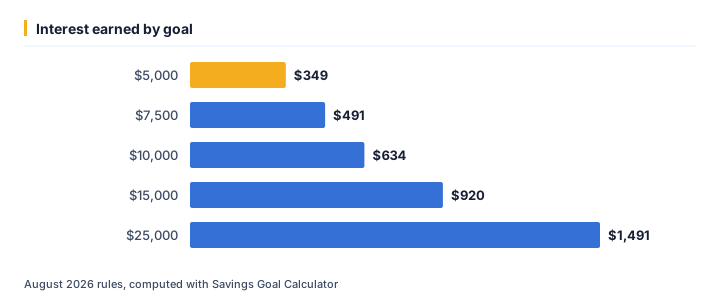
At $5,000, interest earned works out to $349; at $25,000 it is $1,491. Looking only at total contributions tends to understate how much the outcome shifts across that range.
One example, straight from the API
The middle row above (goal = $10,000) is not a rounded illustration — it is exactly what /api/v1/tools/savings-goal-calculator/calculate returns for that input, August 2026 rules:
{
    "tool": "savings-goal-calculator",
    "inputs": {
        "goal": 10000,
        "current": 1000,
        "years": 3,
        "rate": 4
    },
    "result": {
        "months": 36,
        "needed": 9000,
        "monthly_savings_required": 232.38,
        "total_contributions": 8365.77,
        "interest_earned": 634.23
    }
}
Assumptions behind these figures
| Input | Value |
|---|---|
| Goal | $10,000 |
| Current | $1,000 |
| Years | 3 years |
| Rate | 4% |
| As of | August 2026 |
| Method | identical to /tools/savings-goal-calculator |
Rates, thresholds and typical costs change over time; the numbers above are accurate as of August 2026, not a permanent guarantee. For your own situation, open the Savings Goal Calculator and enter your real numbers — the calculator runs the same code that produced every figure on this page.
Ready to crunch your numbers?
Open the Compound Interest Calculator and get an answer in seconds.
Editorial Team
We write plain-English money guides and build the free calculators behind them.