Standard US retirement-planning benchmarks suggest having 3× your annual salary saved by age 40. The decade between 30 and 40 is the most consequential of any working lifetime — contributions and compounding now produce far more retirement wealth than contributions later.
The decade from 30 to 40 is the most consequential 10 years in most Americans' working lifetimes. Compound interest math is fundamentally a function of time, and a dollar invested at 35 has roughly 5-10× the retirement value of a dollar invested at 55 — depending on assumed returns. Hitting the standard 3×-salary benchmark by 40 is not about catching up; it's about positioning the rest of your career to benefit from the longest possible compounding window.
This guide walks through the standard benchmark, what the median 40-year-old actually has, situational adjustments, and the recovery plan if you're behind.
The Quick Answer
The most widely cited US benchmark, used by Fidelity and most major financial-planning frameworks:
By age 40: have 3× your current annual salary saved across all retirement accounts.
For specific salary brackets:
| Annual Salary | 3× Benchmark (retirement at 40) | + Emergency Fund (6 months) | Combined Target |
|---|---|---|---|
| $50,000 | $150,000 | $18,000-$22,000 | $168,000-$172,000 |
| $65,000 | $195,000 | $22,000-$28,000 | $217,000-$223,000 |
| $80,000 | $240,000 | $25,000-$33,000 | $265,000-$273,000 |
| $100,000 | $300,000 | $30,000-$40,000 | $330,000-$340,000 |
| $125,000 | $375,000 | $35,000-$45,000 | $410,000-$420,000 |
| $150,000 | $450,000 | $42,000-$52,000 | $492,000-$502,000 |
| $200,000 | $600,000 | $52,000-$62,000 | $652,000-$662,000 |
The 3× retirement-savings target is in addition to an adequately funded emergency fund (typically 6 months of essential expenses by age 40, since job-loss timelines lengthen with age and career specialization). Other goals (children's college funds, real estate, family business) sit on top.
For your complete net worth picture beyond retirement, use the Net Worth Calculator.
Why 3× Salary?
The 3× salary at 40 benchmark, like the 1× at 30 benchmark, is derived from the math of retirement adequacy.
Standard US retirement planning assumes:
- 80% income replacement target in retirement
- 4% safe withdrawal rate from invested savings
- Working backward, ~10× salary saved at age 65-67 is the rough target
- Achieved through consistent 15% savings rate over a 40-year career
- Assumed 7% average real return on investments
These assumptions produce the well-known age-based benchmark sequence:
| Age | Benchmark (× current salary) |
|---|---|
| 30 | 1× |
| 35 | 2× |
| 40 | 3× |
| 45 | 4× |
| 50 | 6× |
| 55 | 7× |
| 60 | 8× |
| 67 | 10× |
The gap from 30 (1×) to 40 (3×) reflects 10 years of contributions plus compound growth on the existing balance. The gap from 40 to 50 (3× to 6×) is steeper because compounding accelerates as balances grow.
These benchmarks are sanity checks, not commandments. They assume consistent contributions, reasonable returns, and steady salary growth — none of which is guaranteed. They are useful for spotting whether your trajectory is roughly on track for a comfortable retirement at 65-67.
What the Median 40-Year-Old Actually Has
Various data sources on US retirement savings by age:
Median net worth, age 35-44: ~$135,000 (Federal Reserve Survey of Consumer Finances) Median retirement savings, age 35-44: ~$45,000-$60,000 (various industry surveys) Median for age 40 specifically: estimated $50,000-$80,000 in retirement accounts Percentage of 35-44 year olds at or above 3× salary benchmark: estimated 15-25%
The honest picture: the median US 40-year-old is meaningfully below the 3× salary benchmark. This is not unique to any single generation — it reflects structural challenges (student debt repayment, housing costs, raising children, career interruptions for caregiving) that compress savings rates during the 30s for many households.
Being at or near the median puts you with most of your peers. Being at 3× salary puts you in roughly the top quartile. Being at 5-6× salary puts you in the top 10-15% — and on track for early financial independence if you continue the trajectory.
The Catch-Up Plan If You're Behind
If you're 40 and below the 3× salary benchmark, there's still substantial runway — 25 years until traditional retirement age, which is enough time for both contributions and compounding to produce meaningful results.
The specific catch-up math, for someone at 40 earning $80,000 with $80,000 saved (1× salary instead of 3×):
Target at 67: 10× salary = $800,000 (in today's dollars)
To hit $800,000 from $80,000 starting balance over 27 years at 7% real return:
- Existing $80,000 grows to ~$500,000 with no further contributions
- Need additional ~$300,000 from new contributions and their growth
- Required monthly contribution: ~$525/month (assuming 7% real return)
- As a percent of salary: ~8% of $80,000
This is achievable. The catch-up is mostly about getting the contribution rate to 12-15% of salary going forward and capturing every dollar of employer 401(k) match. The compounding still works — 25 years is plenty.
For a deeper version of the same exercise:
Behind by 25% (have ~$180,000 against a $240,000 target on $80,000 salary): Increase contributions to 15% of salary over the next 5 years. Capture all employer match. Stop adding new debt. Trajectory recovery: realistic by age 50.
Behind by 50% (have ~$120,000 against a $240,000 target): Increase contributions to 18-20% of salary. Audit current spending for two structural cuts. Consider whether home equity, business interests, or other assets can be optimized to free up cash flow. Recovery realistic by age 55.
Behind by 75%+ (have ~$60,000 or less against a $240,000 target): A more aggressive plan is needed. 20-25% savings rate, additional income channels, possibly delayed retirement to 70 instead of 65-67. The math is harder but not impossible. Many readers in this position do achieve comfortable retirement by 70 with focused effort.
The mathematical reality of the catch-up: every year of delay raises the required contribution rate. Starting catching up at 40 requires roughly 12-15% of salary; waiting until 45 requires 18-22%; waiting until 50 requires 25-30%. Time is genuinely your friend at 40, even if you're behind.
Beyond Retirement: The Full 40-Year-Old Financial Picture
Retirement savings are one component of financial health at 40. A more complete picture:
Emergency fund: 6 months of essential expenses, ideally fully funded by 40. For most US households, $25,000-$40,000.
No high-interest debt: Credit card debt and personal loans should be at or near zero. Mortgage and remaining student loans are acceptable holdings.
Home equity: For homeowner households, 30-50% equity in the primary residence is a typical 40-year-old target. Renters can substitute additional brokerage or retirement savings.
Adequate insurance: Active health insurance with reasonable deductible. Disability insurance (especially for primary earners). Term life insurance if dependents exist. Adequate liability limits on auto and homeowner's policies.
College savings (if applicable): For households with children, some progress toward college savings (typically a 529 plan). Standard guidance suggests aiming for ~$50,000-$100,000 per child by the time they're 12-15 years old — though this varies significantly by family priorities.
Estate planning basics: A will (or trust for households with substantial assets), beneficiary designations on retirement accounts and life insurance, and basic powers of attorney. These are often deferred from the 30s into the 40s.
A 40-year-old who hits 3× salary in retirement, has 6 months of emergency fund, has no credit card debt, has reasonable insurance, and has at least started major-life-event funds (college, home down payment, family business reserve) is in a fundamentally strong position.
What Stops 40-Year-Olds From Hitting the Benchmark
Three patterns dominate why 40-year-olds end up below the benchmark:
Lifestyle inflation. Salaries grew through the 30s; spending grew with them or faster. The increased income that should have been redirected to savings ended up in larger housing, cars, and discretionary spending. The fix is to redirect the next raise (or 50% of it) automatically to savings before lifestyle adjusts.
Childcare and raising children. Two-income households with childcare costs of $1,500-$3,000/month per child have a structurally lower savings capacity during the years children are 0-5. The fix is to ramp savings aggressively once children enter school (and childcare costs drop) and to maximize tax-advantaged accounts even during the high-childcare years.
Career disruption or non-promotion. A job loss, extended layoff, layered career change, or career plateau during the 30s reduces accumulated savings. The fix is to focus on income recovery (career investment, networking, possible education) rather than just spending cuts.
These are real challenges, not personal failings. The 3× benchmark assumes a smooth career; many real careers aren't smooth.
The 50-Year-Old Look-Ahead
The 40-year-old who hits 3× salary is positioned to reach 6× by 50, which becomes the springboard to a comfortable retirement at 65-67. The math:
Age 40: $240,000 saved (3× $80,000 salary) Age 50 with 15% contributions and 7% real returns: ~$580,000 (about 6.5× salary, assuming modest salary growth to $90,000 by 50) Age 60 with continued 15% contributions: ~$1,200,000 (about 12× salary) Age 67 with continued 15% contributions: ~$1,900,000 (about 18× salary)
This produces a retirement income of approximately $76,000/year (using the 4% safe withdrawal rate) plus Social Security — comfortable for most US households.
If 40 instead hits 1× salary ($80,000 saved), the same 15% contributions through age 67 produce approximately $1,250,000 — still respectable, but $650,000 less than the 3×-at-40 trajectory. The decade from 30 to 40 genuinely matters that much in compound terms.
Frequently Asked Questions
Should I count my spouse's retirement savings? For household planning, yes — combined balances against combined salaries. For individual benchmarking, separate calculations. Most couples should be tracking both numbers.
Does my home equity count toward the 3× target? The 3× retirement benchmark refers specifically to retirement accounts. Home equity is part of net worth but is generally not liquid for retirement income without selling or downsizing. Don't substitute home equity for retirement savings.
What if I'm 42 and have only $50,000 saved? Start an aggressive catch-up immediately. 12-15% contribution rate to retirement, prioritize employer match, audit spending for redirectable expenses. The math allows catching up by 55-60 with focused effort starting now.
Should I prioritize children's college savings or my own retirement? Almost universally, retirement first. Children can borrow for college; you cannot borrow for retirement. Capture employer match, fully fund retirement to the recommended rate, then redirect surplus to college savings. The exception is parents very near retirement with adequate retirement balances who want to support children debt-free.
What if I work in a field with no employer 401(k)? Open a Roth IRA (or traditional IRA) at any major broker. Annual limit is $7,500 in 2026 ($8,600 if age 50+). For self-employed, consider SEP-IRA or solo 401(k) with much higher limits (up to $72,000 depending on income).
Is the 3× benchmark too aggressive for my situation? The benchmark assumes a fairly average set of variables. If you have substantially higher fixed costs (high cost of living, multiple dependents, supporting aging parents), the retirement income target you're saving toward may need to be different. A fee-only CFP from letsmakeaplan.org can help calibrate the specific number for your situation.
Next Steps
If you're 40 or approaching it:
- Calculate your current retirement savings total across all accounts.
- Calculate your current annual salary. The benchmark target is 3× this number.
- Calculate the gap. If behind, increase contributions immediately and audit current spending for two structural cuts.
- Run the Compound Interest Calculator at your current contribution rate to see the projected balance at age 50, 60, and 67.
For the broader long-term plan, see Building Wealth: The Complete Beginner's Guide and the comparison with the earlier benchmark in How Much Should I Have Saved by 30?.
The 3× salary benchmark at 40 is achievable from any starting point with enough runway. The most important variable is not where you are today, but what you do in the next 5-10 years — the most consequential decade for anyone serious about retirement adequacy.
Run the numbers
Everything below came out of this site's own Savings Goal Calculator. The figures are not quoted from anywhere else: each row is one run of the same calculation the tool page performs, using August 2026 rules. Put the same inputs in and you will get the same output.
How the result moves with goal
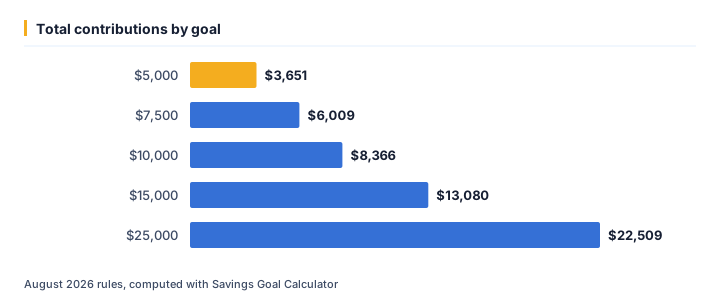
We ran 5 values of goal through the calculator and left every other input at its default. As of August 2026, the output was:
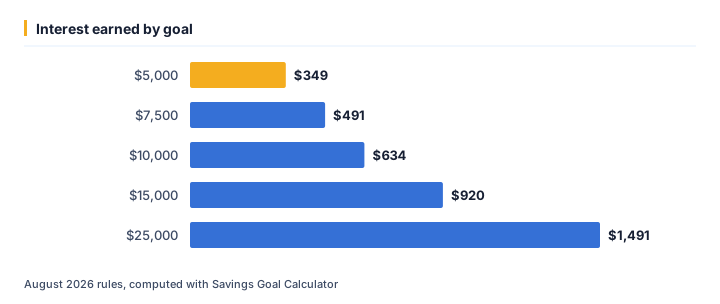
| Goal ($) | Total contributions ($) | Interest earned ($) | Needed ($) |
|---|---|---|---|
| 5,000 | 3,651.45 | 348.55 | 4,000 |
| 7,500 | 6,008.61 | 491.39 | 6,500 |
| 10,000 | 8,365.77 | 634.23 | 9,000 |
| 15,000 | 13,080.09 | 919.91 | 14,000 |
| 25,000 | 22,508.72 | 1,491.28 | 24,000 |
Running goal from $5,000 up to $25,000 moves total contributions from $3,651 to $22,509 — a spread of $18,857. That gap is the part a single headline rate never shows.
The same runs seen through interest earned
At $5,000, interest earned works out to $349; at $25,000 it is $1,491. Looking only at total contributions tends to understate how much the outcome shifts across that range.
One example, straight from the API
The middle row above (goal = $10,000) is not a rounded illustration — it is exactly what /api/v1/tools/savings-goal-calculator/calculate returns for that input, August 2026 rules:
{
    "tool": "savings-goal-calculator",
    "inputs": {
        "goal": 10000,
        "current": 1000,
        "years": 3,
        "rate": 4
    },
    "result": {
        "months": 36,
        "needed": 9000,
        "monthly_savings_required": 232.38,
        "total_contributions": 8365.77,
        "interest_earned": 634.23
    }
}
Assumptions behind these figures
| Input | Value |
|---|---|
| Goal | $10,000 |
| Current | $1,000 |
| Years | 3 years |
| Rate | 4% |
| As of | August 2026 |
| Method | identical to /tools/savings-goal-calculator |
Rates, thresholds and typical costs change over time; the numbers above are accurate as of August 2026, not a permanent guarantee. For your own situation, open the Savings Goal Calculator and enter your real numbers — the calculator runs the same code that produced every figure on this page.
Ready to crunch your numbers?
Open the Compound Interest Calculator and get an answer in seconds.
Editorial Team
We write plain-English money guides and build the free calculators behind them.