The US convention for tipping food delivery drivers in 2026 is 15-20% of the food cost, with a $5 minimum on small orders. Delivery driver earnings depend heavily on tips — base pay from DoorDash, Uber Eats, and Grubhub is typically very low without tips.
Food delivery tipping in the US has become one of the most-debated everyday tipping conventions. The apps suggest amounts that often feel high, the base pay from DoorDash, Uber Eats, and Grubhub is genuinely low, and the question of whether to tip before or after delivery has real consequences for service. This guide covers exactly how much to tip in 2026, why the convention is what it is, and the small set of cases where the standard rules adjust.
The Quick Answer
For US food delivery in 2026:
| Food Cost | Standard (15%) | Default (20%) | Generous (25%+) |
|---|---|---|---|
| $15 | $5 (minimum) | $5 (minimum) | $5 |
| $25 | $5 | $5 | $6.25 |
| $35 | $5.25 | $7 | $8.75 |
| $50 | $7.50 | $10 | $12.50 |
| $75 | $11.25 | $15 | $18.75 |
| $100 | $15 | $20 | $25 |
The 2026 default for satisfactory food delivery is 20% of the food cost, with a $5 minimum on small orders. The 15% line is the floor; 25%+ is appropriate for bad weather, long distances, heavy orders, or excellent service.
The $5 minimum on small orders is the most important rule: a 15% tip on a $15 order is $2.25, which after the app's various fees often leaves the driver with $3-$4 total compensation for what may have been 30-45 minutes of work. Few drivers would accept such orders without the customary minimum.
For specific orders and split-tip math, use the Tip Calculator.
How Delivery Driver Pay Actually Works
Understanding the math behind delivery driver earnings makes the tipping convention easier to reason about.
A typical $30 food delivery on DoorDash or Uber Eats in 2026 breaks down approximately like this:
- Customer pays: $30 food + $3-$6 delivery fee + $2-$4 service fee + $5 tip = $40-$45 total
- App keeps: delivery fee + service fee = $5-$10
- Driver base pay (set by the algorithm): $2-$5
- Driver tip: $5
- Driver's total earning for the trip: $7-$10
After the driver's vehicle costs (fuel, wear, insurance), the net take-home from a typical 25-40 minute delivery is $4-$7. Less self-employment tax (15.3% on the gross), it lands at $3.50-$6.
This is the reason tip percentages are functionally the dominant share of driver earnings. A $5 tip is the difference between profitable and unprofitable for many trips; $0 tips frequently make a delivery a net loss for the driver after gas.
The Pre-Tip vs Post-Tip Decision
This is the most consequential delivery tipping question. On DoorDash, Uber Eats, and most apps, you have two options:
Pre-tip (at checkout, included in the order acceptance). The driver sees the total potential earning (base pay + tip) before deciding to accept the order. Drivers prioritize higher-paying orders.
Post-tip (after delivery, added in the app). The driver does not see the tip when accepting. Acceptance and timing depend purely on base pay.
The practical consequence: pre-tipping at the customary 15-20% almost always results in faster acceptance, shorter wait times, and assignment to a driver who actively wanted the order (often resulting in better service). Post-tipping results in slower service, more order rejections, and longer waits.
The recommendation across most US delivery contexts in 2026: pre-tip at 20% of the food cost ($5 minimum), and add an additional post-delivery tip if the service was excellent. This pattern produces both fast service and recognition for exceptional drivers.
When to Tip Above 20%
Several specific situations where 25-30% is the appropriate default:
Bad weather. Heavy rain, snow, ice, extreme heat. The driver chose to work in difficult conditions. Add 5-10 percentage points or a flat $3-$5 extra.
Long distances. A delivery from a restaurant 8+ miles away (more common in suburban areas) takes the driver longer in both directions. The standard 20% on a $30 order ($6) does not compensate for 45 minutes of driving. Add $3-$5 extra.
Large or heavy orders. Pizza orders for 6+ people, multiple bags of takeout, beverages-heavy orders. Driver effort is meaningfully higher. Add $2-$5 extra above standard tipping.
Late-night or pre-dawn deliveries. Often few drivers available; the ones working deserve recognition for the unusual hours.
Specific instruction compliance. Orders that required the driver to climb stairs, navigate gated apartment complexes, hand-deliver to a specific room, or follow detailed instructions. Add $2-$5.
Excellent communication. Driver texted to confirm the order, reported any issues, was professional throughout. Add $2-$5.
When 15% Is the Floor (Not the Default)
The 15% floor is defensible only when:
- The order was straightforward, the delivery quick and uneventful, and there were no complicating factors.
- The food cost is low ($15-$20), where the percentage is less meaningful than the $5 minimum.
For most other orders in 2026, 20% is the customary default. 15% as a habit is below the social convention.
App-Specific Notes
The major US delivery apps have slightly different conventions and mechanisms, though the customer-facing tipping math is approximately the same.
DoorDash
- Pre-tipping is strongly encouraged and visible to drivers.
- Without a tip, base pay alone often does not justify the order, leading to rejections and stale orders.
- Customer tipping is the primary form of driver compensation.
- Standard: 20% of food cost, $5 minimum.
Uber Eats
- Similar dynamic to DoorDash; pre-tipping affects acceptance.
- Uber's algorithm sometimes batches orders, which can affect timing independently of tip size.
- Standard: 20% of food cost, $5 minimum.
Grubhub
- Slightly more variable driver acceptance behavior; pre-tipping still recommended.
- Restaurant-direct partnerships are more common, sometimes with restaurant employees making the deliveries.
- Standard: 20% of food cost, $5 minimum.
Restaurant-Direct Delivery (Domino's, Pizza Hut, restaurant employees)
- These deliveries are typically driven by restaurant employees, often paid hourly with tips.
- Standard convention: 15-20% of order cost, $3 minimum on small orders.
- The economics are different from app-based delivery — the driver is usually a regular employee with predictable hours.
Cash vs In-App Delivery Tips
In-app tipping has become the default in 2026 because:
- It's the easier customer experience (one transaction).
- It records the tip for both customer and driver.
- It allows pre-tipping (which affects service).
Cash tipping has narrower use cases:
- For exceptionally good service post-delivery, a $5-$10 cash bill is appreciated and immediate.
- For situations where the app tip processing has a delay or fee structure that disadvantages the driver.
- In small towns where the same drivers serve regularly and a cash relationship matters.
The combined pattern that works well: pre-tip 20% in-app for prioritization and standard service, plus a $3-$5 cash bill at the door for excellent service.
When NOT to Tip Standard
A small set of situations:
Order arrived cold or significantly delayed (driver's fault). A pattern of bad service warrants tipping the floor ($5 minimum) rather than the standard 20%. Use the in-app rating and feedback to communicate the issue.
Items missing or wrong (driver's fault, not the restaurant's). Tip the floor and contact app support for compensation on the missing items.
Driver was unprofessional or made the customer uncomfortable. Tip $0 in the app and report. The app generally handles this seriously.
The "tip" is actually a delivery fee already passing to the driver. Some restaurants have built delivery into menu pricing — verify with the restaurant.
In nearly all other cases, the standard 20% applies.
Special Situations
A few specific common cases:
Group orders for offices or events. A $200 group order should tip 18-22% ($36-$44), particularly if the driver had to coordinate a complex hand-off. The lower percentage on large orders is acceptable because the absolute dollar amount is still meaningful.
Grocery delivery (Instacart, Shipt). A different category with its own conventions — see specialized guidance. Generally 15-20% of the grocery cost, with attention to the shopper's effort on out-of-stock substitutions.
Alcohol delivery. Add $2-$5 extra above standard food delivery tipping. The driver was required to check ID and complete additional verification.
Catering delivery. $5-$15 extra above the food-cost percentage. Catering deliveries often require setup, multiple trips, and physical effort.
Frequently Asked Questions
Why are delivery tips higher than in-restaurant tips? Two reasons. First, the driver's costs (fuel, vehicle wear) come out of their pocket, unlike a restaurant server whose costs are absorbed by the employer. Second, the base pay from delivery apps is meaningfully lower than the tipped minimum wage at restaurants, so tips form a larger share of total earnings.
Should I tip on the food or the total (including fees)? Tip on the food cost only. Service fees and delivery fees mostly go to the app, not the driver. The convention is 15-20% of the food, $5 minimum.
What if I'm getting delivery from a no-tip restaurant? If the restaurant has a no-tip policy and uses its own delivery staff, the policy applies — no tip required. If a no-tip restaurant uses a third-party delivery app, the app driver is independent and should still be tipped per the standard delivery convention.
Is the in-app suggested tip the right amount? Often higher than the standard convention (app suggested defaults are sometimes 25-30%). The standard 20% is socially acceptable; the higher percentages are appreciated but not required. If you're satisfied with the higher percentage default, that's generous, not obligatory.
Should I tip extra during the holidays? A common gesture in December — many regular users add $5-$10 extra per delivery during the season-of-giving period, or tip at 25% as a default.
What if the driver delivered to the wrong address? Use the app support to resolve the missing-order issue. Tip the driver based on whether the wrong delivery was the driver's fault (app provided wrong address — driver gets standard tip; driver ignored clear instructions — floor tip).
Next Steps
For exact tip math on specific delivery orders, use the Tip Calculator. For tipping conventions across every other US service category — restaurant, bar, salon, rideshare, hospitality — see the Tipping Guide: U.S. Standards by Service.
The delivery driver economics in 2026 make tipping the dominant share of driver compensation. A consistent 20% pre-tip habit produces faster, better service and is the social default that has settled across the major US delivery markets. For frequent delivery users, building the habit of pre-tipping at 20% ($5 minimum) is one of the simplest customer-side improvements to delivery quality.
Run the numbers
Everything below came out of this site's own Tip Calculator. The figures are not quoted from anywhere else: each row is one run of the same calculation the tool page performs, using August 2026 rules. Put the same inputs in and you will get the same output.
How the result moves with bill
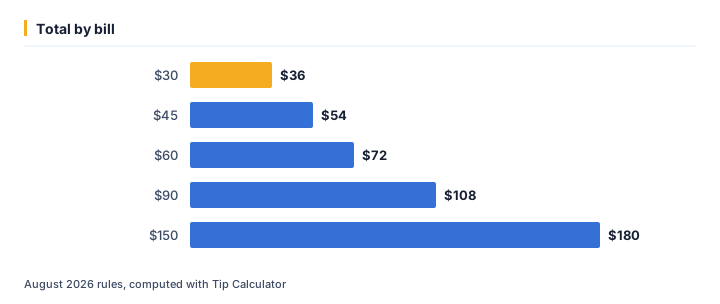
We ran 5 values of bill through the calculator and left every other input at its default. As of August 2026, the output was:
| Bill ($) | Total ($) | Tip amount ($) | Per person ($) |
|---|---|---|---|
| 30 | 36 | 6 | 18 |
| 45 | 54 | 9 | 27 |
| 60 | 72 | 12 | 36 |
| 90 | 108 | 18 | 54 |
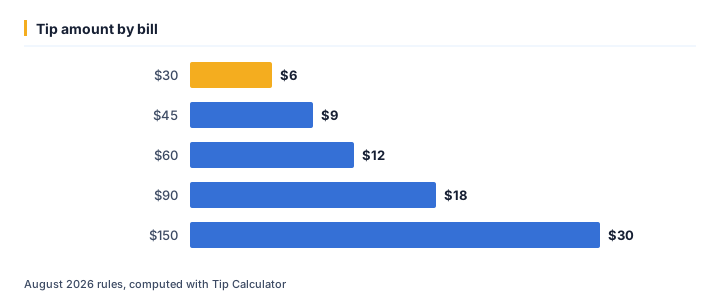
| 150 | 180 | 30 | 90 |
Running bill from $30 up to $150 moves total from $36 to $180 — a spread of $144. That gap is the part a single headline rate never shows.
The same runs seen through tip amount
At $30, tip amount works out to $6; at $150 it is $30. Looking only at total tends to understate how much the outcome shifts across that range.
One example, straight from the API
The middle row above (bill = $60) is not a rounded illustration — it is exactly what /api/v1/tools/tip-calculator/calculate returns for that input, August 2026 rules:
{
    "tool": "tip-calculator",
    "inputs": {
        "bill": 60,
        "tip": 20,
        "people": 2
    },
    "result": {
        "tip_amount": 12,
        "total": 72,
        "per_person": 36
    }
}
Assumptions behind these figures
| Input | Value |
|---|---|
| Bill | $60 |
| Tip | $20 |
| People | $2 |
| As of | August 2026 |
| Method | identical to /tools/tip-calculator |
Rates, thresholds and typical costs change over time; the numbers above are accurate as of August 2026, not a permanent guarantee. For your own situation, open the Tip Calculator and enter your real numbers — the calculator runs the same code that produced every figure on this page.
Ready to crunch your numbers?
Open the Tip Calculator and get an answer in seconds.
Editorial Team
We write plain-English money guides and build the free calculators behind them.