On a $50 restaurant bill in the US, the customary tip range is $9 (18%) to $12.50 (25%), with $10 (20%) being the modern default for table service. Different service categories — takeout, bar tabs, delivery, salon — have their own conventions.
A $50 bill sits in the sweet spot where US tipping conventions are most actively discussed: large enough that the difference between 15% and 25% is meaningful ($5), small enough that the mental math wants to round to a "nice" number. This guide covers exactly how much to tip on a $50 bill across every common service category, why the standard percentages differ by category, and which edge cases (tip-free restaurants, "service charge" rows, party-size minimums) change the answer.
The Quick Answer for a $50 Restaurant Bill
For full-service restaurant dining in the US in 2026, the customary range on a $50 pre-tax bill is:
| Service Level | Percentage | Tip on $50 |
|---|---|---|
| Below-standard service | 15% | $7.50 |
| Standard / good service | 18% | $9.00 |
| Modern default (table service) | 20% | $10.00 |
| Excellent service | 22% | $11.00 |
| Outstanding / large party | 25% | $12.50 |
The most common default across US table-service restaurants is now 20%, with 18% considered the floor for satisfactory service. Below 15% should signal a real problem with the service (and should ideally be paired with a brief explanation to the manager so the issue can be addressed, rather than communicated only through the tip line).
Run any bill total through the Tip Calculator to handle pre-tax vs post-tax tipping, splits across multiple diners, and rounding to a clean total payment.
Why 20% Has Become the Default
Twenty percent has gradually replaced 15% as the US baseline at full-service restaurants over the past two decades. Three forces drove the shift:
Tipped minimum wages have not kept pace. The federal tipped minimum wage has remained at $2.13/hour since 1991. Even in the substantial number of US states that have set higher tipped minimums, server take-home from tips alone makes up the bulk of total earnings. As food prices rose, the percentage convention shifted to maintain the same approximate hourly compensation.
Default presets on payment terminals shifted up. Most modern payment terminals show three suggested tip percentages — and over the past decade, those defaults have moved from (15%, 18%, 20%) to (18%, 20%, 25%) at most chains. Defaults shape behavior; the new normal became 20%.
Restaurant tip pooling expanded. Many restaurants now share tips across servers, bussers, runners, and sometimes kitchen staff. A 20% tip on a $50 bill at a tip-pool restaurant supports 3-5 workers, not one — which has shifted the "what is fair" calculation upward over time.
The result is that 20% is now the operational default for satisfactory service in most US table-service contexts. 18% remains acceptable for adequate service; 25% remains the convention for excellent service or large parties.
Pre-Tax vs Post-Tax Tipping on $50
A common question: do you tip on the $50 before sales tax, or on the post-tax total?
The traditional convention is pre-tax — the percentage is applied to the cost of the food and drink only, not the tax. Sales tax goes to the state and city, not the server; basing the tip on the post-tax number means tipping the government.
In practice, the difference on a $50 bill is small. At a 7% sales tax, the post-tax total is $53.50, and 20% on $53.50 is $10.70 versus $10.00 pre-tax. Most diners in 2026 — and most tip-calculator suggestions on payment terminals — calculate post-tax for simplicity. Either is defensible; pre-tax is technically traditional, post-tax is operationally common.
The category where the distinction matters more is alcohol-heavy bills, because alcohol is sometimes taxed at a higher rate, and on a high-tax bar tab the gap between pre-tax and post-tax tipping can grow meaningfully.
Tip on $50 for Other Service Categories
The 18-20% restaurant convention is not universal. Different service categories have their own established norms.
Bar (Drinks Only)
For a $50 bar tab paid at the end of the night:
- $1 per drink ordered (historical convention, still common for casual bars)
- 15-20% of total bill (modern convention, especially at cocktail bars)
On $50, expect to tip $8-$10. For complex craft cocktails (which require more time and skill), the higher end is more appropriate. For self-pour beer at a casual bar, $1-$2 per drink is still acceptable.
Takeout
Takeout tipping is genuinely contested in the US. The honest position:
- Pickup only, minimal staff interaction: No tip expected. 0-5% if you choose.
- Restaurant prepared a complex takeout order, packaged thoughtfully: 10% is generous and appreciated. $5 on $50.
- Restaurant brought it to your car or required staff time: 10-15%. $5-$7.50.
The pressure on payment terminals to show suggested takeout tips of 18-25% is a recent (and not universally adopted) shift. Many takeout customers continue to tip $0 or a small flat amount without social consequence.
Delivery
For food delivery — DoorDash, Uber Eats, Grubhub, or restaurant in-house delivery:
- Standard: 15-20% of the food order, or $5 minimum (whichever is higher).
- On $50: $7.50-$10, plus consider an extra $1-$3 for bad weather, large orders, or long distances.
The delivery driver's earnings depend heavily on the customer tip — base pay from the app is typically low. A pre-checkout tip (rather than post-delivery) often results in faster acceptance of your order. See How Much to Tip on Food Delivery for the full breakdown.
Rideshare (Uber, Lyft)
If your Uber or Lyft ride was $50 (a relatively long ride for most US cities):
- Standard: 15-20%, so $7.50-$10.
- Quick mental math: $7 for standard service, $10 for above-average (clean car, helped with luggage, navigated tricky routes).
Tipping is increasingly expected on rideshare in the US — the social norm has shifted in the last 5 years from "optional" to "expected at 15%+." See How Much to Tip an Uber or Lyft Driver.
Hair Salon / Barber
If your salon bill is $50:
- Standard: 18-22%, so $9-$11.
- Cash is preferred by most salon and barber workers, since some salons take a cut of card-based tips.
The salon tip frequently goes to multiple workers — the colorist, the shampoo assistant, the stylist. Ask the salon what the convention is; some have a posted tip-distribution policy. See How Much to Tip at a Hair Salon.
Hotel Bellhop / Concierge
If a bellhop carried bags or a concierge arranged a service costing roughly $50:
- Bellhop: $1-$2 per bag, generally $3-$5 total — not percentage-based.
- Concierge (if booking arrangements): 10-15% of the booking, so $5-$7.50 on a $50 transaction.
When Not to Tip on a $50 Bill
A few situations where no tip is conventional in the US:
Restaurants that publish "no tip" policies. A small but growing number of US restaurants have eliminated tipping in favor of higher menu prices and stable hourly wages. The bill itself is the final amount. Tipping anyway is welcome but not expected.
Service charges already added. Many restaurants automatically add 18-20% to parties of 6 or more, or to all parties in tourist areas. If a "service charge" line already appears, the total is the bill — adding another tip on top is redundant. Read the receipt carefully: "service charge" and "gratuity" rows are sometimes added without obvious labeling.
Fast food and counter service (no table service). Convention does not require tipping at McDonald's, Chipotle, or counter-service coffee shops. The growing presence of tip prompts on payment terminals at these venues is a social shift many Americans have explicitly rejected. Tip if you wish; do not feel obligated.
Self-service or vending. Self-serve frozen yogurt, ice cream, or pre-packaged food does not carry a tipping convention.
Quick Mental Math for Tip on $50
The fastest way to calculate tip on $50 without a phone:
- 10%: Move the decimal one place. 10% of $50 = $5.
- 20%: Double the 10%. 20% of $50 = $10.
- 15%: Halfway between. 15% of $50 = $7.50.
- 18%: Add half of 10% (so $2.50) to 15% ($7.50) → $9.00. Or take 20% ($10) and subtract a tenth of that ($1) → $9.
- 22%: Take 20% ($10) and add 10% of that ($1) → $11.
- 25%: A quarter of $50 → $12.50.
The pattern that works on any bill: calculate 10% first by moving the decimal, then double, halve, or adjust by smaller increments. After enough practice, 18% of any restaurant bill takes about three seconds.
Frequently Asked Questions
Should I tip on the pre-tax or post-tax amount? Pre-tax is the traditional convention; post-tax is more operationally common in 2026 because most payment terminals calculate on the total. On a $50 bill, the difference is about $0.50-$0.70 at typical sales tax rates. Either is socially acceptable.
Is 15% still acceptable for restaurant tipping in 2026? Yes for adequate-but-unremarkable service, though 18% has become the more common floor. Below 15% should signal a genuine service problem.
Do I need to tip extra for splitting a bill? Each diner should calculate their tip on their portion of the bill at the same percentage. The total tip should not be lower because the bill was split. If splitting evenly on a $50 bill across two people, each pays $25 + their share of a $10 tip ($5 each).
Should I tip more on a $50 brunch with kids? Generally yes — children's plates require additional service (refills, dropped items, cleanup). Most parents in the US default to 22-25% at family restaurants for this reason.
What if the service was genuinely bad? Tip the floor (10-15%) and speak to the manager about the issue. Tipping zero is communicating without explanation — the server may attribute it to your personality rather than to a specific service failure. Direct feedback to the manager is more constructive.
Are tip percentages different in tourist areas? The percentages are the same, but service charges (automatically added gratuities) are more common. Read the bill carefully in heavy-tourist contexts (Times Square, Las Vegas Strip, French Quarter) to avoid double-tipping.
Next Steps
For any specific $50 (or other amount) bill where you want exact pre-tax / post-tax math, splits, or rounded totals, use the Tip Calculator — it handles every edge case in under five seconds. For the full breakdown of tipping conventions across every service category in the US, see the Tipping Guide: U.S. Standards by Service.
If you frequently calculate tips mentally and want a faster method, see How to Calculate Tip Quickly — the mental-math shortcuts take about ten minutes to learn and replace the need for an app for most bills.
Run the numbers
Everything below came out of this site's own Tip Calculator. The figures are not quoted from anywhere else: each row is one run of the same calculation the tool page performs, using August 2026 rules. Put the same inputs in and you will get the same output.
How the result moves with bill
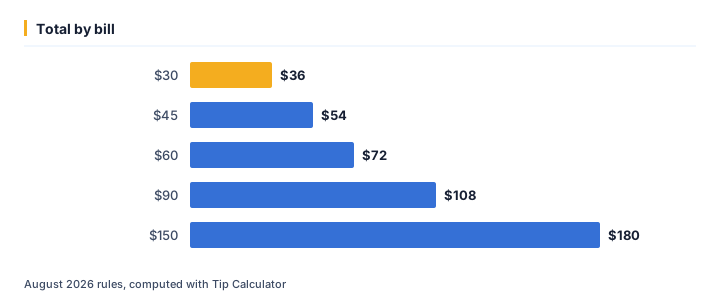
We ran 5 values of bill through the calculator and left every other input at its default. As of August 2026, the output was:
| Bill ($) | Total ($) | Tip amount ($) | Per person ($) |
|---|---|---|---|
| 30 | 36 | 6 | 18 |
| 45 | 54 | 9 | 27 |
| 60 | 72 | 12 | 36 |
| 90 | 108 | 18 | 54 |
| 150 | 180 | 30 | 90 |
Running bill from $30 up to $150 moves total from $36 to $180 — a spread of $144. That gap is the part a single headline rate never shows.
The same runs seen through tip amount
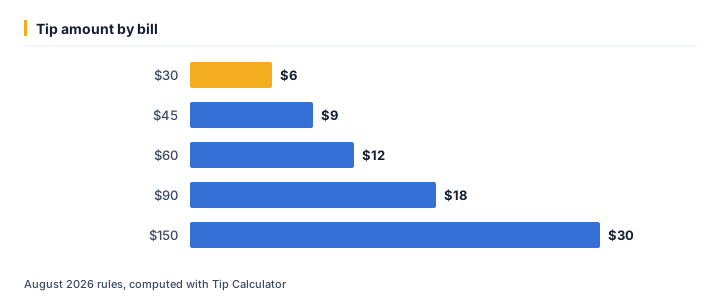
At $30, tip amount works out to $6; at $150 it is $30. Looking only at total tends to understate how much the outcome shifts across that range.
One example, straight from the API
The middle row above (bill = $60) is not a rounded illustration — it is exactly what /api/v1/tools/tip-calculator/calculate returns for that input, August 2026 rules:
{
    "tool": "tip-calculator",
    "inputs": {
        "bill": 60,
        "tip": 20,
        "people": 2
    },
    "result": {
        "tip_amount": 12,
        "total": 72,
        "per_person": 36
    }
}
Assumptions behind these figures
| Input | Value |
|---|---|
| Bill | $60 |
| Tip | $20 |
| People | $2 |
| As of | August 2026 |
| Method | identical to /tools/tip-calculator |
Rates, thresholds and typical costs change over time; the numbers above are accurate as of August 2026, not a permanent guarantee. For your own situation, open the Tip Calculator and enter your real numbers — the calculator runs the same code that produced every figure on this page.
Ready to crunch your numbers?
Open the Tip Calculator and get an answer in seconds.
Editorial Team
We write plain-English money guides and build the free calculators behind them.