The US hair salon tipping convention is 18-22% of the service cost, paid in cash if possible. The exact percentage depends on the service type, whether multiple stylists worked on your appointment, and whether the stylist owns the salon.
Hair salon tipping in the US has its own set of conventions that differ in three important ways from restaurant tipping. The customary range is wider (18-22% versus 18-20%), cash is meaningfully preferred over card, and multi-service appointments often involve tipping more than one worker. This guide covers exactly how much to tip in each common scenario, why the conventions are what they are, and the small set of situations where the standard rules change.
The Quick Answer
For a standard US hair salon appointment in 2026, the customary tip range:
| Service Total | Standard (18%) | Generous (22%) | Excellent (25%) |
|---|---|---|---|
| $30 | $5-$6 | $7 | $7.50 |
| $50 | $9 | $11 | $12.50 |
| $75 | $13.50 | $16.50 | $19 |
| $100 | $18 | $22 | $25 |
| $150 | $27 | $33 | $37.50 |
| $200 | $36 | $44 | $50 |
The default for satisfactory service is 18-20%. The 22-25% range is reserved for excellent work, complex multi-step services (full color + cut + style), or stylists you've built a long relationship with. Below 15% should signal an actual problem with the service.
For specific amounts and split-tip math across multiple workers, use the Tip Calculator.
Why the Salon Convention Is 18-22%, Not 15-20%
Three structural factors push hair salon tipping rates slightly higher than restaurant tipping:
Salon workers often pay "booth rent" or commission splits. Many US stylists are independent contractors who rent their chair from the salon (typically $200-$500/week) or split their service revenue with the salon owner (often 40-60%). The stylist's take-home from the listed service price is therefore lower than it appears, making the tip a meaningfully larger share of their actual earnings.
Salon services require skill and time investment. A cut takes 30-60 minutes; color services can take 2-4 hours. The relationship is closer to skilled-trade work than to table service, and the tipping convention reflects that.
The customer-stylist relationship is recurring. Most US salon customers see the same stylist for months or years. Tipping at the higher end of the range maintains the working relationship — over a year of monthly visits, the cumulative difference between 18% and 22% is the difference between someone fitting you in for an emergency appointment and not.
For these reasons, 20% is the typical default for satisfactory service at US hair salons, with 22-25% common for stylists you've worked with for a while.
By Service Type
The customary tip percentage varies slightly by service complexity. The dollar amount, not the percentage, is what to focus on — but the percentages are useful guides.
Haircut Only
- Standard cut: 18-20% of the price.
- Quick trim or bang trim ($15-$25): Many customers tip a flat $5-$10 minimum regardless of percentage, since smaller services still require setup time.
- Men's barber cut: 15-20% is standard at traditional barbershops; 20-25% at higher-end men's salons.
Color Service
Color services often involve multiple workers (a colorist, a shampoo assistant, sometimes a stylist for the cut and style):
- Single-process color: 18-20% of the total, generally to the colorist directly.
- Multi-process color (highlights, balayage, color correction): 20-25%. The work is technically demanding and time-intensive.
- Color + cut + style appointment: 18-22% on the total, with the tip distributed across the workers who served you. Ask the salon for the convention; some have a posted policy.
Blowout / Style Only
- Standard blowout ($35-$60): 18-22%, generally $8-$15.
- For event styling (wedding, special occasion): 22-25%, plus a small extra cash tip for any additional time.
Treatment Services (Deep Condition, Keratin)
- Standard treatment ($30-$150): 18-20% of the treatment cost.
- For combined treatment + other services: include in the overall appointment tip percentage.
Children's Cuts
- Convention: 18-20%, often with a small additional flat amount ($2-$5) if the stylist managed a difficult child gracefully.
Cash vs Card: Why Cash Is Preferred
This is the part of hair salon tipping conventions that surprises restaurant-trained tippers. Cash is meaningfully preferred at most US salons, for a specific reason:
Card-based tips often have a salon's cut taken out. Many salons deduct a 2-3% credit card processing fee from card-based tips before passing the rest to the stylist. Some salons also use card tips toward booth-rent calculations or commission splits in ways cash tips avoid.
Cash tips go directly to the stylist. No deductions, no delays, no salon administration. The full amount you intended actually reaches the worker.
Cash provides flexibility for multi-stylist appointments. Distributing $20 across two workers from a single card transaction is awkward; handing each worker $10 in cash is instant.
The practical guidance: bring small bills to your salon appointment ($5, $10, $20). If you forget, card-based tipping is still acceptable — but if you visit the same salon regularly, build the habit of cash tipping. Stylists notice, and the relationship benefits.
Should You Tip the Salon Owner?
This is the most asked question in US salon tipping, and the answer has shifted in the last decade.
Traditional rule: No, you do not tip the salon owner — they "set the price" and the tip would be paying themselves.
Modern reality: The traditional rule has largely been abandoned. Most US salon owners now also work as stylists, often at the same prices as their employees. They put in the same time and skill on your appointment. Not tipping them feels (and often is) awkward.
The 2026 convention: Tip the salon owner at the same rate as any other stylist who performs the same work — 18-22%. If you specifically know the owner does not accept tips (some still don't), they will gracefully refuse. The default should be to tip; let them say no if it applies.
Multi-Stylist Appointments
A common scenario: your appointment includes a shampoo assistant, a colorist, and a different stylist for the cut and blowout. Three workers touched your appointment. How to split the tip?
The general distribution at most US salons:
- Shampoo assistant: $3-$8 in cash, handed directly after the shampoo. Independent of the percentage tip below.
- Primary service provider (the stylist or colorist who did the main work): 18-22% of the appointment total, the bulk of the tip.
- Secondary service provider (e.g., the cut after a color): Often part of the same 18-22% if the stylist worked under the colorist's direction; a separate 15-20% of their service portion if they were a fully separate appointment.
Ask the salon if you're unsure — most have a posted or stated convention. Salon front desks are accustomed to "how should I distribute the tip?" questions.
Barber Shop Conventions
Traditional barber shops (the $15-$25 cut, walk-in, no appointment) have a slightly different convention than higher-end salons:
- Standard: 15-20% of the cut price. On a $20 cut, $3-$4.
- For a longer-relationship barber: $5 flat is typical and appreciated.
- For a straight-razor shave or extra services: 20% of the total, often paid in cash.
The "$5 minimum regardless of cut price" rule at traditional barbershops produces effective tipping rates of 25-33% on cheap cuts, which is the social norm — barbers depend on tips, and the small percentage off a $20 service does not generate meaningful earnings without a floor.
When Not to Tip at a Salon
A small number of situations:
Service was genuinely bad — the cut is wrong, the color is wrong, the stylist was unprofessional. Speak to the salon manager before paying. Most salons will offer a correction, a refund, or a complimentary fix. If the salon handles the problem professionally, tip the original stylist at the floor (10-15%) and the corrective stylist at the standard rate.
Service was at a no-tip salon. A small but growing US salon category has eliminated tipping in favor of higher transparent pricing. Verify before paying.
A consultation only (no service performed). Most salon consultations are free and do not require a tip.
Holiday Tipping at Salons
A US convention worth knowing: if you visit the same stylist regularly through the year (e.g., monthly), a holiday "thank you" tip is customary in December. The typical amount is one full appointment's worth of cost, given in cash as an extra above the regular appointment tip.
For example: if you visit a stylist 12 times a year at $80 per appointment (regularly tipping $16-$20 each time), the holiday tip in December would be approximately $80 in cash, in addition to that month's regular tip. The gesture is appreciated and reinforces the relationship.
This is not required, and skipping it has no social consequence in most cases. But for stylists who genuinely take care of you across the year, it's a meaningful recognition.
Frequently Asked Questions
Do I tip on the pre-tax or post-tax salon bill? The convention is pre-tax (on the service cost only, not the sales tax). On a $100 service in a 7% sales tax state, you'd tip on $100, not on $107.
What about salon products purchased during the appointment? Products (shampoo, conditioner, styling cream) are typically not tipped on. Tip on the service cost only. If a stylist spent considerable time advising on products and you bought several, a $5-$10 cash extra is appreciated but not expected.
Should I tip the same percentage at a high-end salon? At very high-end US salons ($200+ cuts, $500+ color), the percentage convention can shift slightly higher (20-25%) because the customary tipping culture in that price tier is more generous. Read the salon's vibe; observe other clients if possible.
What if my appointment ran shorter than booked? Tip on the actual service performed, not the booked time. A 30-minute appointment that ran 20 minutes is still tipped at 18-22% of the price charged.
Is it weird to ask a stylist about their tip policy? No — it's common and welcomed. "How is tipping handled here?" is a normal question, especially at a new salon or for a multi-service appointment. The salon will tell you the convention.
What about home-based stylists? Independent home-based stylists set their own prices, often without "the salon's cut." Tipping is still customary at 15-20%, but some independents prefer their listed price to be the final amount — ask directly the first time.
Next Steps
For exact tip math at your specific service price — including across multiple workers in a single appointment — use the Tip Calculator. For US tipping conventions in every other service category (restaurant, bar, delivery, rideshare, hospitality), see the Tipping Guide: U.S. Standards by Service.
The hair salon tipping convention is more about the long-term relationship than about the single appointment. Cash-tipping at the higher end of the standard range, for a stylist you trust, is one of the highest-ROI small gestures in personal finance — both for the worker and for your future appointments.
Run the numbers
Everything below came out of this site's own Tip Calculator. The figures are not quoted from anywhere else: each row is one run of the same calculation the tool page performs, using August 2026 rules. Put the same inputs in and you will get the same output.
How the result moves with bill
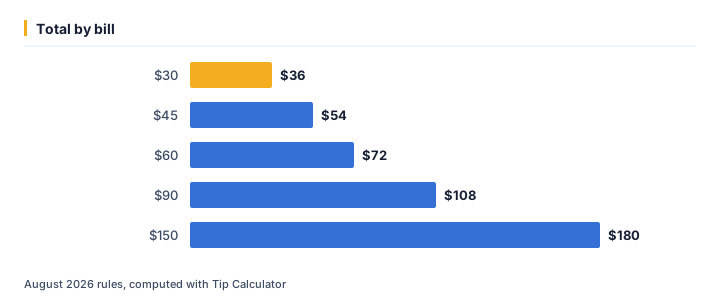
We ran 5 values of bill through the calculator and left every other input at its default. As of August 2026, the output was:
| Bill ($) | Total ($) | Tip amount ($) | Per person ($) |
|---|---|---|---|
| 30 | 36 | 6 | 18 |
| 45 | 54 | 9 | 27 |
| 60 | 72 | 12 | 36 |
| 90 | 108 | 18 | 54 |
| 150 | 180 | 30 | 90 |
Running bill from $30 up to $150 moves total from $36 to $180 — a spread of $144. That gap is the part a single headline rate never shows.
The same runs seen through tip amount
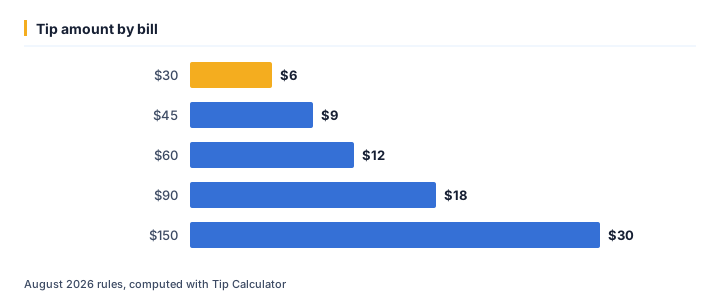
At $30, tip amount works out to $6; at $150 it is $30. Looking only at total tends to understate how much the outcome shifts across that range.
One example, straight from the API
The middle row above (bill = $60) is not a rounded illustration — it is exactly what /api/v1/tools/tip-calculator/calculate returns for that input, August 2026 rules:
{
    "tool": "tip-calculator",
    "inputs": {
        "bill": 60,
        "tip": 20,
        "people": 2
    },
    "result": {
        "tip_amount": 12,
        "total": 72,
        "per_person": 36
    }
}
Assumptions behind these figures
| Input | Value |
|---|---|
| Bill | $60 |
| Tip | $20 |
| People | $2 |
| As of | August 2026 |
| Method | identical to /tools/tip-calculator |
Rates, thresholds and typical costs change over time; the numbers above are accurate as of August 2026, not a permanent guarantee. For your own situation, open the Tip Calculator and enter your real numbers — the calculator runs the same code that produced every figure on this page.
Ready to crunch your numbers?
Open the Tip Calculator and get an answer in seconds.
Editorial Team
We write plain-English money guides and build the free calculators behind them.