Fast mental-math tricks for tipping in restaurants, bars, delivery, and travel — the 10% trick, the double-the-tax shortcut, clean ways to split, and a quick-reference table.
The check lands on the table, the server walks away, and four people are looking at you because you're the one who is "good at math." You have twenty seconds before someone says something polite about splitting it later, and you'd rather just handle it now. This is the moment tip math is for.
Almost every tip you will ever calculate can be done in your head in under ten seconds with one trick — the 10% shortcut — and one tweak per percentage point above or below. By the end of this article, you will be able to estimate 15%, 18%, 20%, and 22% tips on any bill instantly, split a check cleanly, and know which non-restaurant situations actually call for a tip in the US.
This is the practical math companion to our US tipping standards and etiquette guide. That one covers who to tip and how much. This one is about how to do the arithmetic without holding up the table.
The 10% Trick (Start Here)
Ten percent of any number is the same number with the decimal moved one place to the left. That's the entire trick, and it's the foundation of every other tip you will calculate.
- 10% of $40.00 is $4.00
- 10% of $67.50 is $6.75
- 10% of $128.00 is $12.80
- 10% of $214.30 is $21.43
Once you can get 10% in your head, every other common tip percentage is a small adjustment on top of that anchor:
- 15% = 10% + half of 10%. On a $40 bill: $4.00 + $2.00 = $6.00.
- 18% = double the 10%, then shave a little. On $40: $8.00 − $0.80 = $7.20.
- 20% = double the 10%. On $40: $4.00 × 2 = $8.00.
- 22% = 20% + 2%. On $40: $8.00 + $0.80 = $8.80.
- 25% = 20% + a quarter of the 20%. On $40: $8.00 + $2.00 = $10.00.
You will use 18% and 20% the most. Practice those two until they're automatic.
The Double-the-Tax Shortcut (and Where It Lies)
A second, looser trick: in many parts of the US, doubling the sales tax on the receipt gives you a tip somewhere between 15% and 20%. The math works because state and local restaurant tax rates often land in the 8–10% range. But sales tax varies a lot by state, and you should know what doubling actually gives you where you live.
- Texas: ~8.25% total in most cities. Double the tax on a $40 meal: $3.30 × 2 = $6.60 — roughly 16.5%, which is a stingy modern tip.
- California: 7.25% statewide, but major cities run 8.75–10.75%. At LA's 9.5%, doubling gets you 19% — basically perfect. At 7.25% in a low-tax county, you'd be at 14.5%.
- New York City: restaurant sales tax is 8.875%. Double it and you're at about 17.75% — slightly low but acceptable.
Doubling the tax is passable in high-tax cities, but in places like Texas it leaves your server short. A safer composite rule: double the tax, then add a dollar or two for sit-down service. That nudges you back into the 18–20% range almost regardless of state. The 10% trick remains more reliable everywhere because you control the multiplier.
Pre-Tax or Post-Tax? The Polite Default
The polite modern default is to tip on the pre-tax subtotal, but tipping on the post-tax total is also normal and not rude. On most checks, the difference is a dollar or two.
Let's compute the gap so you can decide for yourself.
Scenario A — $80 pre-tax meal, NYC sales tax 8.875%.
- Tax: $80 × 0.08875 = $7.10; post-tax total $87.10
- 20% on pre-tax: $80 × 0.20 = $16.00
- 20% on post-tax: $87.10 × 0.20 = $17.42
- Difference: $1.42
Scenario B — $200 pre-tax dinner, NYC sales tax 8.875%.
- Tax: $200 × 0.08875 = $17.75; post-tax total $217.75
- 20% on pre-tax: $40.00
- 20% on post-tax: $43.55
- Difference: $3.55
On a casual meal, the gap is the cost of a soft drink. On a $200 anniversary dinner, it's the cost of dessert. Pick a default, apply it consistently, and stop worrying about it. The Tip Calculator lets you toggle pre-tax vs post-tax so you can see the gap on your specific check.
Splitting the Bill Cleanly
Splitting is where tip math slows people down — not the percentage, but the division. The trick is to add the tip before you divide, then round the per-person number up to keep the math friendly.
Example: $128 pre-tax dinner for four, 20% tip.
- 20% of $128: double the 10% ($12.80) = $25.60
- Bill plus tip: $128 + $25.60 = $153.60
- Divide by 4: $38.40 per person, round up to $39 each
The rounding-up move is worth internalizing. It keeps the per-person number a whole dollar, makes cash splits trivial, and quietly bumps the tip from 20% to about 22% — a small generosity that costs almost nothing per head.
Example: $214 pre-tax dinner for six, 18% tip.
- 10% of $214: $21.40
- 18% ≈ 20% − 2% ≈ $42.80 − $4.28 ≈ $38.50
- Total: $252.50; divide by 6 ≈ $42.10 per person, round up to $43 each
For uneven splits — one person ordered the $90 steak and someone else ordered a $14 salad — switch to a tip calculator and use per-person mode. Doing unequal splits by hand is where the math actually goes wrong.
Quick-Reference Tip Table
Here is a table you can mentally photograph for the bills you encounter most often. All figures are tip-only, in US dollars, on the pre-tax subtotal.
| Pre-tax bill | 15% | 18% | 20% | 22% |
|---|---|---|---|---|
| $40 | $6.00 | $7.20 | $8.00 | $8.80 |
| $60 | $9.00 | $10.80 | $12.00 | $13.20 |
| $85 | $12.75 | $15.30 | $17.00 | $18.70 |
| $120 | $18.00 | $21.60 | $24.00 | $26.40 |
| $200 | $30.00 | $36.00 | $40.00 | $44.00 |
A useful pattern to spot in the table: the 20% column is always exactly twice the 10% value (which is the bill with the decimal shifted), and the 18% column is always about 90% of the 20% column. Both observations are just the 10% trick in disguise. Once you see the structure, you don't need the table.
When the Calculator Earns Its Place
Mental math handles 90% of real tipping situations. The other 10% are worth handing off to a tool. Reach for the Tip Calculator when:
- The split is uneven. Six people, one ordered three cocktails, two ordered appetizers — don't do this in your head while everyone watches.
- You're tipping a group of 8+. Many restaurants auto-apply an 18% gratuity for large parties; verify before you add more.
- The check has multiple service charges already on it (resort fees, "kitchen appreciation," mandatory gratuity). The math gets gnarly fast.
- You're tipping in a foreign currency — pair the calculator with our Currency Converter.
Rule of thumb: use the 10% trick at the dinner table, use the calculator when the bill has more than three line items you don't recognize.
Tipping in Non-Restaurant Situations
The restaurant case is the most common, but it's far from the only one. A quick reference on what to do — and how to compute it — in the situations Americans actually hit most often. (For a deeper dive on whether each of these warrants a tip and how the norms vary, see our tipping standards guide.)
Food delivery (DoorDash, Uber Eats, pizza). Tip on the food subtotal, not the delivery or service fees. Range is 15–20%, with a $4–5 minimum on small orders. On a $32 order: 18% is about $5.75, round to $6.
Rideshare (Uber, Lyft). 15–20% of the fare. The app does the math with preset buttons. For a $24 ride, the $4 button is 16.7%; the $5 button is 20.8%.
Bartender at a wedding or open bar. Even when the bar is "free," tip per drink: $1–2 per beer/wine pour and $2–3 per cocktail. Drop it in the jar when you order the first round.
Hair stylist or barber. 15–20% of the service. On a $75 haircut: $13–15. Round to $15 and hand it directly to the stylist in cash if possible. The older "don't tip the owner" rule is largely gone.
Hotel housekeeping. $2–5 per night, left on the pillow each morning with a brief note so it's clearly the tip. Daily beats a lump sum because different staff may rotate.
Movers. $20–40 per mover for a half day, $40–80 per mover for a full day, in cash. A three-person crew for a full-day local move is $120–240 across the team. Factor it into your moving budget alongside the boxes and the truck — run the numbers in our Budget Calculator before move day.
Valet. $3–5 when they bring your car back. Cash, in hand before they pull up.
Across all of these, the math is small-dollar and approximate. You're not optimizing percentages, you're remembering to do it at all.
Tipping Abroad — Where the US Habit Misfires
US tipping norms are unusually generous by world standards, and exporting them everywhere will both cost you money and occasionally confuse locals. A very compressed version:
- Most of Western Europe: service is often included (look for "service compris" in France, "servizio incluso" in Italy, "Bedienung inklusive" in Germany). Rounding up or adding 5–10% for great service is plenty.
- Japan: tipping is not customary and can be politely refused. Don't.
- United Kingdom: 10–12.5% in restaurants, often pre-added as a "discretionary service charge" — check the bill before adding more.
- Mexico, parts of Central America: 10–15% in restaurants is standard and expected.
- Australia, New Zealand: tipping is light. 10% for great service is generous.
When you're abroad and computing in an unfamiliar currency, two things help: the 10% mental anchor still works (10% of any number is still that number with the decimal moved), and the Currency Converter handles the conversion to USD so you can sanity-check what you actually paid. Norms vary regionally and culturally — when in doubt, ask a local or check a recent travel guide for the specific country.
Common Mistakes
A short list of small errors that quietly cost real money over time, or worse, leave servers short.
- Tipping on the post-card-surcharge total. Some restaurants add a 3–4% credit-card processing fee. That's not part of service — it's the restaurant's cost of doing business. Tip on the food and drink subtotal, not the surcharge.
- Double-tipping at counter-service places. Many fast-casual spots flip the screen with 15/18/20% buttons even though no one served your table. There's no consensus here — many people skip it. What you don't want is to hit a tip button and then drop cash in the jar too.
- Missing the auto-gratuity line. Large-party bills often include "18% gratuity" already. Add another 20% on top and you've tipped close to 40%. Read the bill before signing.
- Tipping the delivery fee. The fee the app charges mostly doesn't go to the driver. Tip on the food subtotal and ignore the app's "service fee" line.
- Tipping alcohol at a different rate than food. Old etiquette suggested lower tips on bar tabs. Modern practice is the same percentage on the full subtotal — the bartender's labor is the same whether they pour a $14 or $22 glass.
Frequently Asked Questions
What's the fastest way to tip 20% in my head? Move the decimal one place left (that's 10%), then double it. On $73.40, 10% is $7.34, doubled is $14.68. Done in five seconds, no math needed beyond doubling a small number.
Is 18% or 20% the new "standard"? There is no single standard. In most US cities, 18% is the polite floor for adequate sit-down service and 20% is the modern default for good service. Twenty-two to twenty-five percent signals strong appreciation. Below 15% is read as a complaint about the service. Norms drift over time and vary by region, so use this as a guideline, not a rule.
Do I tip on the bill before or after tax? Either is acceptable. Pre-tax is the technically polite default and what most servers expect; post-tax adds a dollar or two on most checks and won't offend anyone. Pick one and stop deliberating.
How do I split a bill when one person ordered way more? Two clean options. Option A: each person pays for their own items plus a 20% tip on their own subtotal — works well when everyone is paying separately on their phones. Option B: total the bill, add the tip, divide evenly, and let the lighter-orderer leave a few extra dollars informally. For uneven splits across many items, use a tip calculator with per-person mode — that's exactly what it's for.
Should I tip on takeout I picked up myself? There's no consensus. Many people tip nothing on true counter pickup; some leave 10% as a courtesy if the order was complicated or the staff packed it carefully. Neither choice is rude.
What about countries that don't tip — should I still leave something? Generally no. Tipping in countries where it isn't customary can come across as awkward or, in some places like Japan, mildly disrespectful. Round up or leave a small token for exceptional service, but don't apply US percentages. Norms vary by country and even by city within a country.
Does the Tip Calculator handle group splits and tax? Yes. The Tip Calculator supports per-person splits, pre-tax vs post-tax toggles, and the auto-gratuity case. Drop your numbers in and it does the per-head arithmetic for you.
Next Steps
- Practice the 10% trick on three real numbers today. Your morning coffee, your lunch bill, a random price on a menu. Move the decimal, double it, that's your 20% tip. Five seconds, zero tools.
- Bookmark the Tip Calculator on your phone. The next time you're splitting a bill seven ways or staring at a check with three mystery surcharges, you'll be glad it's one tap away.
- Read the US tipping standards guide once. It covers the who and how much questions that this article skipped — every situation from haircuts to dog groomers to tattoo artists — so the next time you're caught off guard, you already know the answer.
Tipping is one of the few financial skills that gets easier the more you practice in public. After a few weeks of doing the 10% move at every check, you'll forget you ever needed an article about it.
Run the numbers
Everything below came out of this site's own Budget Calculator (50/30/20). The figures are not quoted from anywhere else: each row is one run of the same calculation the tool page performs, using August 2026 rules. Put the same inputs in and you will get the same output.
How the result moves with income
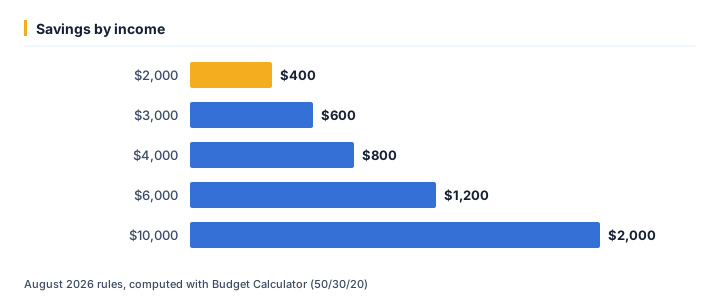
We ran 5 values of income through the calculator and left every other input at its default. As of August 2026, the output was:
| Income ($) | Savings ($) | Needs ($) | Wants ($) |
|---|---|---|---|
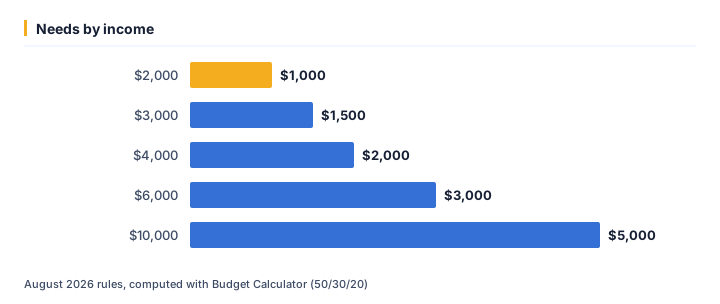
| 2,000 | 400 | 1,000 | 600 |
| 3,000 | 600 | 1,500 | 900 |
| 4,000 | 800 | 2,000 | 1,200 |
| 6,000 | 1,200 | 3,000 | 1,800 |
| 10,000 | 2,000 | 5,000 | 3,000 |
Running income from $2,000 up to $10,000 moves savings from $400 to $2,000 — a spread of $1,600. That gap is the part a single headline rate never shows.
The same runs seen through needs
At $2,000, needs works out to $1,000; at $10,000 it is $5,000. Looking only at savings tends to understate how much the outcome shifts across that range.
One example, straight from the API
The middle row above (income = $4,000) is not a rounded illustration — it is exactly what /api/v1/tools/budget-calculator/calculate returns for that input, August 2026 rules:
{
    "tool": "budget-calculator",
    "inputs": {
        "income": 4000
    },
    "result": {
        "needs": 2000,
        "wants": 1200,
        "savings": 800
    }
}
Assumptions behind these figures
| Input | Value |
|---|---|
| Income | $4,000 |
| As of | August 2026 |
| Method | identical to /tools/budget-calculator |
Rates, thresholds and typical costs change over time; the numbers above are accurate as of August 2026, not a permanent guarantee. For your own situation, open the Budget Calculator (50/30/20) and enter your real numbers — the calculator runs the same code that produced every figure on this page.
Ready to crunch your numbers?
Open the Budget Calculator (50/30/20) and get an answer in seconds.
Editorial Team
We write plain-English money guides and build the free calculators behind them.