Saving your first $1,000 in 90 days is less about heroic frugality than about a small number of deliberate moves: automating the transfer, cutting two predictable spending leaks, and adding one short-term income lever.
Most people who set out to save their first $1,000 quit by week three, not because the goal is unreachable but because they tried to win it on willpower alone. White-knuckling through a month of frugality almost never works. What works is engineering: an automated transfer that hides the money before you can spend it, two deliberate spending cuts that compound silently in the background, and — if the timeline is tight — one short-term income lever to bridge the gap.
This guide walks through the exact math of saving $1,000 in 90 days from an average US take-home pay, the specific cuts that move the number, and the small set of habits that quietly compound into a real emergency fund.
Why $1,000 Is the Right First Target
Most personal-finance frameworks recommend $1,000 as the absolute first savings milestone, ahead of every other priority except meeting minimum debt payments. There are three reasons.
It absorbs the most common emergency. Roughly 60% of US households who experience an unplanned expense in any given year report a cost between $400 and $1,000 — a car repair, an urgent dental visit, an unexpected appliance failure, an insurance deductible. A $1,000 buffer turns those incidents from credit-card-debt-creating crises into routine inconveniences.
It builds the savings habit. $1,000 is small enough to hit in 60–120 days, large enough to feel like a real accomplishment. The psychological shift from "I have no buffer" to "I have a buffer" is the single most important change in beginning to handle money differently. Once the habit is in place, scaling to $5,000, $10,000, or a full six-month fund is largely a matter of continuing the same automation.
It frees the next move. Until you have a $1,000 cushion, every dollar of extra debt payment is fragile — one car repair forces it back onto a credit card. Past $1,000, accelerated debt payoff (or investing) stops being a one-emergency-away gamble.
The Math: What $1,000 in 90 Days Actually Costs
Three months is roughly 13 weeks or 6 paychecks for a typical biweekly schedule. The arithmetic is straightforward:
- Per week: $1,000 / 13 ≈ $77 per week
- Per biweekly paycheck: $1,000 / 6 ≈ $167 per paycheck
- Per day: $1,000 / 90 ≈ $11 per day
The per-day number is the useful one. Eleven dollars a day is the cost of two takeout coffees, one delivered lunch, or one impulse Amazon order. Most readers, looking honestly at their last 30 days of transactions, will find several days where $11 of spending was not worth the satisfaction it provided. That is the leak the plan targets.
Run your specific timeline through the Savings Goal Calculator to confirm the weekly target. If 13 weeks is tight, the calculator will show what 16 or 20 weeks looks like — sometimes giving yourself an extra month is the difference between hitting it and quitting.
Step 1: Automate the Transfer Before You Spend a Dollar
The single highest-impact action is moving the money before it has a chance to be spent. Before you cut a single expense, before you pick up a side gig, open a separate high-yield savings account (most US online banks let you do this in under ten minutes from your phone) and set up an automatic transfer for the day after each payday.
Some specifics that matter:
- Use a different bank from your checking account. Money in the same bank is too visible — you will see it, mentally count it, and find ways to spend it. A separate institution adds 2-3 days of friction to a withdrawal, which is enough to break impulse decisions.
- Schedule for the day after payday, not payday itself. Some employers' direct deposits clear later in the day; you want the money to settle before the transfer fires.
- Start with $80 per paycheck even if you "cannot afford" it. You can afford less than you think. Most people who try this report not noticing the missing $80 by the second paycheck. If a transfer truly creates a cash crunch, lower it to $50 and increase quarterly — but try the higher number first.
The phrase "pay yourself first" is overused for a reason. Treating savings as a fixed expense — automated, non-negotiable, off the top — is the only durable mechanism. Saving "what is left at the end of the month" almost always produces $0 left.
Step 2: Cut the Two Biggest Predictable Leaks
You do not need to cut twenty things. Most savings plans fail by trying to. The winning move is identifying the two biggest predictable leaks in your current spending and cutting each by half — not eliminating them, just halving them.
The most common leaks across US households trying to save their first $1,000:
Restaurant and delivery spending. The median household with a delivery-app habit spends $80–$200 per month on DoorDash, Uber Eats, or Grubhub alone, before counting restaurant dine-in. Cutting this in half typically frees $40–$100/month with no lifestyle felt-effect — most people cannot recall what they ordered three Tuesdays ago.
Subscription bloat. Pull a 12-month checking statement and circle every recurring charge. The average household runs 9–12 active subscriptions but uses only 4–6. Streaming services, cloud storage tiers above what is needed, "free trials" that converted, gym memberships used less than twice a month, app subscriptions, monthly delivery boxes. Audit and cancel anything used less than once per week. Most readers free $30–$80/month on this single pass.
Combined, these two cuts often free $80–$150/month — meaningfully more than half of the $77/week needed to hit $1,000 in 90 days. Crucially, they do not require willpower at the moment of spending; they happen once, then run themselves in the background.
Step 3: Add One Short-Term Income Lever
If steps 1 and 2 are not enough — or if you want to hit $1,000 in 60 days instead of 90 — add one short-term income lever rather than cutting more aggressively. Income is almost always easier to expand than spending is to compress past a certain point.
Three levers that have the best ratio of dollars-to-time for a 90-day window:
- Sell unused items. Most US households can identify $300–$800 of resellable goods — old electronics, gaming consoles, designer clothes, exercise equipment, kitchen gadgets, collectibles. Facebook Marketplace, eBay, and OfferUp move items in 1–14 days. A focused weekend of listing typically produces $400+ of incremental savings inside two weeks.
- One-off freelance or task work. Existing skills (graphic design, writing, basic accounting, music lessons, tutoring) command $25–$75/hour on Upwork or directly. Six hours per month of side work at $40/hour adds $240, more than covering the cut paychecks.
- Workplace overtime, holiday shifts, or referral bonuses. Often overlooked because they require no skill development. Many employers pay $250–$1,000 referral bonuses for successful hires, or hourly overtime at 1.5× during peak periods.
Pick one lever. Not three. The discipline of finishing the first $1,000 before adding complexity is exactly the discipline being built.
A 13-Week Schedule You Can Actually Follow
Here is what the weeks look like in practice. The pattern matters more than the exact dates.
| Week | Action | Target Balance |
|---|---|---|
| 1 | Open separate HYSA. Schedule $80 biweekly auto-transfer. List 5 items for sale. | $80 (after first transfer) |
| 2 | Audit and cancel 3 unused subscriptions. Cancel one delivery-app habit (cook 4 nights at home). | $80 |
| 3 | Second transfer fires. Sell first listed item. | $160 + sale proceeds |
| 4 | Review week 1-3 spending. Identify one more leak. | $240 |
| 5–6 | Steady state. Two transfers. One additional item sold. | $400 |
| 7–8 | Add one income lever (overtime shift, freelance hour, etc.). | $560 |
| 9–10 | Steady state. Push to clear final low-priority subscriptions. | $720 |
| 11–12 | Final push. Cash any pending side income. | $880 |
| 13 | Hit $1,000. Move money into a labeled "Emergency Fund Tier 1" account. | $1,000 |
The realistic curve is rarely linear. Most readers land at $1,000 between weeks 11 and 14 depending on which weeks have unusual expenses. Anything inside 16 weeks is a success.
What To Do The Day You Hit $1,000
Two things, immediately, in this order:
Move the money out of casual reach. Transfer it from the regular HYSA into one explicitly labeled "Emergency Fund Tier 1." Make the account name visually distinct in your banking app. This makes accidental spending psychologically harder — and a 2-3 day transfer delay between accounts gives you time to reconsider any "emergency" that turns out to be a want.
Do not pause the automatic transfer. Most people who hit $1,000 turn off the automation as a reward. They then take 18–36 months to hit $2,000 instead of three more months. Leave the $80 biweekly transfer running and reset the next milestone — $3,000 (which roughly covers one month of US household expenses for many readers), then a full one-month, then three-month, then six-month emergency fund. The hard work was building the automation. Riding it forward is free.
Common Reasons People Stall (and What to Do)
A few recurring patterns to watch for.
"I keep dipping into savings for not-quite-emergencies." The fix is friction. Use a different bank, ignore the linked debit card, treat the account as if it does not have a withdrawal function. If you need money in 2-3 days, that is fast enough for a real emergency; if you need it in 30 minutes, it is probably not an emergency.
"I cut everything and still cannot save $77/week." This is an income problem, not a spending problem. The lever to pull is earning more — overtime, a side gig, asking for a raise, or job-hunting if you have been underpaid for 18+ months. Most US households below $35,000 gross will need both spending discipline and income growth to hit savings milestones; this is a structural reality, not a personal failing.
"I had a setback and now feel like I should start over." You do not. A withdrawn $400 for a real car repair is the system working — that is what the fund was for. Reset the target by adding back what was used. Two steps forward, one step back is still net forward.
Frequently Asked Questions
Should I save $1,000 before paying off credit card debt? Most US personal-finance frameworks (Dave Ramsey's baby steps, NerdWallet's beginner ladder, the FIRE community's emergency-fund-first principle) recommend yes — build a $1,000 starter buffer first, then attack credit card debt aggressively, then build a full emergency fund. The reasoning: without any buffer, every emergency forces more debt, and you never escape. This is general guidance; your specific situation may warrant different ordering, and a fee-only CFP from letsmakeaplan.org can advise on edge cases.
Should the $1,000 sit in checking or savings? Savings, specifically a high-yield savings account (HYSA). Mainstream US online banks pay 3.5–4.5% APY at the time of writing — meaningfully above the 0.01% on most checking accounts. The interest is small in absolute terms on $1,000 (~$3-4/month) but the deeper reason is friction: savings accounts are slightly harder to spend from, which is exactly the property you want.
What if I have an irregular income? Switch from per-paycheck transfers to a percentage-of-deposit rule: every time income arrives, immediately transfer 10–15% into the savings account. Track your 90-day rolling average to confirm you are on pace. Irregular income makes calendar-based plans frustrating; percentage-based plans absorb the variance.
How quickly can $1,000 realistically be saved? Aggressive readers, willing to combine all three steps and run lean for a month, regularly hit $1,000 in 30–45 days. Comfortable but determined readers land at 75–90 days. Readers doing only the automation, without spending cuts or income work, take 4–8 months. Pick the pace that you will actually finish.
Is $1,000 enough as a final emergency fund? No — $1,000 is a starter fund, not the destination. The standard target is 3–6 months of essential expenses, which for a typical US household runs $9,000–$25,000. The point of $1,000 is to absorb the most common emergencies and stop the debt cycle, not to weather a job loss. Continue building once you hit the milestone. See How Much Emergency Fund Do You Really Need? for sizing the next target.
Next Steps
If you do nothing else this week:
- Open a separate high-yield savings account today (not next week — today).
- Schedule an automatic $80 biweekly transfer for the day after your next paycheck.
- Cancel three subscriptions you have not used in the last 30 days.
The first $1,000 is the hardest dollar of savings most Americans will ever build. After it, the system carries itself. Run the Emergency Fund Calculator once your starter buffer is in place to see what the next milestone looks like and how long it will take at the same automated pace.
Run the numbers
Everything below came out of this site's own Budget Calculator (50/30/20). The figures are not quoted from anywhere else: each row is one run of the same calculation the tool page performs, using August 2026 rules. Put the same inputs in and you will get the same output.
How the result moves with income
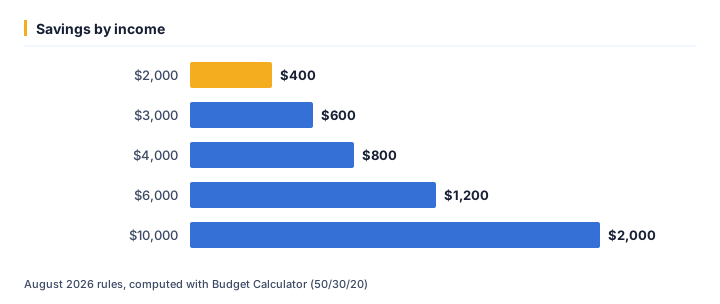
We ran 5 values of income through the calculator and left every other input at its default. As of August 2026, the output was:
| Income ($) | Savings ($) | Needs ($) | Wants ($) |
|---|---|---|---|
| 2,000 | 400 | 1,000 | 600 |
| 3,000 | 600 | 1,500 | 900 |
| 4,000 | 800 | 2,000 | 1,200 |
| 6,000 | 1,200 | 3,000 | 1,800 |
| 10,000 | 2,000 | 5,000 | 3,000 |
Running income from $2,000 up to $10,000 moves savings from $400 to $2,000 — a spread of $1,600. That gap is the part a single headline rate never shows.
The same runs seen through needs
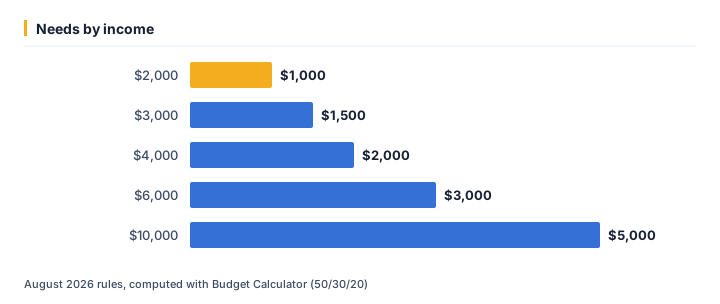
At $2,000, needs works out to $1,000; at $10,000 it is $5,000. Looking only at savings tends to understate how much the outcome shifts across that range.
One example, straight from the API
The middle row above (income = $4,000) is not a rounded illustration — it is exactly what /api/v1/tools/budget-calculator/calculate returns for that input, August 2026 rules:
{
    "tool": "budget-calculator",
    "inputs": {
        "income": 4000
    },
    "result": {
        "needs": 2000,
        "wants": 1200,
        "savings": 800
    }
}
Assumptions behind these figures
| Input | Value |
|---|---|
| Income | $4,000 |
| As of | August 2026 |
| Method | identical to /tools/budget-calculator |
Rates, thresholds and typical costs change over time; the numbers above are accurate as of August 2026, not a permanent guarantee. For your own situation, open the Budget Calculator (50/30/20) and enter your real numbers — the calculator runs the same code that produced every figure on this page.
Ready to crunch your numbers?
Open the Budget Calculator (50/30/20) and get an answer in seconds.
Editorial Team
We write plain-English money guides and build the free calculators behind them.