Saving $10,000 in 12 months works out to roughly $192/week or $833/month — within reach of most US households earning at least the median income, but only if the plan is built around automation, structural cost cuts, and one durable income lever, not willpower.
Ten thousand dollars in a year is the savings goal that produces both more genuine success stories and more abandoned attempts than almost any other in personal finance. It is too big to do casually and too small to require a complete life rebuild. The clean win — the household that finishes the year having actually deposited $10,000 into a previously empty account — comes from a small set of decisions made up front, not from a year of disciplined daily cuts.
This guide breaks down the per-paycheck math, the structural decisions that determine whether you finish or stall, and the quarterly checkpoints that catch problems before they unwind the whole plan.
The Math: What $10,000 in 12 Months Really Costs
The arithmetic is the most useful place to start, because the per-paycheck number is what makes the goal feel either reasonable or absurd.
- Per week: $10,000 / 52 ≈ $192 per week
- Per biweekly paycheck: $10,000 / 26 = ~$385 per paycheck
- Per month: $10,000 / 12 ≈ $833 per month
- Per day: $10,000 / 365 ≈ $27 per day
On a US median household take-home of roughly $5,000–$5,500/month, $833/month is about 16% of net income — comfortably inside the 20% savings target of the 50/30/20 framework. The mathematical takeaway: $10,000 in a year is achievable for the median American household if the full 16% of net pay can be redirected to this single goal for 12 months.
For households below median income, the path usually requires either a meaningful income increase or a longer timeline. For above-median households, $833/month is closer to 10-12% of take-home — well within reach without sacrificing existing retirement contributions or lifestyle quality. The honesty up front matters: if the math does not work on your real numbers, stretching to 15 months produces a far better outcome than abandoning at month 5.
The Four-Lever Framework
Every successful $10,000-in-a-year plan moves four levers in different proportions. You do not need to maximize all four — just to push hard enough on enough of them to clear the per-paycheck target.
Lever 1: Automation. Moving the money before you see it. Highest-leverage single action; covers 100% of the goal if income permits.
Lever 2: Structural spending cuts. Cutting one or two large recurring categories (housing, transportation, food) by 30–50%. Sustainable for a year, unlike small-cuts-across-everything.
Lever 3: One steady income channel. Overtime, freelance, side business — modest volume sustained for 12 months. Adds $2,000–$6,000 over a year.
Lever 4: Windfalls. Tax refunds, bonuses, gifts, rebates. Directed entirely to savings instead of partly to lifestyle. Often $1,500–$5,000 of "found money" per year.
The art is in the proportions, which differ by household. A high-income household may use only Lever 1 plus Lever 4. A median household typically needs Levers 1, 2, and 3. A below-median household usually needs Lever 3 at higher volume plus structural Lever 2 cuts.
Step 1: Front-Load the Automation
Open a separate high-yield savings account at a different institution from your primary checking — Ally, Marcus, Discover, SoFi, and Capital One all currently pay 3.5–4.5% APY. The interest on $10,000 over a year is real money: at 4% APY, a steadily growing balance earns roughly $200–$220 in interest over 12 months, which is the equivalent of one extra week's worth of contributions for free.
Set the automatic transfer for the day after each payday. Most readers do best at the full $385 biweekly from paycheck 1; some need to ramp from $300 to $385 over the first two months. The principle is that the money should never be visible to your normal spending account.
A useful psychological trick: label the account by purpose. "Emergency Fund," "House Down Payment," "Career Reserve Fund." Money with a name is markedly harder to dip into than money in a generically labeled "Savings 2" account.
Step 2: Pick the One Structural Cut That Pays for the Year
If your math is comfortable with one structural cut, pick the largest available. If it is tight, pick two. Almost no one needs three.
The candidates, ranked by typical annual dollar impact:
Housing. A move to a unit $300/month cheaper produces $3,600/year — more than a third of the goal. The hassle is real (moving costs, lease timing, deposit) but the impact dwarfs every smaller decision.
Transportation. Refinancing a car loan from 8% to 5% on a $25,000 balance saves ~$45/month, or $540/year. Trading a leased premium SUV ($550/month) for a reliable used sedan with a $200/month payment saves $4,200/year. Going from two cars to one (where it fits the household's geography) commonly saves $6,000+/year.
Food. Cutting delivery from 4×/week to 1×/week saves $80–$160/month. Restaurant dining from 8×/month to 3×/month saves $150–$300/month. Together: $2,500–$5,000/year, with no meaningful quality-of-life loss after the adjustment period.
Subscriptions and recurring fees. Smaller dollar amount but the easiest to execute. The average household runs 9-12 active subscriptions and uses 4-6. A 30-minute audit + cancellation pass typically saves $400-$900/year.
Notice the order: housing and transportation are 5-10× more impactful than subscriptions, but most savings advice focuses on the latter because they require less courage. Doing the hard one once is worth doing the easy one twenty times.
Step 3: One Income Channel for 12 Months
A year-long plan benefits from a modest, sustainable income channel rather than a frenetic side hustle that burns out in month 4.
The income lever options, by sustainability:
Workplace overtime or weekend shifts. Highest hourly rate for the lowest setup cost. Four hours/week at $35/hour for 50 weeks (allowing 2 weeks of normal life) = $7,000. By itself, 70% of the $10,000 goal.
Annual raise or job change. Often overlooked as a "savings" lever. An 8% raise on a $60,000 salary adds $4,800 gross per year, or ~$3,400 net — for zero ongoing effort once secured. If you have not had a raise in 18+ months, this is the highest-ROI lever in the whole plan.
Sustained freelance. Three to five hours per week of skill-based freelance work (writing, design, coding, accounting, tutoring) at $40-$60/hour produces $6,000-$15,000/year gross, or $4,500-$11,000 net after the 25-30% tax set-aside.
A small business or content channel. Lower per-hour return early, but compounding. A side Etsy store, niche blog, YouTube channel, or small consultancy commonly produces $200-$600/month after a 90-day ramp. Twelve months at $400/month = $4,800.
Pick one. The discipline of finishing the year on one channel beats juggling three half-built ones every time.
Step 4: Direct Every Windfall to the $10,000
Tax refunds, year-end bonuses, gift money, rebate checks, refund of a security deposit, side gig pay-outs that arrive in a lump — these are "found money" relative to your normal monthly budget and they often add $1,500-$5,000/year. The single most effective rule: every windfall goes directly to the savings account, in full, the day it lands.
Half-rules ("I'll save half and spend half") rarely work because the spend half compounds into lifestyle changes; the save half does not compound into anything. Full-rules ("100% to savings until the goal is hit") finish the goal months earlier and do not produce regret.
A Quarterly Schedule
The pace matters less than the structure. Most successful $10,000 years follow a similar curve:
| Quarter | Months | Cumulative Target | Focus |
|---|---|---|---|
| Q1 | 1-3 | $2,500 | Open HYSA, execute auto-transfer, run one structural cut, launch income channel. |
| Q2 | 4-6 | $5,000 | Steady state. Push income channel to full output. Capture tax refund if applicable. |
| Q3 | 7-9 | $7,500 | The hard quarter. Vacation season, social events, motivation low. Hold the auto-transfer. |
| Q4 | 10-12 | $10,000 | Push to finish. Year-end bonus directed entirely to plan. Final review of subscriptions before next year. |
Most stall-outs happen at month 4 (initial energy gone, goal still far) and month 8 (mid-year fatigue). Knowing they are coming, and planning the auto-transfer to handle them without manual intervention, is the difference between $10,000 and $6,200.
What to Do With $10,000 the Day You Hit It
The temptation will be to spend a little — a reward dinner, a small upgrade. Do not. The risk is that the reward becomes a new monthly expense, which immediately undoes the lifestyle compression that made the savings possible.
Instead, do three things in this order on the day you hit the goal:
- Move the $10,000 out of the active savings account into a separately labeled, explicitly purposed account — "Six-Month Emergency Fund" or "House Down Payment" or "Sabbatical Reserve."
- Do not pause the automatic transfer. Continue at the same $385 biweekly. The next $10,000 will take you 9-10 months instead of 12, because the structural cuts and income channel are still in place — you only had to build them once.
- Run the Compound Interest Calculator on the new balance. Seeing what $10,000 becomes at 7% over 20 or 30 years is the motivational fuel for the next year's savings — most people are visibly surprised by the projection.
Frequently Asked Questions
Should I save $10,000 in cash or invest it? Mostly cash, in a high-yield savings account, for goals that need to be liquid (emergency fund, near-term down payment, sabbatical reserve). If the $10,000 is on top of an already-funded emergency fund and you do not need the money for 5+ years, invest it broadly (low-cost index funds) rather than holding in cash. A fee-only CFP from letsmakeaplan.org can help with the specific call.
Should I prioritize this over retirement contributions? Almost never pause an employer 401(k) match — that is free money. Pausing voluntary Roth IRA contributions for 12 months to hit $10,000 is a defensible call if you are building your first emergency fund; not defensible if you already have an emergency fund.
What if I hit a $2,000 emergency in month 7? Use the savings. Do not "start over." Recalculate the remaining months from the new balance. The plan is robust to a single $1,000-$3,000 disruption — that is what the building automation is for, and the income channel will repay the dip within 4-8 weeks.
Does the math work for two-income households? Easier, because the same $385 biweekly can be split between two earners ($192 each) and is therefore less visible against each paycheck. Two-income households tend to finish $10,000 plans in 9-11 months rather than 12.
Should I use a 12-month CD for higher interest? The yield difference between a 12-month CD and a competitive HYSA is currently small (typically 0.25-0.75%) and the CD's lack of accessibility eliminates the plan's ability to absorb a real emergency. HYSA is the right vehicle. CDs make sense for already-built emergency funds you genuinely will not touch.
Next Steps
If you do nothing else this week:
- Run the math on your actual take-home pay — confirm whether $833/month is feasible or whether the timeline needs to stretch to 15 months.
- Open a separate HYSA today and schedule the $385 biweekly auto-transfer to start with your next paycheck.
- Identify the one structural cut you will execute in the next 30 days — housing, transportation, food, or subscriptions, ranked by dollar impact.
Saving $10,000 in twelve months is, mathematically, the median US household's first realistic accumulation milestone. Once you have done it once, the system is built — the next $10,000 takes 9-10 months, the one after that takes 8. Run the Savings Goal Calculator to confirm your numbers, and the Compound Interest Calculator to preview what these annual deposits become if you keep going for a decade.
Run the numbers
Everything below came out of this site's own Budget Calculator (50/30/20). The figures are not quoted from anywhere else: each row is one run of the same calculation the tool page performs, using August 2026 rules. Put the same inputs in and you will get the same output.
How the result moves with income
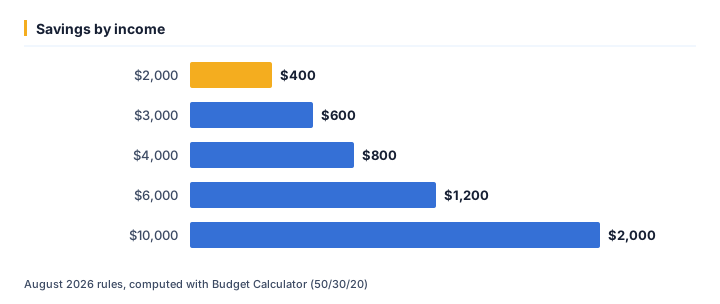
We ran 5 values of income through the calculator and left every other input at its default. As of August 2026, the output was:
| Income ($) | Savings ($) | Needs ($) | Wants ($) |
|---|---|---|---|
| 2,000 | 400 | 1,000 | 600 |
| 3,000 | 600 | 1,500 | 900 |
| 4,000 | 800 | 2,000 | 1,200 |
| 6,000 | 1,200 | 3,000 | 1,800 |
| 10,000 | 2,000 | 5,000 | 3,000 |
Running income from $2,000 up to $10,000 moves savings from $400 to $2,000 — a spread of $1,600. That gap is the part a single headline rate never shows.
The same runs seen through needs
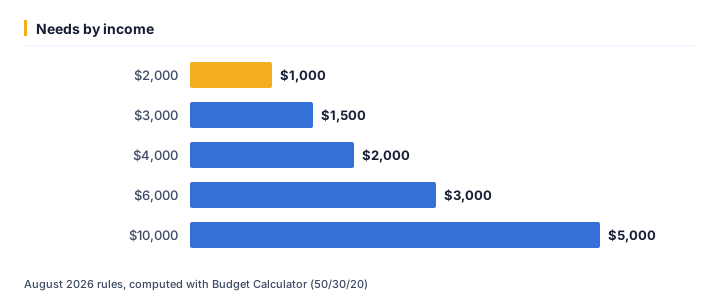
At $2,000, needs works out to $1,000; at $10,000 it is $5,000. Looking only at savings tends to understate how much the outcome shifts across that range.
One example, straight from the API
The middle row above (income = $4,000) is not a rounded illustration — it is exactly what /api/v1/tools/budget-calculator/calculate returns for that input, August 2026 rules:
{
    "tool": "budget-calculator",
    "inputs": {
        "income": 4000
    },
    "result": {
        "needs": 2000,
        "wants": 1200,
        "savings": 800
    }
}
Assumptions behind these figures
| Input | Value |
|---|---|
| Income | $4,000 |
| As of | August 2026 |
| Method | identical to /tools/budget-calculator |
Rates, thresholds and typical costs change over time; the numbers above are accurate as of August 2026, not a permanent guarantee. For your own situation, open the Budget Calculator (50/30/20) and enter your real numbers — the calculator runs the same code that produced every figure on this page.
Ready to crunch your numbers?
Open the Budget Calculator (50/30/20) and get an answer in seconds.
Editorial Team
We write plain-English money guides and build the free calculators behind them.