Saving $20,000 in 24 months requires about $385/biweekly paycheck — roughly 16% of US median net pay. The plan is less about heroic frugality than about a small set of structural commitments held across two years rather than dramatic monthly effort.
A two-year, $20,000 savings plan is one of the highest-impact financial moves an ordinary US household can make. $20,000 is large enough to fundamentally change your relationship to risk — it covers a 6-month emergency for most households, a substantial home down payment in moderate markets, a year of community-college tuition, or the seed of a serious investment portfolio. It is also small enough that the math, sustained over 24 months, does not require extraordinary income.
The honest framing: this is a project, not a sprint. The work is to set up structural commitments in the first 60 days that then run themselves for 22 more months with minimal active management. This guide is that structural framework.
What $20,000 in 24 Months Actually Costs
The arithmetic:
- Per month: $20,000 / 24 ≈ $833 per month
- Per biweekly paycheck: $20,000 / 52 ≈ $385 per paycheck
- Per week: $20,000 / 104 ≈ $192 per week
- Per day: $20,000 / 730 ≈ $27 per day
These numbers are identical to the $10,000-in-a-year plan — the two-year version simply extends the same monthly commitment to its full natural runway. That has a quiet but important consequence: most successful $10,000-in-a-year savers finish $20,000 in year 2 almost without thinking, because the system was already built.
For a median US household earning $5,000–$5,500/month net, $833/month is approximately 16% of take-home, sitting comfortably inside the 20% savings ceiling of the 50/30/20 framework. For above-median dual-income households, it drops to 8-10% of net — achievable without any spending changes at all. For below-median single-income households, it commonly requires structural cuts plus a modest sustained income channel.
Run your specific income through the Savings Goal Calculator to see what $833/month represents as a percentage of your take-home. If the rate exceeds 22% of net pay, stretch the timeline to 30 months rather than aiming for a deficit you cannot sustain.
Why Two Years Is the Right Timeline
There is a tendency to compress savings goals to feel more urgent. Resist it for $20,000.
Compounding starts to matter. At HYSA rates of 4% APY, a steadily growing balance toward $20,000 earns roughly $750-$850 in interest over 24 months — meaningful, and absent on a 12-month plan because the balance never gets large enough early enough.
The plan absorbs life. Twelve-month plans break on the first $2,000 emergency. Twenty-four-month plans absorb the emergency, recover within 60-90 days, and still finish on time. The optionality is the entire point.
Habits become permanent. Anything sustained for 12 months can be reversed. Anything sustained for 24 months tends to stick. By month 18, the automation, the structural cuts, and the income channel feel like permanent infrastructure rather than effortful change.
The Four-Lever Framework
Every successful $20,000-in-24-months plan moves four levers — but unlike shorter-timeline plans, the proportions can be more relaxed because the runway is longer.
Lever 1: Automation. $385 biweekly off the top, the day after each payday, into a separate high-yield savings account at a different institution. This single lever, run for 24 months, produces $20,020 by itself — meaning if your income permits the full $385 deduction without further changes, you can hit the goal on automation alone.
Lever 2: Structural spending cuts. For households where the full $385 biweekly creates a cash crunch, one or two structural category cuts (housing, transportation, food) free the room. Typically $200-$500/month of newly available cash.
Lever 3: Sustained income channel. Modest, durable, low-burnout. Overtime shifts, freelance work, side business — adds $200-$600/month sustained over the 24 months, often turning a tight plan into a comfortable one.
Lever 4: Windfalls. Two years includes two tax refund cycles, two year-end bonuses (if employer pays them), and typically 2-4 other "found money" events (rebates, gifts, account-opening bonuses, security deposit returns). Directing all of them to the plan adds $3,000-$8,000 across the full timeline — enough to absorb several missed monthly contributions if a stretch is needed.
Step 1: Build the Infrastructure in Month 1
Front-load the setup. Everything that follows depends on it.
Open a separate high-yield savings account at a different bank. Online banks (Ally, Marcus, Discover, SoFi, Capital One) currently pay 3.5-4.5% APY. The cross-institution friction (2-3 day transfer delays for withdrawals) is a feature; it adds reflection time before any spending.
Set up the automatic $385 biweekly transfer. Time it for the day after each payday so direct deposits have fully settled. Verify the first two transfers actually fire — about 1 in 8 setups has a silent error.
Label the account explicitly. "Two-Year Reserve" or "House Down Payment" or "Sabbatical Fund." Money with a stated purpose is markedly harder to spend casually than money in a generic "Savings 2" balance.
Run the three pre-work calculations. Real take-home pay (average of last 3 net deposits). Real monthly spending by category (last 90 days, sorted). Real savings rate (last 30 days). The gap between today's savings rate and 16% of net is the work; sizing it up front is what makes it solvable.
Step 2: Execute the Structural Cuts (Months 1-3)
If $385 biweekly is comfortable from current income, skip this step and let automation run. If it creates a cash crunch, the high-impact cuts:
Housing optimization. A unit $250/month cheaper produces $6,000 over 24 months — by itself, 30% of the goal. Considerations: lease timing, moving costs, deposit refund timing. The hassle is meaningful; the dollar impact dwarfs everything else.
Transportation rationalization. Refinancing a car loan at lower interest, trading a leased premium vehicle for a reliable used one, going from two cars to one in households where geography permits — typically $80-$250/month, $1,900-$6,000 over 24 months.
Food category compression. Cutting delivery and restaurants in half typically saves $200-$400/month, or $4,800-$9,600 across the full timeline. The change feels significant for 2-3 weeks, then becomes normal.
Subscription and fee audit. Lower dollar impact but easiest to execute. Auditing recurring charges and canceling unused services typically frees $40-$100/month, $1,000-$2,400 over 24 months.
Doing two of these structurally is enough for nearly every median-income household. Avoid the trap of cutting twelve things by 5% each — those cuts unwind within 90 days as the small-effort discipline erodes.
Step 3: Launch the Income Channel (Months 2-3)
A 24-month timeline rewards a sustainable income channel rather than a high-intensity, short-burn side hustle.
The options, ranked by sustainability over two years:
Workplace overtime, weekend shifts, or eligible role expansion. Highest hourly rate available because no setup or marketing required. Four hours per week at $35/hour for 100 weeks (allowing 4 weeks of normal life across two years) = $14,000. By itself, 70% of the entire $20,000 goal.
Existing-skill freelance at modest volume. Three to five hours per week of writing, design, coding, accounting, tutoring, or consulting at $40-$60/hour produces $6,000-$15,000/year gross. Across 24 months, this lever alone often produces $15,000-$25,000 net of taxes.
A small business or content channel. Lower per-hour return early, but compounding. An Etsy storefront, niche blog or YouTube channel, small e-commerce, or boutique consultancy commonly produces $200-$600/month after a 90-day ramp. Over 22 months of running output, $4,400-$13,200.
Career-trajectory income lever. Often overlooked. An 8% salary increase (raise or job change) on a $60,000 base adds $400/month net. Over the back 18 months of the plan, $7,200. Highest ROI per hour of effort if you have been at the same role for 18+ months without a raise.
Critical tax point on any side income: reserve 25-30% of every dollar earned into a separate "tax savings" sub-account from day one. Self-employment income is subject to federal/state income tax plus the 15.3% self-employment tax. Treating side income as 100% spendable is the most common way long-term savings plans get unwound at the next April 15.
Step 4: Capture Every Windfall (Months 1-24)
Across 24 months, "found money" events typically add $3,000-$8,000:
- Federal and state tax refunds (twice across the timeline). Average federal refund in recent years ≈ $3,000.
- Year-end bonuses (if applicable). Median bonus for salaried US employees ≈ $1,500-$3,500.
- Account-opening bonuses (banks, credit cards used responsibly). $200-$1,000 per event.
- Gifts, rebates, refunds, settlements. Variable.
The single most effective rule: 100% to the savings account, the day the money lands. Not 50%. The "save half, spend half" rule reliably produces lifestyle inflation that lingers past the windfall.
A 24-Month Schedule
The macro view, with predicted stall points marked:
| Months | Cumulative Target | Phase | Notes |
|---|---|---|---|
| 1-3 | $2,500 | Infrastructure | Setup, structural cuts, launch income channel |
| 4-6 | $5,000 | Steady state | Capture first tax refund |
| 7-9 | $7,500 | First stall point | Mid-year fatigue; hold automation |
| 10-12 | $10,000 | End of year 1 | First year-end bonus; project halfway |
| 13-15 | $12,500 | Restart momentum | New-year setup of fresh subscriptions audit |
| 16-18 | $15,000 | Second stall point | Plan is "old" by now; rely on automation |
| 19-21 | $17,500 | Final stretch | Second tax refund; sprint mentally |
| 22-24 | $20,000 | Push to finish | Direct year-end bonus 100% to plan |
Realistically, with HYSA interest at ~4% APY adding $750-$850 across the period, most disciplined plans finish at $20,750-$20,900. Anyone within 30 days of month 24 hitting $20,000 has succeeded — the precise month is noise.
Surviving the Two Stall Points
Almost every 24-month plan stalls twice — once around month 7-9 (mid-year-1 fatigue, motivation gone, goal still far), once around month 15-18 (the "this is forever" phase). The two stalls together account for nearly all plan abandonments.
Defenses:
Stall 1 (month 7-9): Hide the goal, trust the system. Stop checking the balance. Do not recalculate "what's left to go." Let the automation run. Most readers who stop staring at the number for 60 days find themselves at month 10 with $8,500 instead of $7,500 and the urgency restored.
Stall 2 (month 15-18): Reframe to milestones, not goal. "I have hit my second six-month mark" feels more achievable than "I have eight months to go for a number I committed to almost two years ago." Many successful plans use month-18 as a small celebration point (a $50 dinner out, not a $400 vacation) — recognizing the project's durability.
What to Do When You Hit $20,000
Three actions in order on the day the goal lands:
- Move the $20,000 out of the active savings account into a separately labeled, purpose-defined account. "Six-Month Emergency Reserve" or "House Down Payment" or "Career Pivot Fund."
- Do not pause the $385 biweekly automation. The structural changes are in place; the next $20,000 takes 18-22 months instead of 24, because no infrastructure rebuild is required.
- Run the Compound Interest Calculator on $20,000 left to grow for 30 years at 7% — the number ($152,000+) is the motivational fuel for keeping the system running.
When the Math Doesn't Fit
A few honest off-ramps:
If $833/month exceeds 22% of your net pay, stretch to 30 months ($667/month, ~13% of median net). A finished 30-month $20,000 is far more valuable than an abandoned 24-month attempt.
If you carry high-interest debt above $5,000, the rational sequence is typically: build $1,000 starter buffer, attack the debt aggressively, then start the $20,000 plan. Mathematics on a 24%-APR card balance dominates 4% HYSA returns.
If your income is highly irregular, convert to a percentage rule: 15-18% of every deposit. Track rolling 90-day totals against the equivalent monthly target.
Frequently Asked Questions
Should the full $20,000 sit in cash? For an emergency fund or near-term-use savings (down payment within 2-3 years), yes — keep it in HYSA. For longer-horizon savings (5+ years out), invest broadly in low-cost index funds once the balance exceeds one full emergency fund. A fee-only CFP from letsmakeaplan.org can advise the specific cutover.
What if a $5,000 emergency hits at month 12? Use the savings. Do not "restart." Recalculate the remaining 12 months from your new balance — typically still on track to finish around $18,000-$19,000 by month 24, which is excellent.
Should I pause my 401(k) to hit $20,000 faster? Almost never pause an employer match (that is free money). Pausing voluntary contributions above a match for 24 months to build a first emergency fund can be defensible; pausing them once an emergency fund exists is usually not.
Is $20,000 enough for a house down payment? At a 5% down payment on a $400,000 home, $20,000 is exactly enough — though closing costs and reserves typically require another $5,000-$10,000. In high-cost markets, $20,000 may be the deposit on the deposit. Use the Savings Goal Calculator to plan the next milestone after the first $20,000.
Should I use CDs instead of HYSA? At current rates, the difference is small (0.25-0.75% APY) and the CDs lose accessibility. For most 24-month plans, the right vehicle is a high-yield savings account; CDs make sense only if you have already built an emergency fund and genuinely will not touch the funds.
Next Steps
If you do nothing else this week:
- Run the three pre-work calculations and confirm $833/month is feasible against your actual take-home.
- Open a separate HYSA today and schedule the $385 biweekly auto-transfer for the day after next payday.
- Identify which structural cut (housing, transportation, food) is your highest-leverage move and commit to executing it within 60 days.
$20,000 in 24 months is the savings goal that converts the habit of saving from "current project" to "default behavior." Once finished, your relationship to money risk shifts permanently. Run the Budget Calculator to confirm $833/month fits without strain, and the Compound Interest Calculator to see what continuing the same monthly deposit for ten or twenty years produces in long-term wealth.
Run the numbers
Everything below came out of this site's own Budget Calculator (50/30/20). The figures are not quoted from anywhere else: each row is one run of the same calculation the tool page performs, using August 2026 rules. Put the same inputs in and you will get the same output.
How the result moves with income
We ran 5 values of income through the calculator and left every other input at its default. As of August 2026, the output was:
| Income ($) | Savings ($) | Needs ($) | Wants ($) |
|---|---|---|---|
| 2,000 | 400 | 1,000 | 600 |
| 3,000 | 600 | 1,500 | 900 |
| 4,000 | 800 | 2,000 | 1,200 |
| 6,000 | 1,200 | 3,000 | 1,800 |
| 10,000 | 2,000 | 5,000 | 3,000 |
Running income from $2,000 up to $10,000 moves savings from $400 to $2,000 — a spread of $1,600. That gap is the part a single headline rate never shows.
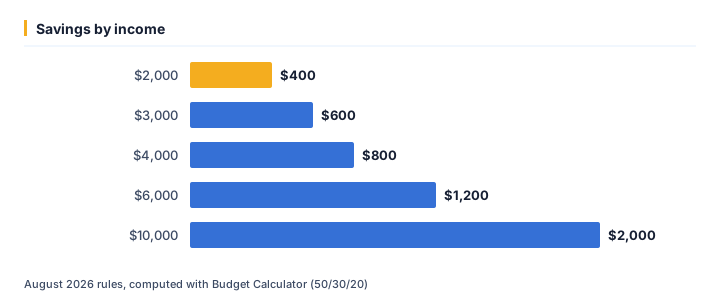
The same runs seen through needs
At $2,000, needs works out to $1,000; at $10,000 it is $5,000. Looking only at savings tends to understate how much the outcome shifts across that range.
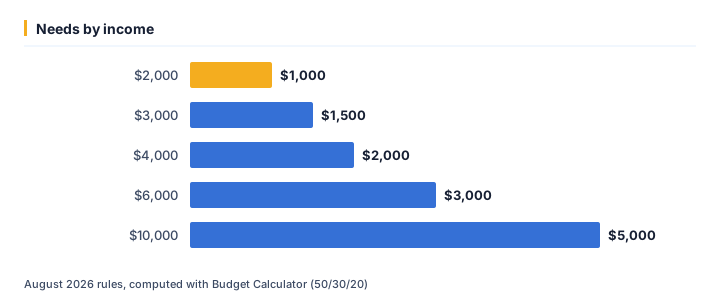
One example, straight from the API
The middle row above (income = $4,000) is not a rounded illustration — it is exactly what /api/v1/tools/budget-calculator/calculate returns for that input, August 2026 rules:
{
    "tool": "budget-calculator",
    "inputs": {
        "income": 4000
    },
    "result": {
        "needs": 2000,
        "wants": 1200,
        "savings": 800
    }
}
Assumptions behind these figures
| Input | Value |
|---|---|
| Income | $4,000 |
| As of | August 2026 |
| Method | identical to /tools/budget-calculator |
Rates, thresholds and typical costs change over time; the numbers above are accurate as of August 2026, not a permanent guarantee. For your own situation, open the Budget Calculator (50/30/20) and enter your real numbers — the calculator runs the same code that produced every figure on this page.
Ready to crunch your numbers?
Open the Budget Calculator (50/30/20) and get an answer in seconds.
Editorial Team
We write plain-English money guides and build the free calculators behind them.