Saving $500 a month on an average US salary is closer to ordinary engineering than to financial heroics — it requires moving roughly 10% of median take-home pay before you see it, and adjusting two or three category-level habits so the diverted money is not missed.
$500 a month is the savings rate that sits squarely inside the realistic zone for an average US household — large enough to be transformative over a few years, small enough that no single category needs to be eliminated to reach it. At $500/month, in twelve months you have $6,000; in five years, before any market growth, you have $30,000. With even modest interest, those numbers move into a one-month, six-month, then full-year emergency-fund range and beyond.
This guide is built around a median US take-home of roughly $5,000-$5,500/month and shows the structural moves required to redirect about 10% of net income into savings, every month, sustainably.
Why $500 Is the Right Default Target
For US households trying to build a foundation rather than chase an aggressive goal, $500/month hits an interesting middle.
It is the inflection point for compounding. Below ~$250/month, contributions feel small enough that even modest market growth dominates the deposit. Above $500/month, contributions feel large enough that they crowd out current quality of life. $500 sits where the dollar amount feels meaningful but does not require visible sacrifice.
It approximates 10% of median take-home. The classic personal-finance heuristic — "save 10–20% of income" — works out to roughly $500–$1,000/month on a median US household income. $500 is the floor of that range, which is exactly what makes it achievable for households just starting the savings habit.
It builds the muscle for larger goals. Most readers who sustain $500/month for 12 months can step up to $700 or $800 in year two with almost no extra friction, because the structural moves (automation, category compression) are already in place. Once the system is built, increasing the dial up takes minutes.
The Math: What $500/Month Means Per Paycheck
The arithmetic for a biweekly schedule (the most common in the US):
- Per month: $500
- Per biweekly paycheck: $500 × 12 ÷ 26 ≈ $231 per paycheck
- Per week: $500 ÷ 4.33 ≈ $115 per week
- Per day: $500 ÷ 30 ≈ $17 per day
At ~10% of median net pay, $500/month sits inside even a conservative version of the 50/30/20 budget rule — leaving room for additional retirement contributions on top, particularly an employer 401(k) match. For two-income households at the median, $500 is closer to 5-7% and is achievable without any spending changes at all; for below-median single-income households, $500 may require either income work or a stretched timeline.
Run your actual take-home through the Savings Goal Calculator to see what percentage $500 represents for you specifically — anything under 12% of net is comfortable for most households; over 18% will require sustained discipline.
Step 1: Automate the $231 Before You See It
The defining mistake of $500/month attempts is treating savings as the residual — "I'll save what's left at the end of the month." This produces $0/month almost without exception, because the dollars left over at month-end always find a destination first.
The reliable mechanism is the opposite: move the savings the day after payday, automatically, before the money is visible in your spending account.
Concrete setup:
- Open a separate high-yield savings account at a different institution from your checking — Ally, Marcus, Discover, SoFi, and Capital One all currently pay 3.5–4.5% APY.
- Schedule a recurring transfer of $231 from checking to savings for the day after each biweekly payday. (Monthly pay schedules: $500 the day after monthly payday.)
- Verify the first two transfers actually fire. About 1 in 8 setups has a quiet error — wrong account number, insufficient permissions, naming mismatch. Catch it in week 3, not month 3.
Why this is the highest-leverage single step in the whole plan: the brain treats "money I have not seen yet" categorically differently from "money I have and chose not to spend." The first is invisible; the second requires willpower at every dining-out, every Amazon click, every coffee. Willpower depletes. Automation does not.
Step 2: Decide Where the $500 Comes From
Most readers, looking honestly at their current spending, do not need to add income to find $500/month. They need to identify which two categories will quietly shrink to make room.
The largest typical opportunities, ranked by dollar impact for the average median-income US household:
Restaurants and delivery (frequently $300–$700/month). Cutting in half — for example, from $480 to $240/month — produces $240/month against the goal. The lifestyle change is real but modest: 4 fewer delivery orders and 2 fewer restaurant meals per month. Within 3 weeks, most readers report not missing the change.
Subscriptions and recurring charges ($60–$200/month for typical households). Streaming services not actively used, gym memberships used <2×/month, cloud storage tiers above what's needed, app subscriptions, recurring delivery boxes. A 45-minute audit + cancellation pass nets $40-$100/month for many readers.
Premium grocery items and convenience food ($80–$200/month). Shifting from premium brands to mid-tier on staples (cereal, dairy, paper goods), and reducing prepared-food purchases (pre-cut produce, prepared meals), typically saves $50-$120/month without changing what is on the plate. The premium tier is often a habit, not a preference.
Discretionary online shopping ($50–$300/month varies wildly). Most easily tracked by reviewing the last 90 days of Amazon, Target, and credit card statements. The category that surprises readers most — the typical median household spends 2-3× more than they would guess on small non-grocery online purchases.
In practice, picking two of these and halving each is enough. You do not need to cut all four. Halving restaurants/delivery + halving subscriptions, for example, produces $260-$350/month on its own — more than half the goal from two structural decisions.
Step 3: Make Up Any Gap With One Small Income Channel
If steps 1 and 2 still leave a gap — common for below-median single-income households — close it with one modest income channel. The goal here is modest, not heroic: $100-$200/month of extra income, sustained for a year, beats $400/month for two months followed by burnout.
The lowest-friction options for $100-$200/month:
- One overtime shift per month at work (if available). Often the highest-hourly-rate income available because no setup or marketing is required.
- Selling 3-5 unused items per month on Facebook Marketplace, eBay, or OfferUp. Most US households can sustain this for 6-12 months before running low on resellable inventory.
- One paid freelance hour per week in an existing skill (writing, design, accounting, tutoring, photography). At $35-$50/hour, this clears $140-$200/month.
- Rebate apps and account-opening bonuses. Genuine, low-effort: bank account opening bonuses commonly run $200-$400 for opening with direct deposit; credit card sign-up bonuses run $200-$1,000 (only useful if you pay statements in full). These are one-off boosts, not recurring channels, but they front-load the first few months.
A 12-Month Schedule
| Month | Action | Cumulative Savings |
|---|---|---|
| 1 | Open HYSA. First $231 transfer fires. Audit subscriptions, cancel 3+. | $231-$500 |
| 2 | Cut delivery/restaurant spending to half of prior 90-day average. | $1,000 |
| 3 | Confirm automation has fired correctly 6× now. Adjust if needed. | $1,500 |
| 4 | First quarterly review. Most readers find the $500/month is not noticed. | $2,000 |
| 5-6 | Steady state. If anything, consider raising to $275 biweekly ($600/month). | $3,000 |
| 7 | Mid-year fatigue. Hold the automation; do not cut spending further. | $3,500 |
| 8-9 | Continued steady state. Any tax refund or bonus flows directly to savings. | $4,500 |
| 10-11 | Push through Q4 spending temptations (holidays). Pre-plan gift budget. | $5,500 |
| 12 | Hit ~$6,000. Move to a labeled "Foundation Reserve" account. | $6,000 |
With interest, the actual balance lands at $6,100-$6,180 depending on the HYSA's APY. The interest itself is small but symbolically important — it is the first time many readers see passive money working.
Year Two: The Dial-Up
The single highest-leverage move once $500/month becomes routine is to increase the dial slightly each January. The increases are small and unnoticed individually; they compound dramatically over 5-10 years.
- Year 1: $500/month ($6,000 contributed)
- Year 2: $600/month ($7,200 contributed)
- Year 3: $725/month ($8,700 contributed)
- Year 4: $850/month ($10,200 contributed)
- Year 5: $1,000/month ($12,000 contributed)
After five years, total contributions = $44,100. With market growth at a conservative 6% blended return, the balance lands somewhere around $50,000-$53,000. This is not the result of a heroic single year; it is the result of one structural setup followed by patient, mostly automated execution.
Run the Compound Interest Calculator on these inputs to see what 10, 20, or 30 years of the same dial-up produces. The numbers are often surprising even to readers comfortable with the concept of compounding.
When $500/Month Does Not Work
A few situations where the plan needs adjustment rather than execution:
Your real take-home is below $3,500/month. $500 is then 14%+ of net income, which is achievable but tight. Consider $300/month initially while income grows.
You have credit-card debt above $5,000. Many frameworks would have you save $1,000 first, then attack the debt aggressively, then resume larger savings. Saving $500 while paying minimums on $10,000 of 24% APR debt is mathematically counterproductive — the debt grows faster than the savings.
Your income is highly variable. Use a percentage rule (10-15% of every deposit) rather than a fixed dollar amount. Track the rolling 90-day total against the $500/month equivalent.
You are within 5 years of retirement. $500/month into HYSA is too conservative; you should be having a fee-only CFP from letsmakeaplan.org advise on glide path and asset allocation.
Frequently Asked Questions
Should the $500 go to retirement or to savings? For most readers building their first emergency fund, $500/month into HYSA is the right starting point until 1-3 months of expenses is in reserve. Once a basic emergency fund is in place, splitting between retirement (especially capturing any employer match) and HYSA makes sense. The general default is: $500 to savings until you have ~$5,000 buffer; then redirect part toward retirement.
Is $500/month enough to retire on? $500/month for 35 years at 7% annual return produces roughly $830,000 in today's dollars (before inflation adjustment). That is meaningful but probably insufficient as a complete retirement plan for most US households. $500 is a foundation, not a finish line — most readers should aim to dial up to $1,000-$1,500/month by their mid-30s.
Why not just round-up every transaction instead? Round-up apps produce small absolute amounts — typically $15-$50/month — which means even a perfectly executed year of them produces only $200-$600 of savings. They are useful as a top-up, useless as the main mechanism. Schedule the $231 biweekly; let round-ups be extra.
What if I can only save $300/month right now? Start there. The structural moves matter more than the specific dollar amount. A finished, sustained $300/month is markedly more valuable than an abandoned $500/month — and once $300 is automatic, ramping to $400 in 6 months is straightforward.
How do I avoid lifestyle creep eating the savings? The single highest-leverage rule is: when income increases (raise, bonus, side income), increase the automated transfer first, then adjust spending second. If a $400/month raise hits in March, raise the biweekly transfer by $185 ($400/2.17) in the same week. Lifestyle creep happens when raises hit the checking account and spending expands to fill them.
Next Steps
If you do nothing else this week:
- Run your actual take-home through the Savings Goal Calculator to confirm $500/month is sustainable.
- Open a separate HYSA today and schedule the $231 biweekly auto-transfer for the day after your next paycheck.
- Cancel three subscriptions you have not used in 30 days. This single action, by itself, often covers 10-20% of the monthly target.
$500/month is the rate at which savings stops feeling like sacrifice and starts feeling like the default. Once the automation is running and one or two category compressions are in place, the work is in not stopping. Run the Budget Calculator to confirm the rest of your spending fits comfortably around the $500 outflow, and revisit the Emergency Fund Calculator once the buffer reaches one full month of expenses.
Run the numbers
Everything below came out of this site's own Budget Calculator (50/30/20). The figures are not quoted from anywhere else: each row is one run of the same calculation the tool page performs, using August 2026 rules. Put the same inputs in and you will get the same output.
How the result moves with income
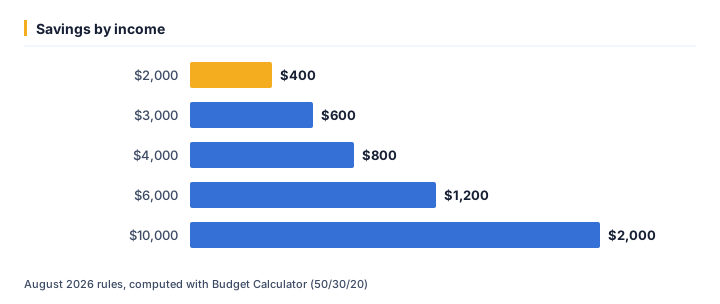
We ran 5 values of income through the calculator and left every other input at its default. As of August 2026, the output was:
| Income ($) | Savings ($) | Needs ($) | Wants ($) |
|---|---|---|---|
| 2,000 | 400 | 1,000 | 600 |
| 3,000 | 600 | 1,500 | 900 |
| 4,000 | 800 | 2,000 | 1,200 |
| 6,000 | 1,200 | 3,000 | 1,800 |
| 10,000 | 2,000 | 5,000 | 3,000 |
Running income from $2,000 up to $10,000 moves savings from $400 to $2,000 — a spread of $1,600. That gap is the part a single headline rate never shows.
The same runs seen through needs
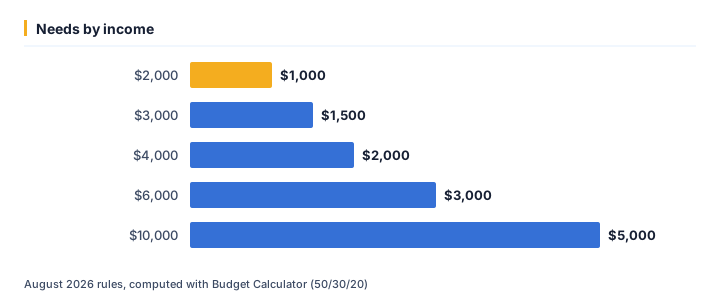
At $2,000, needs works out to $1,000; at $10,000 it is $5,000. Looking only at savings tends to understate how much the outcome shifts across that range.
One example, straight from the API
The middle row above (income = $4,000) is not a rounded illustration — it is exactly what /api/v1/tools/budget-calculator/calculate returns for that input, August 2026 rules:
{
    "tool": "budget-calculator",
    "inputs": {
        "income": 4000
    },
    "result": {
        "needs": 2000,
        "wants": 1200,
        "savings": 800
    }
}
Assumptions behind these figures
| Input | Value |
|---|---|
| Income | $4,000 |
| As of | August 2026 |
| Method | identical to /tools/budget-calculator |
Rates, thresholds and typical costs change over time; the numbers above are accurate as of August 2026, not a permanent guarantee. For your own situation, open the Budget Calculator (50/30/20) and enter your real numbers — the calculator runs the same code that produced every figure on this page.
Ready to crunch your numbers?
Open the Budget Calculator (50/30/20) and get an answer in seconds.
Editorial Team
We write plain-English money guides and build the free calculators behind them.