Saving $5,000 in 6 months breaks down to roughly $192/week or $833/month — reachable on an average US salary if you systematize three things: aggressive automation, two structural spending cuts, and one income channel you can sustain for half a year.
Five thousand dollars in six months sits at the awkward middle of personal-finance goals. It is too large to ignore with a casual round-up app, too small to require a complete lifestyle overhaul. Most people who attempt it succeed or fail in month 3 or 4 — long after the initial motivation has faded, before the goal feels close enough to push for. Knowing where the typical failure point sits, and engineering past it, is half the work.
This guide is a six-month plan that assumes an average US take-home pay, a normal social life, and the same level of willpower you had last month. The work is in the structure, not the heroics.
What $5,000 in 6 Months Actually Looks Like
The arithmetic first. Six months is 26 weeks, 13 biweekly paychecks, or roughly 183 days.
- Per week: $5,000 / 26 ≈ $192 per week
- Per biweekly paycheck: $5,000 / 13 ≈ $385 per paycheck
- Per month: $5,000 / 6 ≈ $833 per month
- Per day: $5,000 / 183 ≈ $27 per day
On a US median household take-home pay of roughly $5,000-$5,500/month, $833 is about 16% of net income. That sits inside the 20% savings ceiling of the 50/30/20 framework, which means it is mathematically achievable for the median earner — though it requires every dollar of "savings" in the framework to be directed at this single goal for six months, with retirement and other savings paused or deprioritized.
For two-income households or above-median earners, the math is easier. For below-median earners or single-income households with kids, $833/month often requires real income growth, not just spending cuts. Run your specific numbers through the Savings Goal Calculator to confirm feasibility before committing — if the weekly target exceeds 20% of your take-home, stretch the timeline to 8 or 9 months.
Pre-Work: Three Calculations to Do This Weekend
Before you change anything, build three numbers. They take an hour combined and they are the foundation everything else rests on.
Your true monthly take-home. Average your last three net paycheck deposits. This is the only income number that matters; gross income lies because the gap between gross and net (taxes, pre-tax deductions) is invisible until you try to budget against it.
Your true monthly spending — by category. Export the last 90 days of transactions from your primary checking and credit cards. Sort into needs / wants / savings. Most readers are surprised by 1–2 categories that are 2-3× larger than they remembered.
Your real savings rate today. What percentage of take-home actually became savings in the last 30 days? Not what you intended to save — what was actually still there at month-end after spending. For about 35% of US households, this number is at or below zero.
The gap between today's savings rate and ~16% (or whatever your $5,000-in-6-months rate works out to) is the work. Knowing the size of the gap up front is what makes it solvable. Vague goals do not get hit.
Step 1: Automate the Transfer at the Right Number
The single most important action is moving $385 per biweekly paycheck into a separate high-yield savings account, automatically, the day after each payday. Not on payday — the day after, so direct deposits have fully settled.
Why this number is non-negotiable. A daily-spending-cut approach ("I'll save $27/day by being more careful") fails because individual transactions resist scrutiny in the moment. A bulk-transfer approach succeeds because the money is gone before you see it. You then live on the rest. The forced scarcity is the entire mechanism.
If $385 per paycheck immediately creates a cash crunch, that is data, not failure. It means you have a spending leak that you are not yet aware of. Lower the auto-transfer to $300, identify and close the leak (steps 2 and 3 below), then raise back to $385 by paycheck 3. Most readers find within two pay cycles that the original $385 was, in fact, comfortable — they just had not run the experiment.
Use a separate bank from your checking. Online HYSA accounts (Marcus, Ally, Discover, SoFi, etc.) commonly pay 3.5-4.5% APY. The 2-3 day transfer delay between institutions is a feature, not a bug — it adds friction that breaks impulse withdrawals.
Step 2: Make Two Structural Cuts, Not Twenty Small Ones
The savings plans that fail are the ones that try to cut fifteen categories by 10% each. The plans that work cut two categories by 50% and leave everything else alone.
For a 6-month, $5,000 plan, the two structural cuts that consistently produce the largest dollar impact for the smallest lifestyle felt-effect:
Housing or transportation. If either is more than 30% of take-home, this is the lever with by far the highest leverage. Refinancing a car loan from 9% to 5% saves $40-80/month on a $25,000 balance. Dropping a $250/month leased SUV for a $140/month used sedan saves $110/month. Moving from a $2,100 apartment to a $1,750 unit in the next neighborhood over saves $350/month. These are unglamorous decisions and they completely dominate any number of clipped-coffee savings.
Food spending (restaurants + delivery + premium grocery). For median US households trying to save aggressively, this category is almost always over-allocated by $200-$400/month versus where it could comfortably sit. Cutting delivery to once a week, restaurants to twice a month, and shifting from premium grocery brands to mid-tier typically saves $250-$500/month — without anything that feels like deprivation past the second week.
Combined, these two structural cuts often produce $400-$800/month — by themselves, often enough to hit $5,000 in 6 months on a median income, before you touch a single subscription or "small win" tactic.
Step 3: Pick One Sustainable Income Channel
A six-month plan does not need a 30-hour-per-week side hustle. It needs one additional income channel, run modestly, for the full duration.
Three that scale well across half a year without burnout:
Workplace overtime, weekend shifts, or eligible bonuses. Often the highest hourly rate available because no skill development or marketing is required. Six months of one overtime shift per week, at $35/hour for 4 hours, adds ~$3,300 — by itself, two-thirds of the goal.
Skill-based freelance at modest volume. Existing professional skills (graphic design, writing, accounting, programming, tutoring, music instruction, photography) command $30-$80/hour. Five hours per week for 26 weeks at $45/hour = $5,850 gross, or roughly $4,400 after the 25-30% tax set-aside described below.
Recurring resale or content monetization. Slower to start, but lower per-hour effort once running. Flipping items from estate sales or thrift stores, running a small Etsy storefront, or monetizing a niche YouTube/blog typically clears $200-$600/month after 60-90 days of setup.
Tax-set-aside note for any side income: Reserve 25-30% of every dollar earned into a separate "tax savings" account from day one. US self-employment income is subject to both federal/state income tax and the 15.3% self-employment tax (Social Security + Medicare). Treating side income as 100% spendable is one of the most common ways savings plans get unwound at tax time. The set-aside is not optional savings; it is money that already belongs to the IRS.
A Realistic Month-by-Month Schedule
The pace matters: front-load the structural changes, expect month 4 to wobble.
| Month | Focus | Cumulative Balance |
|---|---|---|
| 1 | Open HYSA. Run pre-work calculations. Schedule auto-transfer at $385/paycheck. Identify and execute first structural cut. | ~$650 |
| 2 | Execute second structural cut. Launch one income channel (overtime, first freelance gig, etc.). | ~$1,500 |
| 3 | Steady state. Income channel produces first full month. | ~$2,500 |
| 4 | The hard month. Motivation fades, life intrudes, an unexpected expense happens. Hold the auto-transfer. | ~$3,250 |
| 5 | Recovery and steady progress. | ~$4,200 |
| 6 | Final push. Cash any pending side income. | ~$5,000 |
Month 4 is the predictable failure point. Half of attempts that get to $2,500 stall there for 4-8 weeks. The fix is anticipated: in month 3, write a brief note to yourself — phone or paper — explaining why you started, taped somewhere you'll see it in 30 days. This is silly. It is also one of the most documented predictors of finishing the goal.
When the Math Does Not Work
If after the pre-work you discover that $833/month is more than 25% of your take-home, the plan needs adjustment, not abandonment. Three options, ordered by sustainability:
Stretch to 9 or 12 months. $5,000 / 9 months = $556/month. $5,000 / 12 months = $417/month. The slower pace is real progress — finishing $5,000 in 11 months is infinitely better than abandoning $5,000 at month 3.
Stack a structural income increase before starting. If you are 18+ months into your current role without a raise, market data on Glassdoor, Levels.fyi, or BLS often shows underpayment of 8-15%. A successful negotiation or job change recalibrates the entire plan permanently. See Salary Negotiation: Maximizing Your Worth.
Drop the goal to $3,000. Smaller is not failure. A finished $3,000 fund is more valuable than an abandoned $5,000 attempt.
Frequently Asked Questions
Should I pause retirement contributions to hit $5,000 faster? Generally no — if your employer offers a 401(k) match, pausing means losing free money worth far more than the time savings. If you have no match and are in high-interest debt, pausing temporarily may make sense; consult a fee-only CFP via letsmakeaplan.org before making the call.
What if a real emergency hits in month 4? Use the savings — that is what they are for. After the emergency, do not "start over." Recalculate the remaining months from where you are. Withdrawing $800 in month 4 then continuing the plan still gets you to ~$4,200 by month 6, which is excellent.
Should the money sit in a CD for higher interest? For a six-month timeline, the modest extra yield on a CD (typically 0.25-0.75% over HYSA at the time of writing) rarely outweighs the loss of accessibility if an emergency hits. HYSA is the right vehicle here. CDs make sense for funds you genuinely will not touch for 12+ months.
How do I avoid lifestyle creep wiping it out? Move the $5,000 out of the active savings account into a separately labeled, explicitly purposed account the day you hit the goal — "Emergency Fund Tier 2" or "House Down Payment Reserve." Money with a name is harder to spend than money in a general savings balance.
What if my income is irregular (freelance, commission)? Set the auto-transfer as a fixed percentage of every deposit — 15-20% — rather than a fixed dollar amount. Track your six-month rolling average to confirm you are on pace. Irregular income makes calendar plans frustrating; percentage rules absorb the variance smoothly.
Next Steps
If you do nothing else this week:
- Run the three pre-work calculations (true take-home, true spending by category, real savings rate).
- Open a separate HYSA today and schedule a $385 biweekly auto-transfer for the day after next payday — start with what feels almost too aggressive.
- Identify the single largest structural cut available (housing, transportation, or food) and put one action against it this week.
$5,000 in six months is not a willpower problem. It is a structural problem with a known structural solution. Once the automation is running and the two big cuts are in place, the work is mostly waiting. Run the Budget Calculator to confirm the numbers fit your specific income, and the Emergency Fund Calculator to see what milestone comes next.
Run the numbers
Everything below came out of this site's own Budget Calculator (50/30/20). The figures are not quoted from anywhere else: each row is one run of the same calculation the tool page performs, using August 2026 rules. Put the same inputs in and you will get the same output.
How the result moves with income
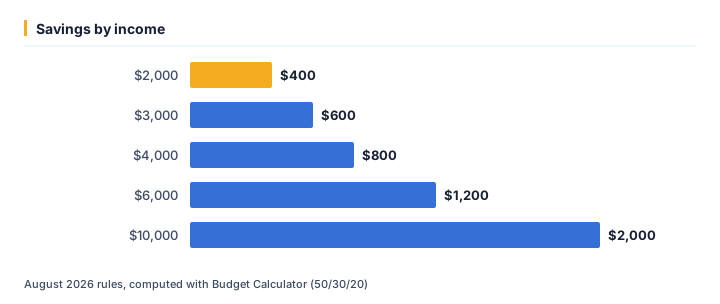
We ran 5 values of income through the calculator and left every other input at its default. As of August 2026, the output was:
| Income ($) | Savings ($) | Needs ($) | Wants ($) |
|---|---|---|---|
| 2,000 | 400 | 1,000 | 600 |
| 3,000 | 600 | 1,500 | 900 |
| 4,000 | 800 | 2,000 | 1,200 |
| 6,000 | 1,200 | 3,000 | 1,800 |
| 10,000 | 2,000 | 5,000 | 3,000 |
Running income from $2,000 up to $10,000 moves savings from $400 to $2,000 — a spread of $1,600. That gap is the part a single headline rate never shows.
The same runs seen through needs
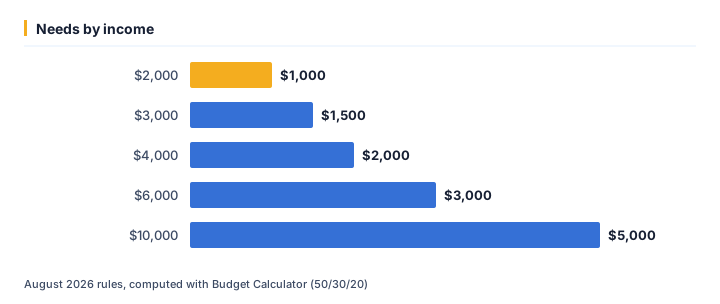
At $2,000, needs works out to $1,000; at $10,000 it is $5,000. Looking only at savings tends to understate how much the outcome shifts across that range.
One example, straight from the API
The middle row above (income = $4,000) is not a rounded illustration — it is exactly what /api/v1/tools/budget-calculator/calculate returns for that input, August 2026 rules:
{
    "tool": "budget-calculator",
    "inputs": {
        "income": 4000
    },
    "result": {
        "needs": 2000,
        "wants": 1200,
        "savings": 800
    }
}
Assumptions behind these figures
| Input | Value |
|---|---|
| Income | $4,000 |
| As of | August 2026 |
| Method | identical to /tools/budget-calculator |
Rates, thresholds and typical costs change over time; the numbers above are accurate as of August 2026, not a permanent guarantee. For your own situation, open the Budget Calculator (50/30/20) and enter your real numbers — the calculator runs the same code that produced every figure on this page.
Ready to crunch your numbers?
Open the Budget Calculator (50/30/20) and get an answer in seconds.
Editorial Team
We write plain-English money guides and build the free calculators behind them.