A plain-English walk through the fundamentals of personal finance — earning, spending, saving, investing, and protecting — built around the five habits that actually move your net worth in 2026.
Most personal finance advice arrives in fragments — a viral budget hack, a debt-snowball template, a tip about compound interest — and somehow never adds up to a system you can actually live by. This guide is the opposite. It walks through the whole picture in plain English so you can see how every piece fits, decide what to focus on first, and build the kind of money habits that quietly compound for the rest of your life.
You do not need a finance degree, a six-figure income, or a perfect credit score to start. You need a clear map. By the time you finish reading, you will know exactly what "managing your money" means, what to do this month, and which free calculators to use to put real numbers on each decision.
What Personal Finance Really Means
Personal finance is the ongoing process of deciding how money flows through your life: what you earn, what you spend, what you save, what you invest, and what you protect against. Every adult is already doing personal finance — the only question is whether you are doing it intentionally or by accident.
A useful working definition: personal finance is the set of habits that turns income into long-term security. Income alone does not do that. Plenty of high earners stay broke, and plenty of modest earners retire wealthy. The difference is almost never a single big decision. It is the boring, repeatable behaviors that you put on autopilot.
There are five pillars that organize the entire field. Get each one to "good enough" and you will outpace the vast majority of Americans on financial security, regardless of your starting point.
The Five Pillars of Personal Finance
1. Earning
Your income is the raw material everything else is built from. Most people accept whatever number their employer offers and never revisit it. That is the single most expensive habit in personal finance.
Three earning levers matter most for working adults:
- Negotiate every offer and every annual review. Even a 5% raise on a $60,000 salary, invested at 7% for 30 years, compounds into roughly $300,000 of extra retirement wealth. The 30-minute conversation is the highest-paid half hour you will ever work.
- Develop a marketable specialty. Generic roles pay generic wages. Specialists with rare combinations of skills (engineering plus a domain, design plus product, accounting plus tax software, nursing plus a certification) are paid materially more for the same hours.
- Add a small income stream on the side. It does not need to become a business. An extra $500 a month, channeled straight into investments, becomes about $600,000 over 30 years at 7% returns.
2. Spending
Spending is where most personal finance battles are won or lost. You do not need to track every coffee, but you do need a framework. The simplest one — popularized by Senator Elizabeth Warren — is the 50/30/20 rule: roughly 50% of your take-home pay on needs (housing, transportation, groceries, insurance, minimum debt payments), 30% on wants (dining out, hobbies, travel, streaming, anything you would cut if you lost your job), and 20% on savings and extra debt payoff.
The numbers are guidelines, not commandments. In high cost-of-living cities, needs may push to 60% and the wants budget shrinks. What matters is that every dollar is assigned a job before the month begins. Money without an assignment evaporates.
A starting exercise: download your last three months of bank and credit-card statements and sort every transaction into needs, wants, or savings. You will see your real ratio. Most people are shocked the first time. Use the Budget Calculator (50/30/20) to plug in your numbers and see exactly how much room you have to cut or save.
3. Saving
Saving is the buffer that keeps a setback from becoming a catastrophe. There are three distinct savings goals worth keeping in separate buckets:
- Emergency fund. Three to six months of essential expenses, held in a high-yield savings account, untouched unless you actually lose income or face a major medical bill. The point is not the interest — it is the calm of knowing one bad month does not unravel you.
- Sinking funds. Predictable, irregular expenses (annual car insurance, holiday gifts, Christmas, a wedding you have on the calendar). You contribute monthly so the money is already there when the bill arrives.
- Goal savings. A down payment, a sabbatical, a new car. Set a target amount and a deadline, then back into a monthly contribution.
How much emergency fund you really need depends on income stability, household composition, and how easily you could find new work. Single-income households with kids tend to want six months; dual-income households with no dependents can usually live well at three. The Emergency Fund Calculator sizes the buffer based on your real expenses.
4. Investing
If saving is the buffer, investing is the engine. The reason it matters is one of the most important pieces of math in any adult's life: compound interest.
A dollar invested at age 25 at a 7% real return grows to about $14.97 by age 65. The same dollar invested at age 45 grows to only about $3.87. Same dollar. Same market. The only variable is time. This is why "start now, even small" outperforms "start later when I make more" almost every time.
For most Americans, the investing playbook is unglamorous on purpose:
- Capture your full employer 401(k) match (it is a 50–100% instant return).
- Contribute to a Roth IRA up to the annual limit (in 2026, that limit is set by the IRS — confirm the current figure with a Certified Financial Planner before contributing).
- Invest in low-cost, broadly diversified index funds rather than picking individual stocks.
- Increase your contribution rate by 1% every time you get a raise.
- Do nothing during market downturns except keep contributing.
The Compound Interest Calculator shows you exactly how much a regular contribution becomes over 10, 20, and 30 years. Most people underestimate the result by an order of magnitude.
5. Protecting
The final pillar is the one nobody likes to think about: protecting what you have built. The basics are surprisingly compact:
- Health insurance. Non-negotiable. A single uninsured ER visit can wipe out a decade of savings.
- Renters or homeowners insurance. Pennies a day to protect tens of thousands of dollars of belongings and liability.
- Term life insurance if anyone depends on your income (children, a non-working spouse, aging parents). Term — not whole life — for almost everyone.
- Disability insurance. Statistically more likely than dying young, and far more financially destructive. Often available through your employer at low cost.
- A simple will and beneficiaries on every account. Free or near-free, and the most consequential paperwork most people will ever sign.
A good rule: protection should be in place before you start "optimizing" investments. Insurance is not exciting, but it is what keeps a single bad event from undoing years of slow, patient saving.
A 7-Step Path to Financial Health
If the pillars feel abstract, here is the order most personal finance educators recommend. Work through them sequentially. Do not skip to step 5 because investing is more interesting than step 2.
- Track every dollar for one month. You cannot manage what you do not measure. Use a spreadsheet, a budgeting app, or your bank's built-in categorization.
- Build a $1,000 starter emergency fund. Even before paying down high-interest debt, this small cushion stops you from adding new debt the next time a tire blows out.
- Capture your full employer 401(k) match. Free money. Do not leave it on the table for any reason short of a financial emergency.
- Wipe out high-interest debt. Anything over about 7% — most credit cards, some auto loans, payday loans, private student loans. Use either the avalanche method (highest rate first, mathematically optimal) or the snowball method (smallest balance first, behaviorally easier).
- Grow the emergency fund to 3–6 months of expenses. Now you are durable.
- Invest 15% of gross income for retirement. Across 401(k), Roth IRA, and any other tax-advantaged accounts available to you.
- Layer on bigger goals. A house down payment, kids' college, a sabbatical, early retirement. With the first six steps locked in, these become tractable instead of overwhelming.
The path is intentionally boring. That is the point. Excitement is what convinces people to chase the next hot stock, the next side hustle, the next refinance. Boring habits, compounded, are how regular people end up financially free.
Common Mistakes (and How to Avoid Them)
Across thousands of personal finance case studies, the same handful of mistakes show up over and over. Knowing them in advance is most of the protection.
Lifestyle inflation. When income rises, spending quietly rises to match it. The household earning $200,000 feels just as squeezed as the household earning $80,000. The fix is to bank every raise — increase your savings rate before your spending rate catches up. A useful rule: save half of every raise, automatically.
Treating credit cards as flexible income. Carrying a balance at 22% APR mathematically guarantees that you spend the next decade transferring wealth to a bank. If you cannot pay the statement in full each month, the card is no longer a payment tool — it is an emergency, and it deserves emergency-level focus.
No emergency fund. Without a buffer, every unexpected bill becomes new debt. The downward spiral usually starts with one $1,500 surprise.
Trying to time the market. Even professional fund managers underperform a basic index fund the majority of the time. Time in the market beats timing the market. If you cannot leave money invested for at least five years, it does not belong in stocks.
Ignoring tax-advantaged accounts. A 401(k) contribution is a federal tax break, sometimes a state tax break, and sometimes a 50–100% employer match — all on the same dollar. Skipping it to "have more cash now" is almost always a losing trade.
Confusing complexity for sophistication. Sophisticated personal finance, for almost everyone, looks like three index funds, automatic transfers, and a written budget. Complexity is what financial salespeople sell. Simplicity is what works.
Calculators You'll Use Most
The five pillars become much more concrete when you put real numbers on them. These four calculators cover the majority of personal finance decisions:
- Budget Calculator (50/30/20) — see exactly how your current spending splits across needs, wants, and savings, and what changes if you adjust any category.
- Net Worth Calculator — assets minus liabilities, the single most honest number in personal finance. Recompute every quarter.
- Emergency Fund Calculator — translates your real monthly expenses into a target buffer.
- Compound Interest Calculator — shows what your monthly contribution becomes in 10, 20, and 30 years.
A useful ritual: spend one Sunday morning every quarter recomputing all four. Personal finance is not a one-time setup. It is a habit of regular, low-stakes recalibration.
Frequently Asked Questions
Where should I start if I am in my 20s? Step 1 — track spending for a month. Step 2 — capture the employer 401(k) match. Step 3 — open a Roth IRA and contribute whatever you can. Time is your biggest asset; even small amounts now matter more than large amounts at 45.
What if I am starting in my 40s or 50s? The math gets tighter but the path is the same. Maximize tax-advantaged accounts (catch-up contributions are available at age 50+), aggressively pay down high-interest debt, and shift toward simpler, lower-volatility investments as retirement approaches. A one-time conversation with a fee-only financial planner is usually well worth the cost.
Is renting or buying better? Neither, in the abstract. The honest answer depends on how long you will stay (rough rule: at least 5 years to break even on transaction costs), your local rent-to-price ratio, your job stability, and whether home ownership genuinely matches the life you want. Crunch the numbers — do not buy out of guilt or social pressure.
How much should I be saving each month? The 50/30/20 rule suggests 20%. Many financial educators push 15% of gross income for retirement specifically, with additional savings on top for short-term goals. If you are starting from zero, pick a number you can actually sustain — 5% you keep up beats 20% you abandon in three months.
Do I need a financial advisor? For most people, no — at least not a full-time advisor on a 1% AUM fee. A one-time engagement with a fee-only Certified Financial Planner (CFP), particularly around big life events (marriage, kids, home purchase, inheritance, retirement), often delivers more value than an ongoing relationship. The CFP Board's free directory is a good starting point.
What about cryptocurrency, NFTs, or trading apps? Speculative assets belong in the "wants" portion of your budget, not the savings portion. If you find them genuinely interesting, cap them at 5% of investable assets and treat any losses as the cost of entertainment. The boring index-fund path is what funds retirement.
Next Steps
If you read only this far and do only three things this week, do these:
- Run your last month's spending through the Budget Calculator. See your real 50/30/20.
- Compute your net worth. Write it down. You will refer back to this number for years.
- Pick the next pillar you have been neglecting — emergency fund, debt payoff, retirement contributions — and automate one transfer this Friday.
Personal finance is not a finish line. It is a posture you settle into and a set of small choices you make hundreds of times. The good news is that the choices, once they become routine, stop feeling like sacrifices and start feeling like the way you naturally live. That is the whole goal.
Run the numbers
Everything below came out of this site's own Budget Calculator (50/30/20). The figures are not quoted from anywhere else: each row is one run of the same calculation the tool page performs, using August 2026 rules. Put the same inputs in and you will get the same output.
How the result moves with income
We ran 5 values of income through the calculator and left every other input at its default. As of August 2026, the output was:
| Income ($) | Savings ($) | Needs ($) | Wants ($) |
|---|---|---|---|
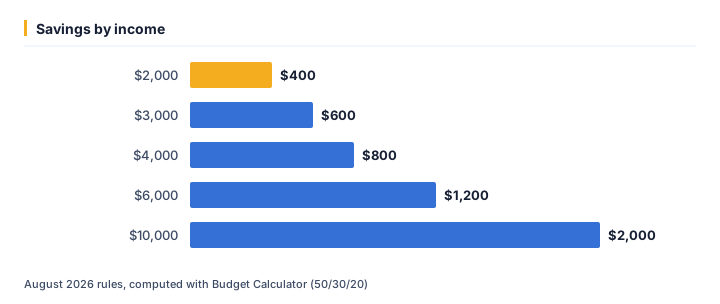
| 2,000 | 400 | 1,000 | 600 |
| 3,000 | 600 | 1,500 | 900 |
| 4,000 | 800 | 2,000 | 1,200 |
| 6,000 | 1,200 | 3,000 | 1,800 |
| 10,000 | 2,000 | 5,000 | 3,000 |
Running income from $2,000 up to $10,000 moves savings from $400 to $2,000 — a spread of $1,600. That gap is the part a single headline rate never shows.
The same runs seen through needs
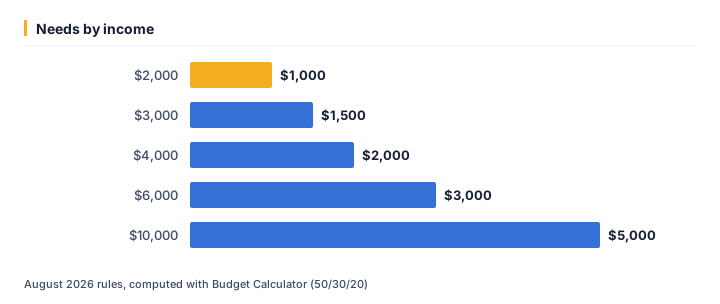
At $2,000, needs works out to $1,000; at $10,000 it is $5,000. Looking only at savings tends to understate how much the outcome shifts across that range.
One example, straight from the API
The middle row above (income = $4,000) is not a rounded illustration — it is exactly what /api/v1/tools/budget-calculator/calculate returns for that input, August 2026 rules:
{
    "tool": "budget-calculator",
    "inputs": {
        "income": 4000
    },
    "result": {
        "needs": 2000,
        "wants": 1200,
        "savings": 800
    }
}
Assumptions behind these figures
| Input | Value |
|---|---|
| Income | $4,000 |
| As of | August 2026 |
| Method | identical to /tools/budget-calculator |
Rates, thresholds and typical costs change over time; the numbers above are accurate as of August 2026, not a permanent guarantee. For your own situation, open the Budget Calculator (50/30/20) and enter your real numbers — the calculator runs the same code that produced every figure on this page.
Ready to crunch your numbers?
Open the Budget Calculator (50/30/20) and get an answer in seconds.
Editorial Team
We write plain-English money guides and build the free calculators behind them.