An emergency fund is a dedicated cash reserve — typically 3 to 6 months of essential expenses — held in a liquid, low-risk account specifically to absorb unexpected costs without going into debt. It's the foundation that makes every other financial decision more resilient.
An emergency fund sits at the foundation of every standard personal-finance framework, almost regardless of which guru, book, or institution is doing the recommending. The reason is mechanical: every other financial decision becomes more durable when you have a cash buffer between you and the next unexpected expense. Pay off debt aggressively? Possible only if the next car repair doesn't put you right back into debt. Invest in long-term equity markets? Possible only if you don't have to sell during a downturn to cover a job loss. The emergency fund is the structural piece that makes everything else work.
This guide explains exactly what an emergency fund is, how to size it, where to keep it, what counts as a real emergency, and how to build one from scratch.
The Definition
An emergency fund is a dedicated cash reserve, held in a liquid (easily withdrawable) and low-risk account, specifically intended to cover unexpected expenses or income disruptions without requiring debt or asset liquidation.
The four characteristics that distinguish it from "general savings":
Dedicated. The money has a single purpose: to absorb emergencies. It is not earmarked for vacation, a future house down payment, or holiday spending. Money with multiple potential uses tends to get used for the most attractive option, leaving the original emergency purpose unfunded.
Liquid. You can access it within 1-3 business days, ideally without penalty. This rules out CDs with early-withdrawal penalties, retirement accounts (which would trigger taxes and early-withdrawal penalties for most people), and illiquid investments.
Low-risk. The money is not subject to market volatility. You don't want to find your $20,000 emergency fund is worth $14,000 the week you need it because the stock market crashed. This rules out stocks, longer-duration bonds, cryptocurrency, and other volatile assets.
Pre-funded, not improvised. The fund exists before the emergency happens. Improvised borrowing during an emergency (credit cards, personal loans, 401(k) loans) is exactly what an emergency fund is designed to replace.
How Much You Actually Need
The standard recommendation across most US personal-finance frameworks is 3-6 months of essential expenses. The exact target depends on your specific situation:
3 months of expenses is generally appropriate for:
- Dual-income households (the second income provides additional buffer)
- Workers in stable, in-demand fields with strong job markets
- Households with limited fixed costs
- Households with significant additional safety nets (family help, etc.)
6 months of expenses is appropriate for:
- Single-income households
- Self-employed or contract workers with income variability
- Workers in specialized fields with longer job searches
- Households with multiple dependents
- Anyone in their 50s+ (job search timelines lengthen with age)
12 months of expenses is appropriate for:
- Highly specialized or executive-level workers (longest job searches)
- Households planning major life changes (parental leave, sabbatical, career pivot)
- Households in very-high-cost-of-living markets where small disruptions cascade
What counts as "essential expenses"? The expenses you'd have to pay even if you lost your income immediately:
- Rent or mortgage (principal + interest + property tax + insurance)
- Utilities
- Health insurance
- Basic groceries
- Essential transportation
- Minimum debt payments
- Insurance premiums
NOT included in "essential expenses" for emergency-fund sizing:
- Restaurant and entertainment spending
- Subscriptions
- Travel
- Most retirement contributions
- Vacation or hobby spending
- Discretionary shopping
For a typical US household, essential expenses run 60-75% of total monthly spending. A household spending $5,000/month total might have essential expenses of $3,500-$3,800/month — meaning a 3-month emergency fund target is $10,500-$11,400, and a 6-month target is $21,000-$22,800.
Use the Emergency Fund Calculator to size yours specifically. For a fuller treatment of the sizing question, see How Much Emergency Fund Do You Really Need?.
Where to Keep It
The right place to keep an emergency fund balances liquidity, safety, and modest yield:
High-yield savings account (HYSA). The standard recommendation. Online HYSAs from Ally, Marcus, Discover, SoFi, Capital One, and similar institutions currently pay 3.5-4.5% APY. FDIC-insured up to $250,000 per account holder. Funds typically transferable in 1-3 business days. This is the right answer for nearly every reader.
Money market account. Similar to HYSA but with check-writing or debit card access. Slightly more flexible at the cost of marginally lower interest. Acceptable but not generally preferred over HYSA.
Short-term CDs (CD laddering). A more advanced approach where you build a "ladder" of 6-month CDs maturing at different times, providing both higher yields and rolling liquidity. Adds complexity in exchange for modestly higher returns. Reasonable for larger emergency funds (>$30,000) where the yield difference matters.
NOT appropriate:
- Checking accounts (no meaningful yield)
- Stocks, bonds, or other invested assets (volatility risk)
- Retirement accounts (early withdrawal penalties + taxes)
- Cryptocurrency (extreme volatility)
- Cash hidden at home (no yield, theft/fire risk, not insured)
The combination most readers settle on: a dedicated HYSA, separate from regular checking, labeled "Emergency Fund" in their banking app. The labeling matters psychologically — money with a stated purpose is harder to spend on non-emergencies.
What Counts as an Emergency
This is the discipline question that determines whether the fund actually works. A few clear examples:
Real emergencies (use the fund):
- Loss of primary income (job loss, disability, business interruption)
- Major medical expense not covered by insurance
- Major car repair on the only car (replacing transmission, engine)
- Major home repair (furnace failure, water heater failure, roof leak)
- Required travel for genuine family emergency (death, hospitalization)
- Insurance deductible after an accident
- Required appliance replacement (only refrigerator dies)
Not emergencies (do not use the fund):
- Holiday gift spending
- Vacation
- A great deal on something you wanted to buy
- Tax bills you knew were coming
- Routine car maintenance
- Pet bills you've been postponing
- Wedding gifts or celebration costs
- Birthday or anniversary spending
- "I want to upgrade" purchases
The distinction is essentially: was this expense unexpected, urgent, and unavoidable? If yes, it's an emergency. If you saw it coming, or you have time to plan, or it's optional, it's not.
For predictable irregular expenses (annual car insurance, holiday spending, planned home repairs), the right tool is a sinking fund — a separate, purpose-labeled savings account that fills up monthly toward the known future expense. The emergency fund is for the unknown; the sinking fund is for the known-but-irregular. See Sinking Funds vs Emergency Funds for the full distinction.
How to Build One
If you have no emergency fund today, the standard build sequence is:
Phase 1: Starter buffer ($1,000). The first $1,000 absorbs the most common emergencies (60% of US emergencies cost under $1,000). Target: 60-90 days. See How to Save $1,000 Fast for the specific plan.
Phase 2: One month of expenses. After the starter buffer, expand to one full month of essential expenses (typically $3,500-$4,500 for a median US household). Target: 6-9 months from starting.
Phase 3: Three months of expenses. The middle target, typically $10,500-$13,500. Target: 12-18 months from starting.
Phase 4: Six months of expenses. The standard full target, typically $21,000-$27,000. Target: 24-36 months from starting.
Each phase produces real protection. The first $1,000 absorbs minor emergencies. The first month covers a brief income disruption. Three months handles most job-loss scenarios. Six months provides robust protection against extended disruption.
The mechanism for all phases is the same: automated transfer to a dedicated HYSA on the day after payday, treated as a non-negotiable expense. The amount scales up as income permits.
When to Use the Emergency Fund
A few practical guidelines:
Use it without guilt for real emergencies. The fund is doing its job when you use it. The psychological resistance to using it is real and counterproductive — the alternative is debt.
Don't try to "preserve" it. Some readers, having built a $20,000 fund, refuse to use it during a $3,000 emergency and instead take on a $3,000 credit card balance at 24% APR. This is mathematically wrong. The fund exists for exactly this purpose.
Replenish after use. After using the fund, the next priority becomes refilling it. The auto-transfer continues; additional cash flow goes to rebuilding until you're back at the target.
Don't constantly "borrow from yourself." A pattern of repeatedly drawing the fund down and refilling it suggests that what you're spending on isn't actually emergency. Track the uses; if a pattern emerges, those expenses probably belong in a sinking fund or your regular budget.
Common Mistakes
A few patterns worth avoiding:
Investing the emergency fund. "If I invest it at 7%, I'll earn $1,400/year on $20,000 instead of $700 at HYSA." True, but if the market drops 30% the week you need the money, you have $14,000 instead of $20,000 — costing you $6,000 to gain $700/year. The math favors HYSA for emergency funds.
Combining with other savings. "I'll keep my emergency fund and vacation savings in the same account." Money with multiple purposes gets used for the most attractive one — typically not the emergency. Keep funds dedicated and labeled separately.
Skipping the emergency fund for "investment opportunities." Some financial messaging suggests skipping the emergency fund in favor of investing more aggressively. This is mathematically defensible only if you have substantial other liquid assets (e.g., a brokerage account) that could function as an emergency fund in a pinch. For most readers, the dedicated emergency fund is the right answer.
Not having one at all. The most common mistake. Federal Reserve data shows that around 30-40% of US adults can't cover a $400 emergency without borrowing. The emergency fund is the single most important first step for these households.
Frequently Asked Questions
Should I pay off credit card debt before building an emergency fund? Most frameworks recommend building a $1,000 starter buffer first, then attacking high-interest debt aggressively, then building the full emergency fund. Reason: without any buffer, every emergency forces more debt, and you never escape the cycle.
Should I include retirement accounts in my emergency reserve? No. Retirement accounts (401(k), IRA) have early-withdrawal penalties (typically 10%) plus regular income tax for traditional accounts. Using them as emergency reserves costs 25-37% of the withdrawal. They are not appropriate emergency funds.
Can a HELOC serve as an emergency fund? Marginally. A Home Equity Line of Credit provides access to cash if needed, but at interest (currently 8-10%) and only if the housing market hasn't declined. As a backup to a real emergency fund, fine. As a primary emergency fund, inadequate.
How does an emergency fund relate to disability or life insurance? They complement each other. Disability insurance replaces income during long disabilities (3-6 months+); the emergency fund covers the gap before disability insurance kicks in (typical 90-180 day waiting periods). Life insurance replaces income for survivors after death; the emergency fund covers immediate post-death expenses.
What if my income is very irregular? Use a percentage rule for funding (10-15% of every deposit) and target the upper end of the recommended range (6-12 months instead of 3-6). Irregular income makes both the need for a buffer and the difficulty of funding it larger.
Do I need separate emergency funds for separate purposes? Usually not. One dedicated emergency fund covers all emergency uses. If you find yourself wanting to subdivide (e.g., "this $5,000 is for car emergencies, this $5,000 is for medical"), that's typically over-engineering — emergencies are interchangeable.
Next Steps
If you don't have an emergency fund:
- Open a dedicated high-yield savings account today (separate from your checking).
- Set up an automatic $100-$200 weekly transfer starting with your next paycheck.
- Target $1,000 in 90 days as the first milestone (see How to Save $1,000 Fast).
If you have a partial emergency fund:
- Use the Emergency Fund Calculator to determine your full target.
- Adjust your automatic transfer to reach the full target within 18-24 months.
- Once at the target, redirect the transfer to other goals (retirement, investing).
The emergency fund is the single most important first step in building durable financial security. Every other personal-finance decision works better when there's a buffer behind it. For the comprehensive sizing question, see How Much Emergency Fund Do You Really Need?, and for the step-by-step build to a 6-month fund, see How to Build a 6-Month Emergency Fund.
Run the numbers
Everything below came out of this site's own Savings Goal Calculator. The figures are not quoted from anywhere else: each row is one run of the same calculation the tool page performs, using August 2026 rules. Put the same inputs in and you will get the same output.
How the result moves with goal
We ran 5 values of goal through the calculator and left every other input at its default. As of August 2026, the output was:
| Goal ($) | Total contributions ($) | Interest earned ($) | Needed ($) |
|---|---|---|---|
| 5,000 | 3,651.45 | 348.55 | 4,000 |
| 7,500 | 6,008.61 | 491.39 | 6,500 |
| 10,000 | 8,365.77 | 634.23 | 9,000 |
| 15,000 | 13,080.09 | 919.91 | 14,000 |
| 25,000 | 22,508.72 | 1,491.28 | 24,000 |
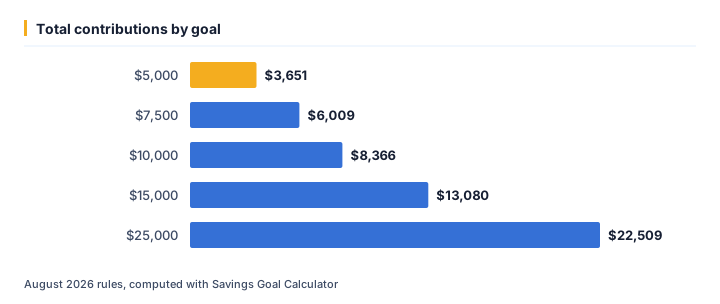
Running goal from $5,000 up to $25,000 moves total contributions from $3,651 to $22,509 — a spread of $18,857. That gap is the part a single headline rate never shows.
The same runs seen through interest earned
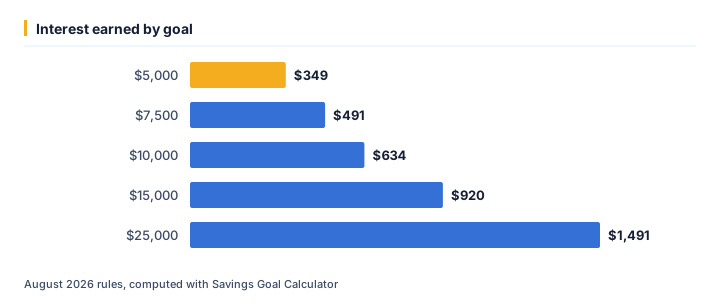
At $5,000, interest earned works out to $349; at $25,000 it is $1,491. Looking only at total contributions tends to understate how much the outcome shifts across that range.
One example, straight from the API
The middle row above (goal = $10,000) is not a rounded illustration — it is exactly what /api/v1/tools/savings-goal-calculator/calculate returns for that input, August 2026 rules:
{
    "tool": "savings-goal-calculator",
    "inputs": {
        "goal": 10000,
        "current": 1000,
        "years": 3,
        "rate": 4
    },
    "result": {
        "months": 36,
        "needed": 9000,
        "monthly_savings_required": 232.38,
        "total_contributions": 8365.77,
        "interest_earned": 634.23
    }
}
Assumptions behind these figures
| Input | Value |
|---|---|
| Goal | $10,000 |
| Current | $1,000 |
| Years | 3 years |
| Rate | 4% |
| As of | August 2026 |
| Method | identical to /tools/savings-goal-calculator |
Rates, thresholds and typical costs change over time; the numbers above are accurate as of August 2026, not a permanent guarantee. For your own situation, open the Savings Goal Calculator and enter your real numbers — the calculator runs the same code that produced every figure on this page.
Ready to crunch your numbers?
Open the Emergency Fund Calculator and get an answer in seconds.
Editorial Team
We write plain-English money guides and build the free calculators behind them.