Wealth is not a number you are born with — it is the predictable output of three levers you control: how much you earn, the share of it you keep, and how long you let it compound.
"Wealth" is one of those words that quietly intimidates beginners. It evokes inherited fortunes, executive bonuses, and lifestyles most of us will never see. The reality is much less dramatic, and much more achievable. Wealth, in any honest definition, is just the gap between what you own and what you owe — your net worth. And that number is the predictable output of three levers that almost every working adult can pull, even on a modest income.
This guide is the beginner's roadmap. It walks through what wealth actually is, the math behind how it grows, the sequence to follow if you are starting from zero, and the habits that turn one good year into thirty quietly compounding ones. No insider secrets, no get-rich-quick angles — just the durable playbook that ordinary people have used to retire with seven-figure net worths for the last hundred years.
What Building Wealth Actually Is
Income and wealth are easy to confuse. They are not the same thing.
Income is what you make in a year. Wealth is what you have kept and grown across all the years before this one. A surgeon making $400,000 a year who spends every dollar has zero wealth. A schoolteacher making $55,000 who saves 15% for 35 years can retire with $1.4 million. The headline is always income; the outcome is always wealth.
The mathematical name for wealth is net worth: total assets (cash, retirement accounts, brokerage accounts, home equity, vehicles, anything you own with resale value) minus total liabilities (mortgage, student loans, car loans, credit card balances, anything you owe). It is the single most honest number in personal finance because, unlike income or job title, it cannot be staged.
Compute yours today with the Net Worth Calculator. Write it down. The whole point of building wealth is moving this one number in the right direction year after year. You are about to see exactly how.
The Three Levers That Move Net Worth
Net worth growth comes from exactly three inputs. There is no fourth. Every wealth-building strategy you will ever read about — frugality, side hustles, real estate, index investing, FIRE — is some combination of these three:
- Income — how many dollars enter your life each month.
- Savings rate — the percentage of those dollars you keep instead of spending.
- Investment return — the rate at which your kept dollars grow on their own.
The interesting part is that they do not contribute equally at different life stages.
In your 20s, savings rate dominates. You don't have much yet, so a high savings rate compounds very quickly relative to your tiny starting base. A 25-year-old saving 20% of a $50,000 salary outpaces a 25-year-old saving 5% of a $90,000 salary, every time.
In your 30s and 40s, income becomes the lever that matters most. Your invested base is now large enough that absolute dollar contributions move it materially. A $20,000 raise that goes straight into investments, rather than into a bigger apartment, can shorten your working career by years.
In your 50s and 60s, investment return takes over. The base is large; small percentage moves swing big absolute dollars. A 10% market year on a $700,000 portfolio is a $70,000 boost — more than most people contribute in cash in a year.
The implication is practical: optimize the right lever for your decade. Beginners who try to "increase investment returns" by stock picking in their 20s are spending energy on the lever that matters least. Save more, earn more, leave the returns to a simple, broadly diversified portfolio.
The Beginner's Wealth-Building Sequence
Knowing the levers is theory. The practical question is: what do I actually do, in what order? Almost every personal finance educator converges on roughly the same sequence. Work through it top-down. Resist the temptation to skip ahead to the exciting parts.
Step 1: Build a $1,000 starter buffer
Before anything else, get $1,000 in a separate savings account labeled "Emergency Only." This is not your real emergency fund yet — it is the buffer that stops the next surprise car repair from becoming credit card debt. Most households can hit this number in 4–8 weeks with focused effort.
Step 2: Capture the full employer 401(k) match
If your employer matches 50% of contributions up to 6% of pay, contributing 6% earns an instant 50% return. There is no investment anywhere in the public markets that competes with that. If money is tight, do the match before any other priority. Free money is the highest-yielding asset you will ever own.
Step 3: Eliminate high-interest debt
Anything above roughly 7% — most credit cards (often 22%+), payday loans, some private student loans, some auto loans — is a wealth destroyer working in the opposite direction of your investments. A 22% credit card balance is, mathematically, a guaranteed 22% negative return.
You have two methods to choose from:
- Avalanche — highest interest rate first. Saves the most money mathematically.
- Snowball — smallest balance first. Builds momentum and motivation. The behavioral edge often beats the mathematical one.
Pick whichever you will actually finish. The best plan you stick with beats the perfect plan you abandon.
Step 4: Grow the emergency fund to 3–6 months of essential expenses
With high-interest debt gone, expand the buffer. Three months for dual-income households with stable jobs; six for single-income households, freelancers, or anyone with dependents. Park it in a high-yield savings account (HYSA) — not the brokerage, not your checking account. The point is durability, not yield.
Step 5: Invest 15% of gross income for retirement
Spread across 401(k) (especially up to the match), Roth IRA (excellent for younger savers in lower tax brackets), and a taxable brokerage if you have additional capacity. The default for almost every beginner: low-cost, broadly diversified index funds. Three-fund portfolios (total US stock, total international stock, total US bond) have outperformed most actively managed strategies over multi-decade horizons.
Step 6: Tackle other major goals
Down payment for a home. Funding a child's 529 college plan. Paying down a mortgage faster. A sabbatical. With steps 1–5 in place, these become tractable rather than overwhelming.
The whole sequence usually takes 5–10 years to fully cycle through. Many beginners get discouraged because they expect to be "done" in 18 months. Wealth building is not a sprint. It is a system you turn on and let run.
Where Time Beats Everything
The single most consequential math in adult life is compound interest. It is also the most under-appreciated, because compounding looks unimpressive for the first decade and then quietly explodes in years 20 through 40.
Here is the classic illustration. Three people each invest $300 a month into a low-cost index portfolio earning 7% annual real returns:
- Alex starts at 25, contributes for 10 years ($36,000 total), then stops.
- Blake starts at 35, contributes for 30 years ($108,000 total).
- Casey starts at 25, contributes for 40 years ($144,000 total).
At age 65, the balances look roughly like this:
- Alex: ~$372,000 (from $36,000 of contributions — a 10x return on dollars in)
- Blake: ~$367,000 (from $108,000 of contributions — about 3.4x)
- Casey: ~$739,000 (from $144,000 of contributions — about 5.1x)
Alex, who only contributed for one decade — but started 10 years earlier than Blake — ends up roughly tied with Blake despite putting in a third of the dollars. Time, not amount, did the heavy lifting.
Plug your own numbers into the Compound Interest Calculator and watch the same dynamic play out. The lesson is unambiguous: the dollar you invest today is worth far more than the dollar you invest 10 years from now. Start the engine early, even if it is small.
The Habits That Get You There
Wealth-building strategies fail less often from bad ideas than from interrupted execution. The habits below are what keep the sequence above on autopilot through the years when motivation dips.
Automate every transfer. Payday → automatic deposit into 401(k) → automatic transfer to IRA → automatic transfer to HYSA → whatever is left lands in checking. Money you never see, you never miss. Behavioral economists rank automation as the single highest-impact intervention in household finance.
Pay yourself first. Savings comes out of the paycheck before any spending decision is made — not from "whatever is left at the end of the month." There is never anything left at the end of the month. Make the savings transfer the day you get paid.
Bank every raise. When you get a 5% raise, increase your savings rate by 3% before adjusting your spending. Lifestyle inflation is the single biggest reason high-earners stay broke. Use the Salary Negotiation Calculator to see exactly how much a single raise, banked rather than spent, compounds to over a career.
Recompute your net worth quarterly. Fifteen minutes every three months. Watching the number move is what makes the abstract concept of wealth concrete and motivating. Use a spreadsheet or the Net Worth Calculator.
Set a savings rate, not a savings amount. Amounts get stale as income grows. A percentage stays meaningful. "I save 20% of every dollar I earn" is a more durable identity than "I save $700 a month."
Avoid lifestyle anchoring. Be very slow to commit to fixed monthly costs — bigger mortgage, leased luxury car, expensive private school — because they are extremely hard to reverse. Variable spending can flex with bad months. Fixed costs cannot. Keep your fixed-cost floor as low as your current life genuinely allows.
Common Wealth-Killers
A short tour of the patterns that quietly drain net worth, in rough order of frequency:
- Lifestyle inflation. Bigger house, nicer car, more subscriptions — every income bump absorbed by new fixed costs. The household never feels rich because the spending grows in lockstep with the earning.
- Carrying credit card balances. A 22% APR balance is a wealth-destroying machine. The math is brutal: $5,000 carried at 22% costs $1,100 a year just in interest. That is $1,100 not going into investments, every year, indefinitely.
- Buying too much house. The "house-poor" pattern. Mortgage, taxes, insurance, repairs, and utilities collectively push past 35% of take-home pay, leaving nothing for retirement contributions or emergencies.
- Trading individual stocks. A handful of beginners get lucky and tell loud stories. The majority underperform a basic index fund and pay short-term capital gains taxes on the trades. Multi-year studies show 80–90% of active traders underperform the market.
- Cashing out a 401(k) when changing jobs. Triggers income tax plus a 10% early withdrawal penalty, and erases decades of compounding on those dollars. Roll over to an IRA or new employer plan; never cash out unless the situation is genuinely catastrophic.
- No insurance, then a single bad event. One uninsured ER visit, one auto accident, one disability — and a decade of savings disappears. Insurance is the cheap, boring backstop that keeps the wealth-building engine intact.
- Lending big sums to family. Emotionally loaded, almost always damages both the finances and the relationship. If you cannot afford to gift it outright, you cannot afford to lend it.
You do not have to avoid all of these to build wealth. Avoiding any three or four of them puts you ahead of the typical American household.
Calculators to Track Your Progress
Building wealth becomes far less abstract when you can see the numbers move. These four calculators cover the core decisions:
- Net Worth Calculator — the master scoreboard. Run quarterly.
- Compound Interest Calculator — projects monthly contributions into 10-, 20-, and 30-year outcomes.
- Savings Goal Calculator — back into a monthly transfer from a target amount and date.
- Salary Negotiation Calculator — the highest-leverage tool of all, because earned income still feeds the entire system.
A useful annual ritual: every January, recompute net worth, increase savings rate by 1%, rebalance investments if needed, and update beneficiaries on every account. One hour, once a year. That hour is worth more than most full weeks of work.
Frequently Asked Questions
How much do I need to "be wealthy"? There is no universal threshold — it depends entirely on your annual expenses and life expectancy. A useful working definition is 25× your annual spending, the level at which a 4% withdrawal rate covers your life indefinitely. Someone living on $40,000 a year is functionally wealthy at $1 million; someone living on $120,000 a year needs $3 million.
What if I am starting late? The math gets tighter but the playbook is the same — and the savings rate lever becomes critical. A 45-year-old saving 30% of income for 20 years still retires with substantial assets, especially when catch-up contributions (available at 50+) come into play. Start now; the next ten years are still the second-best ten years to start.
Should I buy a house to build wealth? Home equity is part of net worth, but the financial case for buying versus renting is more nuanced than most assume. Rough rule of thumb: at least 5 years in the same home to break even on transaction costs (closing costs, agent fees, moving). Buy because you want to live there, not because "renting is throwing money away" — that aphorism ignores the equally real costs of maintenance, taxes, insurance, and opportunity cost on the down payment.
Real estate vs. index funds for wealth-building? Both have minted millionaires. Index funds are simpler, more liquid, and require near-zero ongoing time investment — the best fit for most beginners. Real estate has tax advantages and leverage but demands genuine effort (tenant management, repairs, vacancies). Most diversified wealth-builders use both; many use only index funds and do fine.
What about cryptocurrency, options trading, or other "high-growth" plays? Speculative assets are entertainment, not retirement. Cap them at 5% of investable assets and treat any losses as the cost of the lesson. The 95% that funds your real future belongs in low-cost, diversified index investments. Beginners are particularly vulnerable to speculative-asset pitches because the upside narrative is exciting. The math, across thousands of studied portfolios, has never supported it.
Do I need a financial advisor? For the basic playbook described here, no. A one-time consultation with a fee-only Certified Financial Planner (CFP Board directory) is genuinely valuable around major life events — marriage, kids, home purchase, inheritance, retirement — but ongoing 1% AUM relationships rarely pay for themselves in early- and mid-career years.
Next Steps
This week, do three things:
- Compute your net worth with the Net Worth Calculator. Write it down somewhere durable. You will refer back to this baseline for years.
- Project your current monthly contribution into the Compound Interest Calculator. See what 10, 20, and 30 years actually look like. Adjust the contribution upward until the 30-year number reaches your target retirement net worth.
- Automate one transfer that you currently do manually. Just one. Build the rest of the system around that single anchor.
Wealth, in the only sense that matters to working adults, is not a windfall. It is a sequence — buffer, match, debt, fund, invest, goals — applied patiently over decades, with most of the heavy lifting done by automation and time. The beginners who finish are not the smartest. They are the ones who quietly kept going after everyone else stopped paying attention. That can be you. The cost of starting today is nothing. The cost of waiting another year is meaningful, and gets worse every twelve months.
Run the numbers
Everything below came out of this site's own Savings Goal Calculator. The figures are not quoted from anywhere else: each row is one run of the same calculation the tool page performs, using August 2026 rules. Put the same inputs in and you will get the same output.
How the result moves with goal
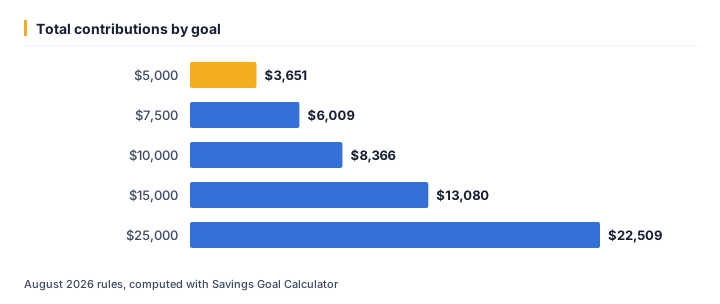
We ran 5 values of goal through the calculator and left every other input at its default. As of August 2026, the output was:
| Goal ($) | Total contributions ($) | Interest earned ($) | Needed ($) |
|---|---|---|---|
| 5,000 | 3,651.45 | 348.55 | 4,000 |
| 7,500 | 6,008.61 | 491.39 | 6,500 |
| 10,000 | 8,365.77 | 634.23 | 9,000 |
| 15,000 | 13,080.09 | 919.91 | 14,000 |
| 25,000 | 22,508.72 | 1,491.28 | 24,000 |
Running goal from $5,000 up to $25,000 moves total contributions from $3,651 to $22,509 — a spread of $18,857. That gap is the part a single headline rate never shows.
The same runs seen through interest earned
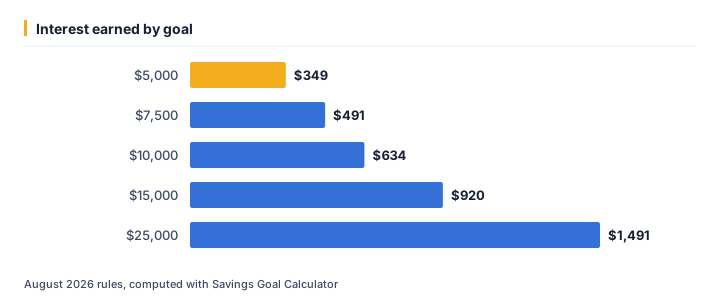
At $5,000, interest earned works out to $349; at $25,000 it is $1,491. Looking only at total contributions tends to understate how much the outcome shifts across that range.
One example, straight from the API
The middle row above (goal = $10,000) is not a rounded illustration — it is exactly what /api/v1/tools/savings-goal-calculator/calculate returns for that input, August 2026 rules:
{
    "tool": "savings-goal-calculator",
    "inputs": {
        "goal": 10000,
        "current": 1000,
        "years": 3,
        "rate": 4
    },
    "result": {
        "months": 36,
        "needed": 9000,
        "monthly_savings_required": 232.38,
        "total_contributions": 8365.77,
        "interest_earned": 634.23
    }
}
Assumptions behind these figures
| Input | Value |
|---|---|
| Goal | $10,000 |
| Current | $1,000 |
| Years | 3 years |
| Rate | 4% |
| As of | August 2026 |
| Method | identical to /tools/savings-goal-calculator |
Rates, thresholds and typical costs change over time; the numbers above are accurate as of August 2026, not a permanent guarantee. For your own situation, open the Savings Goal Calculator and enter your real numbers — the calculator runs the same code that produced every figure on this page.
Ready to crunch your numbers?
Open the Compound Interest Calculator and get an answer in seconds.
Editorial Team
We write plain-English money guides and build the free calculators behind them.