Saving and investing are not the same thing — and confusing them costs households real money in both directions. Here is when each is the right tool, and when crossing the line in either direction is a mistake.
Saving and investing get used as synonyms in everyday conversation, and the conflation is expensive. Money that should be saved (because it might be needed soon) sometimes ends up invested (and then gets sold at a loss at exactly the wrong moment). Money that should be invested (because the horizon is decades long) sometimes sits in a savings account losing purchasing power to inflation year after year. Both errors are common, and both quietly cost households tens or hundreds of thousands of dollars over a working life.
This guide draws the line clearly. It walks through what each tool is actually for, the single test that determines which to use, what belongs where for the most common financial goals, and the patterns that protect you from making the wrong call in either direction.
What Saving and Investing Actually Are
The distinction is simple to state and surprisingly powerful to apply.
Saving is setting money aside in a vehicle whose principal is guaranteed (or nearly so), accepting a low return in exchange for certainty and accessibility. Bank savings accounts, money market funds, short-duration Treasuries, certificates of deposit. The money you put in is the money you can pull out — adjusted for modest interest accrual and the slow erosion of inflation.
Investing is putting money into assets that fluctuate in value, accepting short-term volatility in exchange for a higher expected long-run return. Stocks, bonds, index funds, real estate, business equity. The money you put in is not the money you can pull out next week — it can be more, or less, depending on what the market has done in the meantime.
The key word in both definitions is exchange. Saving exchanges low return for high certainty. Investing exchanges high certainty for high expected return. Neither is universally better; they serve different jobs.
The One Test: Time Horizon
The single most useful filter for "should this money be saved or invested" is the question: how soon will I need it?
- 0–12 months: save. Volatility risk is too high for any window this short; even bonds can swing 5–10% in a year. Cash equivalents only.
- 1–3 years: save, in higher-yield vehicles. HYSA, money market fund, short-duration Treasuries. The horizon is still too short to absorb meaningful equity volatility.
- 3–5 years: mostly save, possibly with a modest conservative allocation. A 60/40 or 70/30 bond/stock mix is sometimes defensible if the goal has flex.
- 5–10 years: mixed; equity exposure becomes appropriate but the allocation should be more conservative than long-term retirement money. A 60/40 or 70/30 stock/bond portfolio.
- 10+ years: invest, heavily in equities. The historical record of 10+ year US equity returns is positive in nearly every starting window; volatility is offset by time.
The simplest version of the rule: money you might need in the next 5 years belongs in savings; money you will not need for 10+ years belongs in investments. The 5–10 year zone is judgment-dependent, but defaulting toward the saving side is conservative and acceptable.
What Goes in Each Bucket
Belongs in savings
- Emergency fund (3–6 months of expenses). The whole point is durable accessibility. Never invest the emergency fund.
- House down payment, if buying within 3 years. Lose 25% of your down payment in a market drop and you may delay home ownership by years.
- Wedding fund, if the wedding is in 1–2 years.
- Planned vacation, car purchase, or moving expense within 18 months.
- Tax money owed in the current or next quarter (for freelancers, business owners, anyone making estimated tax payments).
- An identifiable spending need within 12 months of any size or category.
The best home for short-horizon savings, as of 2026, is a high-yield savings account (HYSA) at an online bank. These pay rates competitive with short-term Treasuries, are FDIC-insured, and allow instant transfer back to checking. See High-Yield Savings vs Money Market vs CDs for the comparison of cash-savings vehicles.
Belongs in investments
- Retirement contributions (401(k), IRA, after-401k brokerage), assuming retirement is 10+ years away.
- College savings for young children (529 plans typically follow an age-based glide path that holds equities heavily when the child is young and shifts toward bonds as enrollment approaches).
- General wealth-building without a specific near-term goal — money you want to grow over decades for "future flexibility."
- A house down payment, if buying is 7+ years away.
- Any cash beyond the emergency fund and known near-term needs — there is no point letting it sit in an HYSA for ten years if it isn't earmarked for anything specific.
For most working-age investors, the right default investment vehicle is a low-cost, broadly diversified index fund. Three-fund portfolios (total US stock, total international stock, total US bond) have outperformed most actively managed strategies over multi-decade horizons. Expense ratios under 0.1%; rebalance annually; do nothing during market downturns except keep contributing.
When Each Crosses the Line
The two most common — and most expensive — mistakes happen at the boundaries.
Investing money that should be saved
Symptoms: house down payment held in stocks because "the market always recovers eventually." Emergency fund held in a brokerage because "savings accounts pay nothing." Wedding fund in an index ETF.
The math: in any 12-month window, the S&P 500 can drop 30%+ (it has, multiple times in recent decades). The market may indeed recover within 2–3 years, but if the money is needed in month 8 of the drop, the household either delays the goal or sells at a 30% loss. Both outcomes are worse than the 1–2% real return forfeited by leaving the money in cash.
The fix: a strict 5-year rule. Any money needed within 5 years lives in cash. The "yield" lost is the cost of certainty — and the certainty is the entire point.
Saving money that should be invested
Symptoms: $60,000 sitting in a checking or low-rate savings account for years, "in case I need it." Six-figure 401(k) match left uncaptured because "investing feels risky." A 30-year-old keeping all their long-term savings in an HYSA.
The math: $60,000 in cash, over 30 years, at 0% real return = $60,000 of purchasing power. The same $60,000 invested in a diversified equity portfolio at 7% real return = roughly $456,000 of purchasing power. The "safety" of cash over a 30-year horizon is an illusion — inflation guarantees substantial real losses, while equity volatility historically self-corrects within 5–10 years.
The fix: anything beyond the right-sized emergency fund + known near-term goals moves into investments. The right-sized emergency fund is enough — more cash beyond that is not extra safety, it is forgone wealth-building.
A Working Order for Most Households
The right sequence for most working-age US households, combining saving and investing decisions:
- $1,000 starter buffer in savings. Before any other goal. Stops the next surprise from becoming new debt.
- Employer 401(k) match captured. Investments; free money. Do this even mid-debt-payoff.
- High-interest debt elimination (above 7–8% APR). Neither saving nor investing competes with paying off 22% credit card debt.
- Full 3–6 month emergency fund in HYSA. Savings. The buffer that lets every other plan survive.
- Retirement contributions to 15% of gross. Investments. Diversified index funds in tax-advantaged accounts.
- Short-term goal funds (under 5-year horizon) in HYSA or money market. Savings.
- Long-term goal funds (10+ year horizon) in investments, typically tax-advantaged where possible (529, Roth IRA, brokerage).
The boundaries between steps are not bright lines. Step 4 and step 5 happen concurrently for many households once the high-interest debt and $1,000 buffer are out of the way. The order matters less than the categories — knowing which money is saving and which is investing, and not mixing them up.
Specific Vehicle Choices
A short guide to the right vehicle for each role.
For savings
- High-yield savings account (HYSA). Default choice. Online bank (Ally, Marcus, Capital One, SoFi, Wealthfront, others). FDIC insured. Instant electronic transfer. Rate roughly tracks short Treasuries.
- Money market fund. Available in any brokerage. Slightly higher yield than HYSA in some periods; very modest tradeoff in liquidity (settles in 1 business day).
- Short-term Treasury bills. 4-week, 13-week, or 26-week T-bills. Higher yield in some periods, exempt from state income tax. Slightly more friction to set up; treasurydirect.gov or any brokerage.
- I Bonds. Treasury savings bonds with rate tied to CPI inflation. $10,000 per person annual limit; 12-month lock-up; 5-year minimum hold to avoid losing the last 3 months of interest. Good for inflation protection on a portion of cash savings.
- CDs. Certificates of Deposit. Lock up funds for a specific term in exchange for a guaranteed rate. Less liquid; useful for funds genuinely not needed before the term ends. Build a CD ladder for staggered maturities.
For investing
- 401(k) / 403(b) / Roth 401(k). Capture employer match first; contribute up to the annual limit if budget allows.
- HSA (if eligible via high-deductible health plan). Triple tax advantage; the most tax-efficient account in the US system. Invest the balance once contributions are above the cash-buffer level.
- Roth IRA. Post-tax contribution, completely tax-free growth and withdrawal. Particularly powerful early in career when in a lower tax bracket.
- Traditional IRA. Pre-tax contribution if income permits the deduction; useful for some households not eligible for Roth.
- 529 plan. Tax-advantaged college savings. Age-based portfolios handle the saving-investing transition automatically as the child approaches college age.
- Taxable brokerage. Once the tax-advantaged accounts are saturated, additional investments live here. Long-term capital gains rates on growth.
The vehicle choices are not exotic. The right answers, for most people, are boring index funds in tax-advantaged accounts, plus an HYSA for the cash side. The path that delivers the best outcome for the largest number of households does not require any clever tactics.
Common Mistakes Beyond the Boundary Errors
- Switching between saving and investing on short-term market moves. "The market is up — I should be in stocks." "The market is down — I should be in cash." Neither response is right; the time horizon hasn't changed.
- Holding multiple savings vehicles for the same goal. One HYSA per goal is enough; multiple accounts at multiple banks for one purpose adds tracking complexity without benefit.
- Investing in single stocks instead of index funds. Active stock-picking underperforms low-cost indexes for the vast majority of investors over multi-decade horizons.
- Cashing out a 401(k) when changing jobs. Triggers income tax + 10% early withdrawal penalty; forfeits decades of compounding. Roll over to an IRA or new employer's plan.
- Pausing investing during market downturns. Exactly the wrong response. Continuing contributions during downturns buys more shares at lower prices — the dollar-cost averaging that drives long-term returns.
- Holding too much in a single employer's stock (concentration risk). Even if it's your own company. Diversification matters; concentration in any single stock has caused more "lost fortunes" than any other personal finance pattern.
Frequently Asked Questions
Should my emergency fund be invested for higher returns? No. The emergency fund's job is durable accessibility, not yield. Recessions cause layoffs (the most common emergency-fund use case) and recessions are also when equity markets are most likely to be down — exactly the wrong moment to be forced to sell. Keep it in cash equivalents.
What about saving in a Roth IRA contributions for emergencies? Roth IRA contributions (not earnings) can be withdrawn anytime tax- and penalty-free. Some households use this as a backup emergency layer. The tradeoff: once withdrawn, you can't recontribute beyond the year's limit, permanently shrinking your retirement tax-advantaged space. Use it as a last-resort secondary buffer, not a primary one.
What is the right stock/bond split for retirement investing? A common rule of thumb is "100 minus your age" in stocks, with the rest in bonds. Modern guidance often pushes more aggressive ("120 minus age" or even more stock-heavy in the early career years). For ages 20–40 with a 25+ year horizon, 80–90% stock is reasonable. For ages 50+, glide toward 60/40 or 50/50.
Is real estate saving or investing? A primary residence is partly both: forced savings (principal payments build equity) plus an illiquid investment in housing as an asset class. Investment property is unambiguously investing — and a different risk/return profile than diversified index funds. Treat them as separate categories in your overall financial plan.
What if my time horizon is uncertain? Bias toward saving. The cost of saving when you could have invested is some forgone return; the cost of investing when you should have saved is potential principal loss at exactly the wrong moment. Asymmetric downside argues for the more conservative tool when in doubt.
Are bonds "saving" or "investing"? Investing, technically — bond prices fluctuate. But high-grade short-duration bonds and short-term Treasuries behave close enough to cash that in practice they fit the "saving" use case. Long-duration bonds are unambiguously investing and have substantial price volatility.
How do I balance saving and investing when income is tight? Sequentially. Get the $1,000 starter buffer + employer match first (steps 1–2 above); then high-interest debt; then complete the emergency fund; then increase investing. Trying to do everything at once usually means progress on nothing.
Next Steps
- List every account you have and label each one Saving or Investing. Note any account that doesn't clearly fit one category. Many households discover dollars are sitting in the wrong place.
- Identify any saving dollars beyond the right-sized emergency fund and known 5-year goals. Those dollars belong in investments — move them within 30 days.
- Identify any investing dollars earmarked for a goal under 5 years away. Those dollars belong in savings — move them within 30 days as well.
The clarity of the framework matters more than getting it perfectly right on day one. A household that understands which money serves which purpose, and respects the boundary in both directions, will outperform the household that treats all dollars interchangeably — every time, over every horizon.
Run the numbers
Everything below came out of this site's own Savings Goal Calculator. The figures are not quoted from anywhere else: each row is one run of the same calculation the tool page performs, using August 2026 rules. Put the same inputs in and you will get the same output.
How the result moves with goal
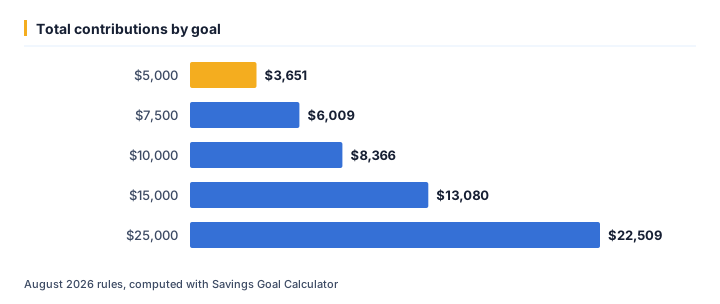
We ran 5 values of goal through the calculator and left every other input at its default. As of August 2026, the output was:
| Goal ($) | Total contributions ($) | Interest earned ($) | Needed ($) |
|---|---|---|---|
| 5,000 | 3,651.45 | 348.55 | 4,000 |
| 7,500 | 6,008.61 | 491.39 | 6,500 |
| 10,000 | 8,365.77 | 634.23 | 9,000 |
| 15,000 | 13,080.09 | 919.91 | 14,000 |
| 25,000 | 22,508.72 | 1,491.28 | 24,000 |
Running goal from $5,000 up to $25,000 moves total contributions from $3,651 to $22,509 — a spread of $18,857. That gap is the part a single headline rate never shows.
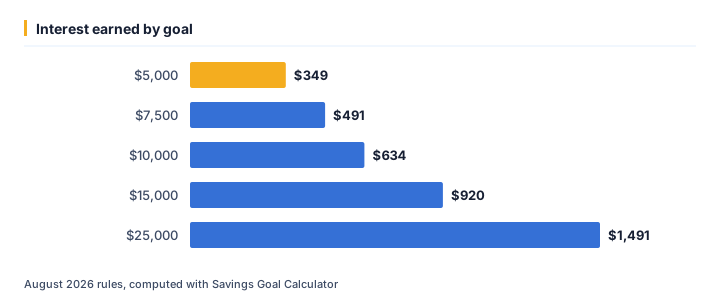
The same runs seen through interest earned
At $5,000, interest earned works out to $349; at $25,000 it is $1,491. Looking only at total contributions tends to understate how much the outcome shifts across that range.
One example, straight from the API
The middle row above (goal = $10,000) is not a rounded illustration — it is exactly what /api/v1/tools/savings-goal-calculator/calculate returns for that input, August 2026 rules:
{
    "tool": "savings-goal-calculator",
    "inputs": {
        "goal": 10000,
        "current": 1000,
        "years": 3,
        "rate": 4
    },
    "result": {
        "months": 36,
        "needed": 9000,
        "monthly_savings_required": 232.38,
        "total_contributions": 8365.77,
        "interest_earned": 634.23
    }
}
Assumptions behind these figures
| Input | Value |
|---|---|
| Goal | $10,000 |
| Current | $1,000 |
| Years | 3 years |
| Rate | 4% |
| As of | August 2026 |
| Method | identical to /tools/savings-goal-calculator |
Rates, thresholds and typical costs change over time; the numbers above are accurate as of August 2026, not a permanent guarantee. For your own situation, open the Savings Goal Calculator and enter your real numbers — the calculator runs the same code that produced every figure on this page.
Ready to crunch your numbers?
Open the Compound Interest Calculator and get an answer in seconds.
Editorial Team
We write plain-English money guides and build the free calculators behind them.