Net worth is the single most honest number in personal finance — assets minus liabilities, repeated quarter after quarter. Here is exactly how to compute yours, what to include, and how to read the trend.
If personal finance had to be reduced to a single number, it would be net worth. Income tells you how much money flows through your hands each year. Net worth tells you how much you actually have to show for it. And unlike income, it cannot be staged — there is no LinkedIn title, leased car, or expensive zip code that meaningfully changes it.
This guide walks through net worth from the ground up: what counts as an asset, what counts as a liability, how to handle the awkward middle cases (cars, jewelry, business equity), how often to recompute, and how to read the trend in ways that actually inform decisions.
What Net Worth Is and Why It Matters
The arithmetic is unintimidating: net worth = total assets − total liabilities. Everything you own at current resale value, minus everything you owe. The result is one number, in one currency, on one date.
Why this number matters more than almost anything else in personal finance:
- It is honest. Two households with identical $150,000 incomes can have wildly different net worths depending on what they have done with the income. Net worth measures the outcome, not the input.
- It moves. Unlike credit score, which fluctuates within a narrow band, net worth grows materially over years and decades — and watching the trend is the most direct signal that your financial habits are working.
- It compounds. Once net worth is positive and growing, investment returns alone can drive it forward even in years when your income is interrupted.
- It is the foundation for every other goal. Retirement readiness, financial independence, home ownership, generational wealth — all of these are expressed in net worth terms eventually.
The first time most people compute their honest net worth, they are surprised. Often pleasantly: 401(k) and home equity, summed together, are larger than expected. Occasionally unpleasantly: student loans, credit card balances, and depreciating auto loans on a relatively new vehicle add up to a negative number for some 20- and 30-somethings. Either result is useful information. You cannot improve a number you have not measured.
What Counts as an Asset
An asset, for net worth purposes, is anything you own that has a realizable cash value. The test: if you sold it next month, how much would actually land in your account? Use that number, not the price you paid or your emotional valuation.
Liquid assets
Cash and cash-equivalents — the dollars you could access today.
- Checking accounts
- Savings accounts (including the emergency fund — yes, it counts)
- Money market accounts
- High-yield savings accounts
- CDs and Treasury bills (use current value; for early-redemption CDs, subtract any penalty)
- Cash on hand (in a meaningful amount)
Investment assets
Anything held in a brokerage, retirement, or similar account, valued at current market price.
- 401(k) and 403(b) balances
- Traditional IRA and Roth IRA balances
- HSA balances
- Taxable brokerage accounts (current market value)
- 529 college savings plans (counts as your asset unless owned by a grandparent)
- Pension lump-sum values (if known) or estimated present value of expected pension payments
- Cryptocurrency holdings at current market price
For retirement accounts, use the gross current balance, not the after-tax value. There is a philosophical argument for using after-tax balances (since you cannot spend pre-tax 401(k) dollars without paying income tax), but the universal convention — and the convention most calculators and planners use — is gross.
Real estate
The fair market value of property you own, not the purchase price or the assessed property tax value. Use a credible recent comp (a similar nearby property that sold in the last 6 months) or a Zillow/Redfin estimate as a starting point, adjusted for known issues with your specific property.
For a primary residence with a mortgage, the asset and the liability go on opposite sides — the full market value is the asset; the remaining mortgage balance is the liability. The difference is "home equity," which equals your contribution to net worth from that single line.
Investment properties follow the same logic: market value on the asset side, outstanding mortgage on the liability side.
Vehicles
This is where many net worth calculations get sloppy. A car is an asset for net worth purposes, but its value depreciates fast and is rarely what owners assume. Use Kelley Blue Book or Edmunds for an honest current value, private-party sale rather than dealer trade-in (dealer trade is usually 10–20% lower than private). Update this number annually.
For most beginners' cars (3+ years old, average mileage), this number is much smaller than the original purchase price. A $35,000 SUV bought new four years ago is often worth $18,000–$22,000 today. That is the asset value, not $35,000.
Other tangible assets
A short list, with the test in mind: "would a stranger pay me this amount within 30 days?"
- Jewelry, art, collectibles — use resale value, which is typically 30–60% of retail price. Most beginners overestimate by 3–5×.
- Equity in a private business — use a defensible valuation, often 2–5× annual profit for small operating businesses. For pre-revenue or unprofitable businesses, the honest value is often $0 regardless of how much you have invested in it.
- Equity in startups (private company stock, RSUs, vested options) — use the most recent third-party valuation. Public company RSUs are easier: current market price × shares.
- Pending tax refunds, if substantial
- Whole life insurance cash value (term life insurance has no cash value and is not an asset)
What does not count
- Your earning potential or future income.
- Frequent flyer miles or credit card points (illiquid, hard to value, often expire).
- Furniture, clothing, household goods — these are real but their resale value is so close to zero, and so labor-intensive to extract, that personal finance convention treats them as $0.
- Stuff your in-laws may someday leave you.
What Counts as a Liability
A liability is any obligation requiring future payment from you. Use the current outstanding balance, not the original principal or the remaining payment count times payment amount.
Secured debt
Debt backed by collateral.
- Mortgage principal balance (not the remaining payments × payment amount — just the principal you currently owe)
- HELOC drawn balance
- Auto loan principal balance
- Other secured loans (RV, boat, etc.)
Unsecured debt
- Credit card balances (sum across all cards; use statement balance, not minimum payment)
- Federal and private student loan balances
- Personal loans
- Medical debt
- 401(k) loans — yes, technically these are loans against your own account. Count them on the liability side; otherwise you double-count.
- Buy-now-pay-later balances (Affirm, Klarna, Afterpay)
Tax obligations
- Outstanding tax bills owed
- Estimated tax liability on substantial recent income that has not yet been paid
What does not count as a liability
- Your monthly rent (until incurred). Rent is a future obligation that has not yet been billed.
- Subscription services you intend to keep.
- Insurance premiums coming up.
- Costs you anticipate but have not committed to.
Net Worth Calculation: Step by Step
The process, start to finish, takes about 30 minutes the first time and 10 minutes every quarter after that.
Step 1: Set a snapshot date
Pick a specific date — typically the last day of a quarter (March 31, June 30, September 30, December 31). Everything is valued as of that date. Mixing valuation dates is the most common beginner error.
Step 2: List assets
Open a spreadsheet or use the Net Worth Calculator. Create rows for every asset category with a current value. Use account statements as of the snapshot date for liquid and investment accounts; market-rate estimates for property and vehicles.
A sensible layout:
| Asset Category | Value |
|---|---|
| Checking | $4,200 |
| HYSA (emergency fund) | $18,500 |
| 401(k) | $87,000 |
| Roth IRA | $32,500 |
| Taxable brokerage | $14,200 |
| HSA | $6,800 |
| Home (market value) | $385,000 |
| Vehicle | $18,500 |
| Total assets | $566,700 |
Step 3: List liabilities
Same structure, opposite direction. Use account statements as of the snapshot date.
| Liability Category | Balance |
|---|---|
| Mortgage | $278,000 |
| Auto loan | $9,200 |
| Credit cards | $1,800 |
| Student loans | $14,500 |
| Total liabilities | $303,500 |
Step 4: Subtract
Total assets minus total liabilities. That is your net worth on this date.
In the example: $566,700 − $303,500 = $263,200.
Step 5: Record and store
Save the snapshot somewhere durable — a spreadsheet, a personal finance app, a one-line note in your calendar. The point is to be able to look back at the same number every quarter and see the trend. One snapshot is data; sixteen quarterly snapshots over four years are a story.
How Often to Recompute
Quarterly is the standard cadence for working adults. Monthly is too frequent — it creates pressure to optimize around short-term noise (market fluctuations, payday timing) rather than the underlying trend. Annually is acceptable but you lose granularity on what is actually working.
A useful ritual: on the first Sunday after each quarter ends, spend 15 minutes refreshing the numbers, comparing to the previous quarter, and noting which categories moved the most. Over time, the patterns become legible: investment contributions and market gains drive the asset side; debt paydowns drive the liability side; one-off events (bonus, inheritance, home value reassessment) show up as sudden spikes worth investigating.
For business owners, founders, or anyone with substantial private-company equity, recompute when there is a material valuation event (new funding round, business sale, equity grant). Otherwise quarterly.
Reading the Trend
Net worth in any single quarter is a snapshot. The trend across many quarters is the story. Two specific patterns are worth watching:
Are you adding to assets faster than to liabilities?
Some quarters, the picture looks great because asset values rose with the market. That is a windfall, not necessarily a sign of good behavior. The behavior-focused metric is the contribution number: how much did you add to investments and debt paydown this quarter, versus how much did the market do for you? In a strong market year, you can feel rich while doing nothing. In a weak market year, your contributions may not move the headline number at all. Both matter; do not confuse them.
Is the gap between assets and liabilities widening?
A household that grows assets from $100k to $200k while liabilities stay flat at $80k has done very well. A household that grows assets from $100k to $300k while liabilities also grew from $80k to $260k looks superficially similar in income but has barely improved net worth. Watch the gap, not just the asset side.
For target benchmarks by age, a popular (and rough) heuristic from The Millionaire Next Door:
Expected net worth ≈ (age × pre-tax income) / 10
A 35-year-old earning $80,000: expected net worth ≈ ($80,000 × 35) / 10 = $280,000. Above that benchmark and you are doing better than your income peers; below, and there is meaningful room. The heuristic is a directional check, not a prescription — it tends to be too aggressive for younger workers (most 25-year-olds are well below the line, and that is fine) and accurate-to-conservative for workers in their 40s and beyond. Use it as a sanity check, not a verdict.
Common Mistakes
- Overvaluing the house. Zillow and Redfin estimates can run 5–15% above realistic sale prices, especially in a softening market. Use a recent comp from your actual neighborhood, not the platform's auto-estimate.
- Overvaluing the car. Use private-party Kelley Blue Book, not the dealer trade-in or your gut feel.
- Forgetting to update. A net worth statement from 18 months ago is not a current net worth statement. Recompute quarterly.
- Mixing valuation dates. Pull every number as of the same snapshot date. A spreadsheet that uses March 31 for the brokerage and August 1 for the mortgage is not a net worth — it is a hybrid.
- Including future earnings or unrealized opportunities. Net worth is what you have now, not what you expect to have.
- Excluding 401(k) loans from liabilities. They are loans; include them.
- Including furniture and clothes. Resale value is near zero; the time required to extract it is large. Convention treats them as $0.
- Treating credit limit as a positive number. Available credit on a card is not an asset. Only the cash and investments are.
- Ignoring tax drag. For most cases, gross retirement account values are fine — but if you are within 5 years of retirement, computing a tax-adjusted net worth as a parallel number is informative.
Frequently Asked Questions
Should I use gross or after-tax retirement account values? For most people, gross. It is the universal convention, what calculators and planners use, and what makes year-over-year comparisons easy. Within 5 years of drawing retirement income, compute a parallel after-tax figure as a planning input — but keep the gross number as the primary one.
Is my emergency fund part of net worth? Yes. Emergency fund cash is an asset. The fact that it is "reserved" mentally does not change the math.
My partner and I keep separate finances. Whose net worth is whose? Compute individual statements (each person's own assets and liabilities) plus a combined household statement. For decisions about household financial trajectory (retirement, home purchases), household net worth is the relevant number. For individual decisions (career changes, gifts to family, individual debt strategy), individual net worth is more useful.
Is home equity "real" wealth? Yes — and no. It counts in net worth, and it is real in the sense that selling the house realizes the value. But it is illiquid (you cannot eat home equity) and it is not diversified. Households with high net worth concentrated in primary residence often look wealthier than their cash flow suggests; this is why retirement readiness uses liquid and investable net worth as separate metrics.
What is a "good" net worth for my age? Use the (age × income) / 10 heuristic as a directional sanity check, knowing it is too aggressive for early-career workers. More useful: track your own trajectory quarter over quarter. A 32-year-old with $50,000 net worth who is adding $20,000 a year is on a vastly better trajectory than a 32-year-old with $200,000 inherited net worth who is going sideways.
Does an annual bonus or RSU vest "count" before I receive it? For vested RSUs already in your account: yes, at current market value. For unvested RSUs or future bonuses: no — they are expected income, not current assets. Resist the temptation to include them; the only honest net worth is the one you would have if you stopped earning today.
How do I value a private business I own? Conservatively. For small operating businesses, 2–4× annual seller's discretionary earnings is a common rough valuation. For pre-revenue ventures, $0 — even if you have invested time and money into them. Recovering the value depends on a future sale that has not happened yet.
Next Steps
- Run the Net Worth Calculator using your current account statements. Spend 30 minutes; do it honestly.
- Save the snapshot somewhere durable. Add a calendar reminder to repeat it on the last day of next quarter.
- Identify the single asset and the single liability category that moved most over the last year. Decide whether the trend in each is what you want to continue.
The number you compute today is the starting point. The trend you build over the next ten years is the whole point. Net worth growth is one of those rare things in life where the formula is widely known, the math is simple, and the people who actually do it consistently end up dramatically ahead of the people who do not. That is the story you are about to write — quarterly snapshot by quarterly snapshot.
Run the numbers
Everything below came out of this site's own Budget Calculator (50/30/20). The figures are not quoted from anywhere else: each row is one run of the same calculation the tool page performs, using August 2026 rules. Put the same inputs in and you will get the same output.
How the result moves with income
We ran 5 values of income through the calculator and left every other input at its default. As of August 2026, the output was:
| Income ($) | Savings ($) | Needs ($) | Wants ($) |
|---|---|---|---|
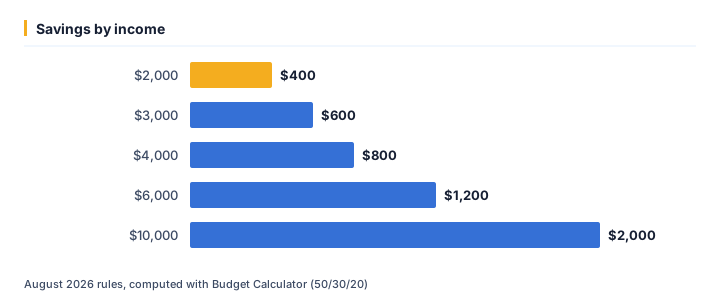
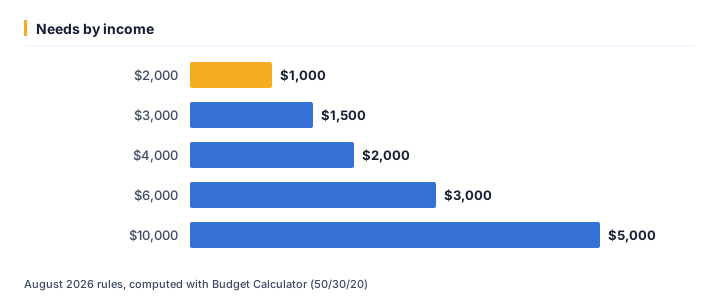
| 2,000 | 400 | 1,000 | 600 |
| 3,000 | 600 | 1,500 | 900 |
| 4,000 | 800 | 2,000 | 1,200 |
| 6,000 | 1,200 | 3,000 | 1,800 |
| 10,000 | 2,000 | 5,000 | 3,000 |
Running income from $2,000 up to $10,000 moves savings from $400 to $2,000 — a spread of $1,600. That gap is the part a single headline rate never shows.
The same runs seen through needs
At $2,000, needs works out to $1,000; at $10,000 it is $5,000. Looking only at savings tends to understate how much the outcome shifts across that range.
One example, straight from the API
The middle row above (income = $4,000) is not a rounded illustration — it is exactly what /api/v1/tools/budget-calculator/calculate returns for that input, August 2026 rules:
{
    "tool": "budget-calculator",
    "inputs": {
        "income": 4000
    },
    "result": {
        "needs": 2000,
        "wants": 1200,
        "savings": 800
    }
}
Assumptions behind these figures
| Input | Value |
|---|---|
| Income | $4,000 |
| As of | August 2026 |
| Method | identical to /tools/budget-calculator |
Rates, thresholds and typical costs change over time; the numbers above are accurate as of August 2026, not a permanent guarantee. For your own situation, open the Budget Calculator (50/30/20) and enter your real numbers — the calculator runs the same code that produced every figure on this page.
Ready to crunch your numbers?
Open the Budget Calculator (50/30/20) and get an answer in seconds.
Editorial Team
We write plain-English money guides and build the free calculators behind them.