A 30-minute, step-by-step walkthrough for calculating your honest net worth — pick a snapshot date, list every asset and liability, subtract, and set a quarterly reminder.
Most adults have never computed their honest net worth. They have a rough sense — maybe a 401(k) balance memorized, maybe a mortgage payoff figure they saw last December — but no single number on a single date that captures where they actually stand. That is the gap this guide closes.
The math is unintimidating: everything you own at realistic resale value, minus everything you owe. The result is one number, in one currency, on one date. It is the single most important number in personal finance, because no job title or zip code can fake it.
This is the 30-minute walkthrough. You will pick a snapshot date, gather statements, list every asset, list every liability, subtract, and save the result somewhere you can find next quarter. The first calculation is the hardest. After that it is about 15 minutes a quarter, forever.
What You'll Need
A spreadsheet makes the quarterly re-runs faster. Block 30 minutes and gather a few things.
- Statements (or live online access) for every bank, brokerage, retirement, and HSA account as of your chosen snapshot date
- Most recent statement for every loan: mortgage, auto, student, credit card, personal, medical
- A calculator, a spreadsheet (Excel, Google Sheets, Numbers), or the Net Worth Calculator on this site
- Your home's current market value, if you own — a Zillow or Redfin estimate adjusted for known issues, or a recent comparable sale
- Kelley Blue Book private-party value for each vehicle you own
- Roughly 30 quiet minutes, the first time through
If anything is missing, do the calculation anyway with reasonable estimates and refine next time. A first-draft net worth based on round numbers beats a perfect one that never gets computed.
Step 1: Pick Your Snapshot Date
Net worth is a point-in-time number, like a photograph. Every figure you record must reflect the same date. Pick one date, write it down, and use it for every account you touch.
The standard choice is the last day of a calendar quarter — March 31, June 30, September 30, or December 31. Quarter-ends line up with how brokerages issue statements, so you can pull official end-of-quarter values rather than approximating from a Tuesday in the middle of the month.
If you are starting mid-quarter, do not wait. Use yesterday's date and call that your baseline. You can re-baseline to the next quarter-end three months from now.
The common pitfall is mixing valuation dates — today's 401(k) balance, today's checking balance, then a mortgage payoff figure from January. That produces a meaningless number. If a balance is genuinely unavailable for your snapshot date, use the closest date you can verify and note it. Consistency beats precision.
Step 2: List All Your Assets
An asset is anything you own that has a realizable cash value. The test: if you sold it next month, how much would actually land in your account? Use that number, not the price you paid and not what you wish it were worth.
Work through the categories below in order. For each line item, record the dollar amount and the account or item it represents. Sum the category subtotals at the end.
Liquid assets
These are the dollars you could access today, with no penalty or significant time delay.
- Checking accounts (every one — including the joint account you forgot about)
- Savings accounts
- High-yield savings accounts (HYSA)
- Money market accounts
- Certificates of deposit (use current value; for CDs you would break early, subtract the penalty)
- Treasury bills and short-term Treasury funds
- Meaningful cash on hand — $50 in your wallet is not material; a $4,000 envelope is
Investment assets
Anything held in a brokerage, retirement, or college savings account, valued at current market price on your snapshot date.
- 401(k) and 403(b) balances
- Traditional IRA balances
- Roth IRA balances
- HSA balances (yes, the HSA counts — it is yours)
- Taxable brokerage accounts
- 529 plans (counts as your asset if you are the account owner)
- Crypto holdings at the snapshot-date market price, not what you paid
Use the gross current balance for retirement accounts, not the after-tax value. There is a reasonable argument for using after-tax balances, but the universal convention is gross. Pick a side and stay consistent across quarters.
Real estate
For each property you own, use a realistic market value — not the purchase price, not the tax assessment, and not Zillow's estimate alone. The cleanest approach:
- Pull the Zillow or Redfin auto-estimate as a starting point.
- Find one or two truly comparable sales within half a mile in the last 6 months.
- Adjust down for known issues specific to your property (deferred maintenance, dated kitchen, busy street).
- Round to the nearest $5,000.
The full market value goes on the asset side; the remaining mortgage balance goes on the liability side. The difference is your home equity.
Vehicles
This is where net worth math goes sideways most often. Owners remember what they paid and forget how fast cars depreciate. Use Kelley Blue Book private-party value for each vehicle, not dealer trade-in (which is typically 10–20% lower) and not the original sticker.
A $42,000 SUV purchased new three years ago is often worth $24,000–$28,000 today. That is the asset value. If the vehicle is leased, it does not belong on the asset side at all — you do not own it.
Other tangible assets
A short list with the test in mind: would a stranger pay you this amount within 30 days?
- Jewelry, art, collectibles — use resale value, typically 30–60% of retail
- Private business equity — value conservatively; if you are unsure, leave it off and add it back when you have a real offer or appraisal
- Vested RSUs — at the current market price of the underlying stock
- Unvested RSUs — leave off until they vest (they are not yours yet)
Total your assets. Set the number aside.
Step 3: List All Your Liabilities
A liability is any outstanding obligation you owe to someone else. Use the most recent statement balance for each, as close to your snapshot date as possible.
Secured debt
Debt backed by an asset that the lender can repossess if you stop paying.
- Mortgage on your primary residence — current outstanding principal, not the original loan amount
- Mortgages on investment or vacation properties
- HELOC balance (only the drawn amount counts; an unused HELOC limit is not a liability)
- Auto loans — current payoff balance, not the sum of remaining payments
Unsecured debt
Debt not tied to a specific asset. Statement balance is what counts — not the minimum payment, not the credit limit.
- Credit card statement balances (every card, even ones you "pay off every month" — whatever the snapshot-date balance is)
- Student loans — federal and private, current outstanding principal
- Personal loans
- Medical debt, including bills in collections
- Buy Now, Pay Later balances (Affirm, Klarna, Afterpay) — easy to forget, but still real debt
- 401(k) loans — these count as a liability against your net worth, even though you owe yourself
Tax obligations
Often overlooked, and sometimes large.
- Outstanding balances owed to the IRS or state on prior tax years
- Estimated taxes accrued but not yet paid (for self-employed and freelancers)
- Property taxes due but not yet paid, if material
Total your liabilities. You now have the two numbers you need.
Step 4: Subtract and Record
Net worth = total assets − total liabilities. Do the subtraction. Write the number down with the snapshot date next to it.
Here is a worked example with rounded illustrative numbers:
| Category | Amount |
|---|---|
| Liquid assets | $18,400 |
| Investment assets (401(k), Roth IRA, brokerage) | $112,000 |
| Home market value | $385,000 |
| Vehicle (KBB private-party) | $19,500 |
| Total assets | $534,900 |
| Mortgage balance | $268,000 |
| Auto loan balance | $11,200 |
| Credit card statement balances | $2,400 |
| Student loans | $24,300 |
| Total liabilities | $305,900 |
| Net worth (snapshot: Sep 30) | $229,000 |
Save the snapshot somewhere durable — a dedicated spreadsheet tab, a note in your password manager, a permanent line in a personal finance app. The whole exercise is wasted if next quarter you cannot find what this number was.
Step 5: Set the Quarterly Reminder
Open your calendar right now and set a recurring reminder for the next four quarter-ends: roughly April 1, July 1, October 1, and January 1, whichever comes next. Label it "Net worth update." Block 20 minutes.
Quarterly is the standard cadence and it is not arbitrary. Monthly is too frequent — markets move enough day to day that monthly snapshots add noise. Annually is too rare — the habit decays, and one data point per year does not show a trend. Four points a year is enough to catch a problem while it is still small.
What matters more than any single snapshot is the trend across snapshots. Plot four quarters on a simple line chart and you will learn more about your finances in 10 seconds than in any other exercise of comparable effort.
A Worked Example: 33-Year-Old Single Professional
Consider a hypothetical reader named Priya, a 33-year-old single software engineer in a mid-cost city. Her September 30 snapshot looks roughly like this.
Assets:
- Checking: $4,200
- HYSA (emergency fund): $22,000
- 401(k): $96,500
- Roth IRA: $31,400
- HSA: $6,800
- Taxable brokerage: $14,000
- Condo (market value, adjusted comps): $340,000
- Honda Civic (KBB private-party, 4 years old): $14,500
Total assets: $529,400
Liabilities:
- Mortgage balance on condo: $251,000
- Auto loan: $0 (paid off last year)
- Credit cards (statement balance, paid in full monthly): $1,800
- Federal student loans: $18,400
Total liabilities: $271,200
Net worth: $529,400 − $271,200 = $258,200
A useful interpretation: about $89,000 of that is home equity, about $148,700 is investment assets, and the remaining $20,500 is liquid cash net of student loans and credit card balance. Investment assets exceed home equity, which is a healthy ratio at this age. The next quarterly snapshot will show whether contributions and market movement are growing the investment side faster than the mortgage is paying down. Knowing which is winning is the point.
What to Do With the Number
The number itself is the starting line, not the finish. A few productive things to do with it:
Track quarterly and plot the trend. Four data points a year tell you direction — up and to the right is the goal. Single snapshots can mislead, especially in volatile market quarters.
Compare against a rough benchmark. A common heuristic is (age × pre-tax income) / 10. So a 35-year-old earning $90,000 should target a net worth of roughly $315,000. This is rough, it ignores cost-of-living differences and student loan timing, and it should not become a source of stress — but it is a useful directional check.
Identify the single highest-leverage move for next quarter. Not five moves. One. Maybe it is increasing 401(k) contributions by 2%. Maybe it is paying down the highest-rate credit card to zero. Maybe it is finally refinancing the auto loan. Pick the one move with the biggest expected impact on the next snapshot, and act on it this week.
For decisions that meaningfully affect your trajectory — buying a home, restructuring debt, choosing between Roth and traditional contributions — consider working with a Certified Financial Planner. The CFP Board's directory at letsmakeaplan.org is a reasonable starting point.
Common Mistakes to Avoid
- Overvaluing the house. Using the Zillow auto-estimate without adjusting for known issues, or using a peak-of-market value from two years ago. Be conservative.
- Overvaluing the car. Using purchase price, MSRP, or dealer asking price instead of KBB private-party value. Most three-year-old vehicles are worth far less than owners assume.
- Mixing valuation dates. Today's 401(k) balance, last month's checking balance, and last year's mortgage payoff figure added together is not a snapshot.
- Forgetting to recompute. A one-time calculation is a curiosity; a quarterly series is a financial dashboard. The trend is the point.
- Including furniture, clothes, and household goods. They have almost no resale value within 30 days. Leave them off.
- Excluding 401(k) loans. A loan from your own retirement account is still a liability — you owe the balance back to the account, with interest.
- Counting unvested RSUs or future bonuses. They are not yours yet. Count them when they vest or hit your account.
- Listing the credit card limit instead of the balance. Only the actual statement balance owed is a liability.
Frequently Asked Questions
Should I use gross or after-tax retirement account values? Use gross — that is, the current balance shown on the statement, without adjusting for future income tax. It is the universal convention. If you want a more conservative view, you can compute a separate "after-tax estimated" net worth, but make your headline number the gross figure so it is comparable to most published benchmarks.
Does my emergency fund count? Yes. It is cash you own. The fact that it is mentally earmarked for emergencies does not change its asset value. Include it under liquid assets at full balance.
How often should I update? Quarterly is the standard. Monthly adds noise without much signal; annually is too infrequent to catch problems early. Four data points a year is the sweet spot.
Is home equity "real" wealth? Mostly yes — but with caveats. It counts at full value, but you cannot spend it without selling, refinancing, or borrowing against the home. A net worth that is 90% home equity is meaningfully less flexible than one that is 30% home equity. Track the composition, not just the total.
What if my spouse and I keep separate finances? Compute each of yours individually first, then add them together for a household number. Both numbers are useful — the individual figures show personal trajectories, and the household number is what matters for major joint goals like retirement and housing.
What's a good net worth for my age?
The rough heuristic (age × pre-tax income) / 10 is a directional benchmark, not a rule. Median US net worth by age is also useful context (and widely available), but median is heavily skewed by home equity and varies enormously by region. The most useful comparison is your own number a year ago.
Next Steps
Do these three things this week, in order.
-
Run the calculation today. Open the Net Worth Calculator and walk through every category in this guide. Save the result somewhere durable. If you hit a missing balance, fill it in tomorrow rather than abandoning the exercise.
-
Set the quarterly reminder. Add a recurring calendar event for the next quarter-end, labeled "Net worth update," with a 20-minute block.
-
Identify one move for next quarter. Based on this snapshot, pick the single highest-leverage change you can make in the next 90 days — increase a contribution, pay down a card, refinance a loan. Use the Compound Interest Calculator to model the long-term effect of changes to savings rates, or the Budget Calculator to find the cash flow to fund the change.
If you want the deeper, theory-heavier companion, the step-by-step net worth guide covers the same ground with more rationale. Re-run the Net Worth Calculator every quarter and watch the trend. The number you write down today is the most useful single data point in your financial life — and the second most useful is the one you write down next quarter.
Run the numbers
Everything below came out of this site's own Budget Calculator (50/30/20). The figures are not quoted from anywhere else: each row is one run of the same calculation the tool page performs, using August 2026 rules. Put the same inputs in and you will get the same output.
How the result moves with income
We ran 5 values of income through the calculator and left every other input at its default. As of August 2026, the output was:
| Income ($) | Savings ($) | Needs ($) | Wants ($) |
|---|---|---|---|
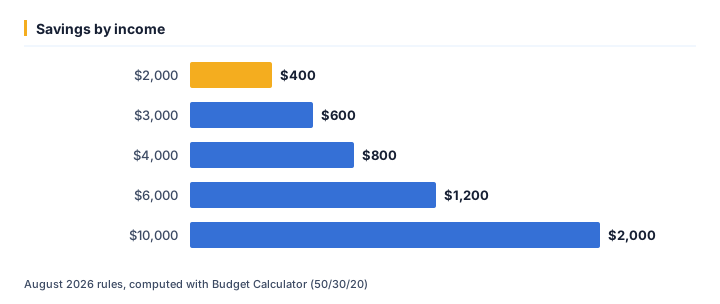
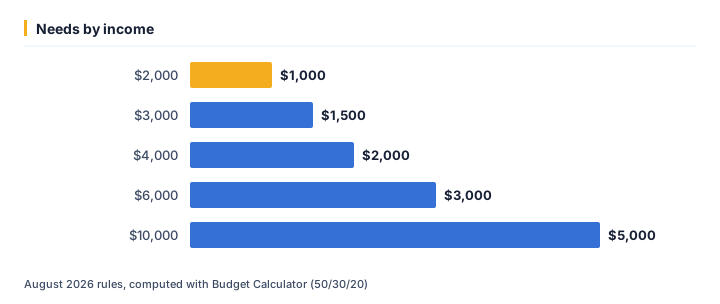
| 2,000 | 400 | 1,000 | 600 |
| 3,000 | 600 | 1,500 | 900 |
| 4,000 | 800 | 2,000 | 1,200 |
| 6,000 | 1,200 | 3,000 | 1,800 |
| 10,000 | 2,000 | 5,000 | 3,000 |
Running income from $2,000 up to $10,000 moves savings from $400 to $2,000 — a spread of $1,600. That gap is the part a single headline rate never shows.
The same runs seen through needs
At $2,000, needs works out to $1,000; at $10,000 it is $5,000. Looking only at savings tends to understate how much the outcome shifts across that range.
One example, straight from the API
The middle row above (income = $4,000) is not a rounded illustration — it is exactly what /api/v1/tools/budget-calculator/calculate returns for that input, August 2026 rules:
{
    "tool": "budget-calculator",
    "inputs": {
        "income": 4000
    },
    "result": {
        "needs": 2000,
        "wants": 1200,
        "savings": 800
    }
}
Assumptions behind these figures
| Input | Value |
|---|---|
| Income | $4,000 |
| As of | August 2026 |
| Method | identical to /tools/budget-calculator |
Rates, thresholds and typical costs change over time; the numbers above are accurate as of August 2026, not a permanent guarantee. For your own situation, open the Budget Calculator (50/30/20) and enter your real numbers — the calculator runs the same code that produced every figure on this page.
Ready to crunch your numbers?
Open the Budget Calculator (50/30/20) and get an answer in seconds.
Editorial Team
We write plain-English money guides and build the free calculators behind them.