New York City and Los Angeles both rank in the top tier of US cost-of-living rankings, but the structure of the cost is meaningfully different: NYC is more rent-heavy, LA is more car-dependent and grocery-heavy. The choice depends as much on lifestyle as on raw dollar amounts.
New York and Los Angeles consistently rank among the most expensive US cities to live in, and the comparison between them is one of the most-searched cost-of-living questions in American personal finance. The honest answer is that they're roughly comparable in total cost — but the structure of the cost is meaningfully different, and which one is more expensive for you specifically depends on your lifestyle, neighborhood choices, and household composition.
This guide breaks down the major categories where the two cities differ, the categories where they're surprisingly similar, and how to think about the comparison for your specific situation.
The Headline Comparison
A typical US household budget in each city (mid-range neighborhood, professional employment, no children for simplicity):
| Category | New York City (Manhattan/Brooklyn) | Los Angeles (Westside/East Side) |
|---|---|---|
| Rent (1BR apartment) | $3,400/month | $2,650/month |
| Utilities | $180/month | $220/month |
| Transportation | $130/month (subway) | $750/month (car) |
| Groceries (single person) | $480/month | $520/month |
| Restaurants (moderate) | $700/month | $750/month |
| Healthcare (post-tax premium) | $250/month | $250/month |
| Phone | $80/month | $80/month |
| Streaming/subscriptions | $80/month | $80/month |
| Subtotal (essential + moderate discretionary) | $5,300/month | $5,300/month |
The headline number ends up surprisingly close. NYC's housing premium is largely offset by LA's transportation premium. The two cities cost approximately the same for a typical professional household — but the experience of the spending is very different.
For your specific household budget across cities, use the Budget Calculator with adjusted local cost assumptions.
Where the Costs Genuinely Differ
Rent: NYC Wins (Most Expensive) by 25-40%
Rent is by far the largest category gap between the two cities. Detailed comparison:
| Apartment Type | NYC (Median Rent) | LA (Median Rent) | NYC Premium |
|---|---|---|---|
| Studio | $2,800/month | $1,850/month | +51% |
| 1BR | $3,400/month | $2,650/month | +28% |
| 2BR | $4,700/month | $3,650/month | +29% |
| 3BR | $7,200/month | $5,400/month | +33% |
Manhattan specifically is more expensive than Brooklyn, Queens, or the Bronx. A 1BR in Manhattan averages $4,200-$4,800; the same apartment in Brooklyn averages $3,000-$3,400; in Queens, $2,400-$2,800.
LA's expensive neighborhoods (Santa Monica, Venice, West Hollywood, Beverly Hills) approach NYC pricing. A 1BR in Santa Monica or West Hollywood often runs $3,200-$4,000. A 1BR in mid-tier neighborhoods like Silver Lake or Mid-Wilshire runs $2,400-$2,800. A 1BR in further-out neighborhoods (Sherman Oaks, Pasadena, East LA) runs $1,800-$2,400.
The aggregate result: NYC rent is meaningfully higher, but the gap narrows substantially if you're willing to live in outer-borough NYC vs westside LA.
Transportation: LA Wins (Most Expensive) by Far
NYC's public transit system makes car ownership functionally optional for most residents. LA's geography requires a car for most realistic lifestyles. This single difference creates the biggest cost-structure gap between the cities.
NYC monthly transportation costs (typical):
- MetroCard / OMNY unlimited monthly: $132
- Occasional taxi/rideshare: $50-$150
- Total: ~$130-$280/month
LA monthly transportation costs (typical, including car ownership):
- Car payment (5-year loan on $30,000 vehicle): $560/month
- Auto insurance (LA premium rates): $200-$300/month
- Gasoline (12,000 mi/year × $3.30): $110/month
- Maintenance, registration, parking: $80-$150/month
- Total: ~$750-$1,100/month
The LA car premium is approximately $550-$700/month more than NYC's transit cost — about $7,000-$8,400 per year of additional expense. This is the single largest cost difference between the cities for a typical professional household and it largely offsets NYC's housing premium.
NYC residents who do own cars face high parking costs ($300-$700/month for a garage spot in Manhattan, $100-$300/month in outer boroughs) and traffic that makes car use impractical for daily commuting. LA residents who try to live car-free face limited transit coverage (the LA Metro system exists but doesn't cover most neighborhoods comprehensively) and longer commute times via rideshare.
Groceries: LA Slightly Higher by ~10%
LA grocery prices are modestly higher than NYC's, partly due to LA's distance from major agricultural distribution hubs (NYC benefits from being closer to East Coast agriculture and major import points).
Typical single-person monthly grocery costs:
- NYC: $440-$520
- LA: $480-$580
- Premium: LA +8-12%
Categories where LA is notably more expensive: dairy products, packaged goods, certain produce items.
Categories where NYC is more expensive: alcohol (NY state taxes), certain imported specialty items.
For households eating at home most days, the LA grocery premium adds approximately $50-$100/month over NYC.
Restaurants: Roughly Equal, with Pricing Differences
The headline numbers for typical mid-range restaurant spending are similar, but the experience differs:
NYC restaurant scene: Higher density, more diversity per square mile, generally higher tipping convention (20-22% is more often expected vs 18-20% in LA), more pressure on dollar amounts per meal in trendy areas.
LA restaurant scene: More casual dining culture, higher emphasis on outdoor seating and quality of life around dining, slightly lower tipping pressure, more drive-through and casual options that make eating out less expensive.
A "moderate" restaurant meal in NYC averages $28-$35 per person; the same meal in LA averages $26-$32. Total monthly restaurant spending for typical professional households is comparable at $600-$900.
Utilities: LA Slightly More Expensive
Utilities are roughly similar but slightly higher in LA due to:
- Air conditioning costs (LA's air conditioning needs in summer exceed NYC's heating costs in winter for many households)
- Higher water bills (LA's drought-related rate structures)
Typical monthly utilities:
- NYC: $150-$220 (electric, gas, water, internet)
- LA: $200-$260 (electric, gas, water, internet)
- LA premium: ~$30-$50/month
State and Local Tax Comparison
Tax differences are significant and often overlooked in cost-of-living comparisons.
| Tax Type | New York (City + State) | California (State + LA) |
|---|---|---|
| State income tax (top marginal) | 10.9% | 13.3% |
| City income tax | NYC: ~3.9% | LA: 0% |
| Combined income tax (effective for typical professional) | ~10-13% | ~9-12% |
| Sales tax | 8.875% | 9.5% |
| Property tax (effective rate) | ~0.9% NYC | ~0.7% LA |
For a typical professional earning $100,000 salary:
- NYC state + city income tax (combined): ~$10,500-$11,500
- LA state income tax: ~$7,500-$8,500
NYC's combination of state + city income tax adds approximately $2,500-$3,000 in annual taxes vs LA, for the same gross income.
This is a real and underappreciated difference. A $100,000 salary in NYC has effective take-home of approximately $63,000-$66,000; the same salary in LA has effective take-home of approximately $65,000-$68,000.
Income to Match the Cost of Living
A useful exercise: what salary do you need to live equivalently in each city?
For a "comfortable but not luxurious" lifestyle (1BR apartment in mid-tier neighborhood, regular restaurants, moderate discretionary spending, ability to save 15% of income):
NYC: $85,000-$105,000 gross salary LA: $80,000-$100,000 gross salary
For a "very comfortable" lifestyle (better apartment, frequent dining out, regular travel, save 20%+):
NYC: $135,000-$170,000 gross salary LA: $130,000-$160,000 gross salary
For "high quality of life with significant savings rate" (better neighborhood, financial cushion, family-friendly options):
NYC: $200,000+ gross salary (often requires dual income or partnership in firm) LA: $185,000+ gross salary (often requires dual income or partnership in firm)
The income thresholds are similar within 5-10%, with NYC slightly higher due to combined housing + tax premium.
If you're negotiating a salary or considering a city move, use the Salary Negotiation Calculator to model the equivalent salary across markets.
Lifestyle Differences That Affect Cost
The pure cost comparison misses several lifestyle factors that change how the cities feel:
NYC subway dependence reduces transportation flexibility but eliminates parking and car maintenance hassles. This is a quality-of-life trade-off, not just a cost one.
LA's space allows larger apartments, outdoor access, and yard space at lower per-square-foot prices. A $2,500 LA apartment may be 800-1,000 sq ft with parking; the equivalent NYC apartment may be 500-600 sq ft without parking.
NYC's high density enables more spontaneous social life and walking-distance options. LA's geography requires more planning for socialization and access.
Healthcare costs are similar but access patterns differ. Both cities have abundant medical resources; specific insurance networks matter more than city choice.
Climate impact on costs. LA's mild climate reduces heating costs (almost zero) but increases cooling costs (significant in summer). NYC has high heating costs in winter, modest cooling needs in summer.
When to Choose NYC vs LA
The cost comparison alone shouldn't drive the city choice — both are at the top of US cost rankings. Some lifestyle indicators of which city better fits which person:
Choose NYC if you value: Public transit reliability, walking-based daily life, density and proximity, finance / tech / creative industry concentration, museums and cultural institutions per square mile.
Choose LA if you value: Larger living space at lower per-square-foot cost, outdoor lifestyle and weather, entertainment industry access, slightly lower tax burden, car-based lifestyle.
Cost-wise, they're approximately equivalent. The decision should be based on lifestyle fit, career opportunity, and family considerations — not the marginal cost difference between them.
Frequently Asked Questions
Is NYC really more expensive than LA overall? Marginally, by 5-10% for typical professional households. The housing premium in NYC is largely offset by LA's transportation premium. The two cities are closer in total cost than the rent comparison alone suggests.
Can I live in NYC without a car? Yes — in fact, most Manhattan and Brooklyn residents don't own cars. The subway system covers most of the city well enough that car ownership is functionally optional and often more expensive than convenient.
Can I live in LA without a car? In limited geographies (downtown LA, Santa Monica, Hollywood with specific commute patterns), partially. For most LA residents, a car is functionally required for full lifestyle access. Some areas have improving Metro coverage.
Which city has better schools? Both have varied school quality. NYC has more competitive public school programs (specialized high schools). LA has stronger ratings in suburban areas of LA County (Pasadena, Manhattan Beach, etc.). For families, school district choice is often more important than city choice.
Are taxes really that different? Yes. The NYC city income tax (3-3.9% on top of state) is unique among major US cities. A $100,000 NYC salary has approximately $2,500 more in income tax than the same salary in LA. Over a career, this adds up to substantial dollars.
How does cost of living in NYC vs LA compare to other US cities? Both are in the top tier of US cost-of-living rankings, with San Francisco typically the only consistently more expensive major city. Mid-cost cities like Austin, Denver, or Atlanta typically run 40-60% less expensive than NYC/LA for similar lifestyle quality. See Cost of Living Comparison Across U.S. Cities for the broader picture.
Next Steps
If you're considering a move between NYC and LA, or between either city and a lower-cost market:
- Use the Budget Calculator to model your specific budget against the cost categories that differ most.
- Calculate the salary equivalent you'd need in each city to maintain your current quality of life.
- Factor tax differences (NYC's city tax is a significant ongoing cost vs LA).
- Consider the lifestyle structure — which spending pattern (rent-heavy NYC vs car-heavy LA) better fits your priorities.
The cost-of-living comparison is one input to the decision, not the whole answer. Both cities are in the top tier of US expense; choosing between them is largely about lifestyle fit, career opportunity, and personal priorities. For broader US city cost comparisons, see Cost of Living Comparison Across U.S. Cities. For aligning a salary to the city's cost of living, the Salary Negotiation Calculator handles the math on equivalent salary across markets.
Run the numbers
Everything below came out of this site's own Budget Calculator (50/30/20). The figures are not quoted from anywhere else: each row is one run of the same calculation the tool page performs, using August 2026 rules. Put the same inputs in and you will get the same output.
How the result moves with income
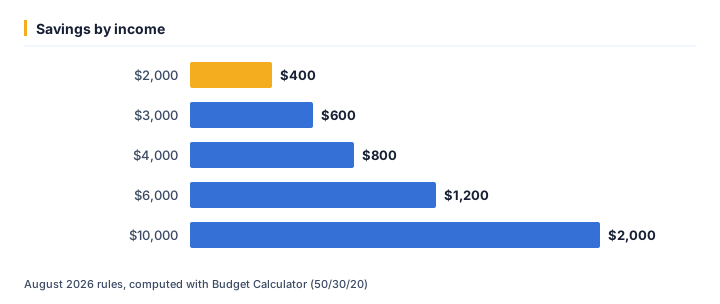
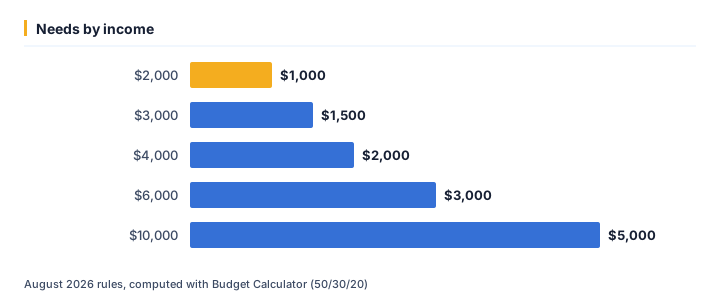
We ran 5 values of income through the calculator and left every other input at its default. As of August 2026, the output was:
| Income ($) | Savings ($) | Needs ($) | Wants ($) |
|---|---|---|---|
| 2,000 | 400 | 1,000 | 600 |
| 3,000 | 600 | 1,500 | 900 |
| 4,000 | 800 | 2,000 | 1,200 |
| 6,000 | 1,200 | 3,000 | 1,800 |
| 10,000 | 2,000 | 5,000 | 3,000 |
Running income from $2,000 up to $10,000 moves savings from $400 to $2,000 — a spread of $1,600. That gap is the part a single headline rate never shows.
The same runs seen through needs
At $2,000, needs works out to $1,000; at $10,000 it is $5,000. Looking only at savings tends to understate how much the outcome shifts across that range.
One example, straight from the API
The middle row above (income = $4,000) is not a rounded illustration — it is exactly what /api/v1/tools/budget-calculator/calculate returns for that input, August 2026 rules:
{
    "tool": "budget-calculator",
    "inputs": {
        "income": 4000
    },
    "result": {
        "needs": 2000,
        "wants": 1200,
        "savings": 800
    }
}
Assumptions behind these figures
| Input | Value |
|---|---|
| Income | $4,000 |
| As of | August 2026 |
| Method | identical to /tools/budget-calculator |
Rates, thresholds and typical costs change over time; the numbers above are accurate as of August 2026, not a permanent guarantee. For your own situation, open the Budget Calculator (50/30/20) and enter your real numbers — the calculator runs the same code that produced every figure on this page.
Ready to crunch your numbers?
Open the Budget Calculator (50/30/20) and get an answer in seconds.
Editorial Team
We write plain-English money guides and build the free calculators behind them.