A single salary negotiation done well can be worth more than a decade of frugal saving. Here is what the research, the recruiters, and the math actually say about getting paid what you are worth.
A 30-minute conversation, once, can be worth more to your lifetime net worth than every coffee you cut, every subscription you cancel, and every coupon you clip for the next ten years combined. Salary negotiation is the highest-leverage activity in personal finance, and it is also the one most workers never seriously practice. The asymmetry is enormous: a few hours of preparation produces tens or hundreds of thousands of dollars of additional lifetime earnings, while the time spent agonizing about food spending produces, at most, a few thousand.
This guide walks through what the research actually says about salary negotiation — who does it, who benefits, the language that consistently works, the leverage that matters, and the long-run compounding effect of a single successful negotiation that most people never see because they never run the numbers.
The Math: Why One Negotiation Matters So Much
Take a 28-year-old earning $75,000, planning to work until 65. Without any negotiation, assuming a typical 3% annual raise schedule and a 7% real investment return on a 15%-of-gross savings rate, lifetime earnings come to roughly $4.7 million and final retirement net worth lands around $1.8 million.
Now imagine the same worker negotiates a $5,000 starting raise on a new job offer. That extra $5,000 compounds in two ways:
- All future percentage raises stack on the higher base. A 3% raise on $80,000 is $200 more per year than a 3% raise on $75,000. Year by year, the gap widens.
- The extra take-home dollars get invested at 7%. A 15% savings rate on the extra $5,000 is an additional $750 invested every year for the next 37 years.
The cumulative result of that single 30-minute negotiation, over a 37-year career, is roughly $300,000 of additional retirement net worth.
Now imagine they negotiated $10,000 instead. Or negotiated successfully at two or three job changes across the career. The lifetime impact runs into seven figures. The Salary Negotiation Calculator lets you plug in your own numbers and see exactly what a specific dollar negotiation translates to over your remaining working years.
The reason this math matters is that it reframes salary negotiation from "asking for an awkward favor" into "claiming the highest-yield investment any working adult can make." The yield is real, the math is documented, and the cost is one slightly uncomfortable conversation.
Who Actually Negotiates (And Who Doesn't)
The published research is consistent and unflattering:
- About 30–40% of US workers negotiate when they receive an initial job offer. The rest accept the first number.
- The negotiation rate is even lower at promotions and annual reviews — under 25% of workers ask for more at the moment when a discussion is most expected.
- Women negotiate less frequently than men (though the gap has narrowed substantially in the past decade), and when women do negotiate, they ask for smaller increases on average. Both gaps contribute meaningfully to lifetime earnings disparities.
- Younger workers (under 30) negotiate the least, in part because the perceived risk of "blowing the offer" looms larger early in a career.
The single most consequential finding: workers who do negotiate receive an increase roughly 70–85% of the time. The fear of negotiation almost always exceeds the actual downside risk. Rescinded offers happen, but they are rare and almost always involve aggressive, hostile demands rather than measured asks.
What Hiring Managers Are Actually Authorized to Do
Most workers misread the salary-offer dynamic. A few facts that change the conversation:
- The first offer is almost never the maximum. Hiring managers typically have a range — sometimes 10%, sometimes 20% — they can flex to without escalating. The first offer is usually somewhere in the lower-middle of that range.
- The company has already invested heavily by the offer stage. A typical full-cycle hire costs $4,000–$15,000 in recruiting fees, time, and interviewing labor. Re-running the search after a candidate declines is far more expensive than meeting them at the top of the band.
- Signing bonuses, equity grants, and relocation are often funded from different budget lines. When base salary has limited flex, these levers may have substantial flex.
- The hiring manager often has more leeway than the recruiter conveys. Recruiters are intermediaries; they have an interest in closing offers at the lowest credible number. The hiring manager has an interest in actually hiring the right person.
The implication: negotiating once, politely, with a specific counter, is almost never the dealbreaker workers fear it will be. The downside is that the company says no and the original offer stands. The upside is a number that could be 5–20% higher.
The Preparation: Numbers Before Words
Negotiation outcomes track preparation quality more than negotiation "skill." The 80% of the work happens before the conversation.
Research the market range
Use multiple sources to triangulate. No single number is authoritative; the goal is a credible range.
- Levels.fyi — strongest for tech and tech-adjacent roles; verified compensation data including base, bonus, and equity.
- Glassdoor — broad coverage; quality varies by employer and role.
- LinkedIn Salary — increasingly robust, weighted by self-reported and platform-derived data.
- PayScale — broad coverage, with adjustments for location and experience.
- BLS Occupational Employment Statistics — government-sourced; useful as a sanity check, less granular by company.
Synthesize into a credible range for your target role at your target seniority in your target geography. Most roles have a band 25–40% wide between the 25th and 75th percentile.
Know your bottom number
The walk-away threshold below which the offer is actually worse than alternatives (staying at current job, taking a competing offer, accepting unemployment for a stretch). This is the only number you must be honest with yourself about.
Know your ask number
The number you would actually be excited to accept. Position your initial counter slightly above this — typically 5–10% above the target — so the company's natural counter-counter lands close to your real ask.
Quantify your alternatives
A competing offer is the strongest single leverage point. If you have one, use it factually and respectfully. If you do not, your current job (with its known compensation, benefits, and seniority) is itself an alternative — implicitly leverage in any new-offer negotiation.
The Conversation: Language That Works
Three communication patterns dominate successful negotiations in published research and real-world recruiter feedback.
Anchor with a specific number, not a range
"My target is $95,000 in base salary" works better than "I was thinking somewhere in the $90,000–$100,000 range." Ranges are read by the other side as a permission to come in at the low end; specific anchor numbers shift the center of the negotiation.
Use the market-data framing
"Based on my research of comparable roles at companies of similar size and stage in this market, the band appears to be $90,000–$110,000. Given my [specific experience], I am targeting $105,000."
This framing accomplishes three things: it depersonalizes the ask (you are not asking for a favor, you are stating market reality), it demonstrates you have done homework, and it invites the company to either match the market or explain why their offer is below it.
Pause after stating the number
Probably the most underused tactic. After you say your number, stop talking. Silence is uncomfortable; most negotiators fill it with concessions. Let the other side respond first. The hiring manager has a number in mind too; you want to hear it before you adjust yours.
A short script that handles 80% of cases:
"Thanks for the offer. I'm excited about the role and the team. Based on my research and my background in [specific area], I was targeting $X. Is that a number we can work with?"
Then pause. Wait. Let the manager respond.
What to Negotiate Beyond Base Salary
When base salary is genuinely capped, several other compensation levers often have flex. The full negotiation surface usually includes:
- Signing bonus. Often substantially negotiable; sometimes funded from a different budget line than base. A $5,000–$25,000 signing bonus is common at mid-to-senior levels.
- Equity grants (RSUs, stock options). Particularly at tech and growth-stage companies, equity is often more negotiable than base. The numbers can be substantial; understand the vesting schedule (typically 4 years with a 1-year cliff).
- Annual bonus target percentage. Often negotiable; particularly at sales, finance, and executive roles.
- Relocation package. Often a fixed budget the recruiter can flex within.
- Start date. Sometimes negotiable to align with your last paycheck at the current employer, capturing a bridge of double income.
- PTO and paid leave. Sometimes flexible; often companies have policy floors but no policy ceilings for senior roles.
- Title and seniority level. Materially affects future raises and external mobility. Worth negotiating even when base is fixed.
- Remote work or hybrid arrangements. Increasingly negotiable; in some cases more valuable than a salary increase.
- Professional development budget. Conferences, courses, books, certifications.
A useful rule of thumb: if base salary is firmly capped, request that one of the other levers be flexed by an amount that makes the total package competitive.
Negotiating an Internal Raise
Different game than a new-offer negotiation, but the same underlying logic.
Build the case before asking
Document your accomplishments over the last 12 months in specific, measurable terms. "Increased platform reliability" is weak; "reduced production incidents by 35% (from 78 to 51 quarter-over-quarter), saving an estimated 240 engineering-hours of reactive work" is strong.
Time the conversation
The best windows are:
- After a successful, visible project ships.
- During the annual review cycle (when budget conversations are happening anyway).
- At the moment you receive a competing offer (if you have one — but be prepared to accept the new offer if your current employer won't match).
Frame as a market-correction, not a request
"Based on my research of comparable roles in the market and my contributions this year, I believe my current compensation is below market. I'd like to discuss bringing it in line. My target is $X."
Internal raises are usually capped at 3–8% annually unless paired with a promotion or counter to an external offer. A larger correction typically requires the leverage of a competing offer or a job change.
Be prepared to leave
The single most consistent finding in compensation data: switching companies typically generates a 15–25% salary jump, while staying generates 3–5%. Over a 30-year career, switching every 3–5 years can produce a final salary 50–100% higher than staying at one employer the entire time. Loyalty to a single employer is, in pure compensation terms, expensive.
Common Mistakes
- Anchoring against your previous salary. Your prior compensation is not the relevant benchmark; the market rate for your target role is. Many states have made it illegal for employers to ask about salary history; even where it is legal, you can decline to provide it.
- Disclosing your number first. Whenever possible, get the company to anchor first. "What is the budget range for this role?" or "What does the comp package typically look like at this level?" If pressed, "I'm not focused on a specific number; I'm looking for a competitive package consistent with the market for this role" buys time.
- Negotiating before the offer is in writing. Verbal offers can shift; written offers are concrete. Always negotiate the written offer.
- Accepting a single round of back-and-forth as final. Many successful negotiations involve a second iteration. After the company's response to your counter, evaluate it against your real targets, and counter again if appropriate.
- Treating the recruiter as the decision-maker. The recruiter is your conduit, not the decision-maker. Polite firmness with the recruiter often results in them advocating up the chain on your behalf.
- Apologizing for negotiating. "Sorry to ask" or "I hate to bring this up" signals that you do not believe the ask is reasonable. The ask is reasonable; do not apologize for it.
- Failing to put the agreed number in writing. Always confirm the final offer details in writing, ideally an email summary, before signing.
Frequently Asked Questions
What if I'm worried the company will rescind the offer if I negotiate? Rescinded offers happen but are very rare and almost always involve hostile or unrealistic asks. A polite, market-informed counter that includes language like "I'm excited about the role and I want to make this work" is essentially never grounds for rescission. The expected cost of negotiating, weighted by the probability of rescission, is far smaller than the expected benefit.
How much should I counter — 5%, 10%, 20%? Depends on how far the initial offer is from your researched market range. A common pattern: counter 10–20% above the initial offer, anticipating the company to come back near the midpoint. If the initial offer is already at or near the top of the band, a smaller counter (5–8%) signals you've calibrated.
Can I negotiate after I've already accepted? Generally no. Once you've accepted in writing, the negotiation is closed. The exception is if material new information emerges (e.g., you discover the company has been hiring peers at substantially higher rates), but this is delicate. The clean path is to negotiate fully before signing.
Does negotiating make me look greedy? Hiring managers expect negotiation. Most have negotiated their own offers and are not surprised when candidates do the same. What they react negatively to is how a negotiation is conducted — aggressive ultimatums, repeated re-negotiation, or demands without justification. A calm, market-anchored counter is normal business communication.
What about for an internal promotion? Same principles apply. Document accomplishments, anchor with a specific number, frame as market-correction rather than personal request. Internal moves are typically capped at smaller percentage increases than external moves — but a successful negotiation at promotion time often shifts the base in a way that compounds for years.
Is it worth negotiating for a small increase ($1,000–$3,000)? Yes, because of compounding. A $2,000 raise on $80,000 base, compounded by future percentage raises and invested at 7% over a 35-year career, becomes roughly $80,000–$120,000 of additional retirement net worth. The 30-minute conversation, even for a "small" amount, has an outsized lifetime payoff.
Next Steps
- Research your current market rate using two of the sources above. Calibrate where your current compensation falls in the band for your role and level.
- Identify your next negotiation moment — annual review, internal promotion, external offer. Block 90 minutes of focused preparation time on the calendar two weeks before.
- Plug a target raise into the Salary Negotiation Calculator to see the lifetime compounded value. The visceral magnitude of the number is what overcomes the residual anxiety about asking.
The conversation will be uncomfortable. That is the price of admission. The lifetime payoff — measured in years of additional financial freedom — is one of the largest single bets you can make. Negotiate, every time, even when it feels awkward. Especially when it feels awkward.
Run the numbers
Everything below came out of this site's own Compound Interest Calculator. The figures are not quoted from anywhere else: each row is one run of the same calculation the tool page performs, using August 2026 rules. Put the same inputs in and you will get the same output.
How the result moves with principal
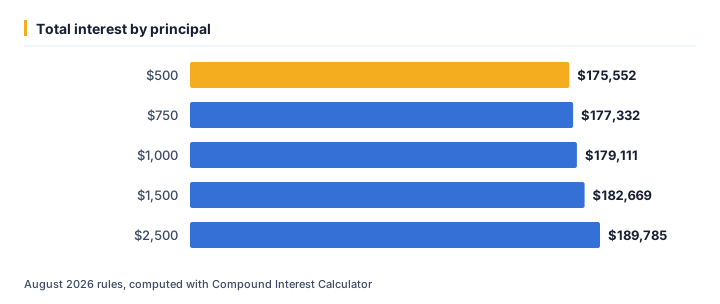
We ran 5 values of principal through the calculator and left every other input at its default. As of August 2026, the output was:
| Principal ($) | Total interest ($) | Total contributed ($) | Future value ($) |
|---|---|---|---|
| 500 | 175,552.45 | 72,500 | 248,052.45 |
| 750 | 177,331.57 | 72,750 | 250,081.57 |
| 1,000 | 179,110.7 | 73,000 | 252,110.7 |
| 1,500 | 182,668.95 | 73,500 | 256,168.95 |
| 2,500 | 189,785.44 | 74,500 | 264,285.44 |
Running principal from $500 up to $2,500 moves total interest from $175,552 to $189,785 — a spread of $14,233. That gap is the part a single headline rate never shows.
The same runs seen through total contributed
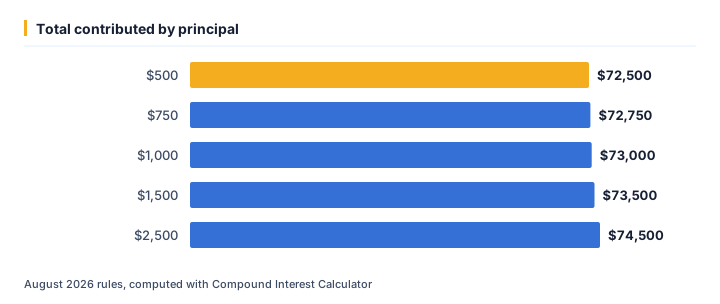
At $500, total contributed works out to $72,500; at $2,500 it is $74,500. Looking only at total interest tends to understate how much the outcome shifts across that range.
One example, straight from the API
The middle row above (principal = $1,000) is not a rounded illustration — it is exactly what /api/v1/tools/compound-interest-calculator/calculate returns for that input, August 2026 rules:
{
    "tool": "compound-interest-calculator",
    "inputs": {
        "principal": 1000,
        "monthly": 200,
        "rate": 7,
        "years": 30,
        "freq": 12
    },
    "result": {
        "future_value": 252110.7,
        "total_contributed": 73000,
        "total_interest": 179110.7,
        "growth_multiple": 3.45
    }
}
Assumptions behind these figures
| Input | Value |
|---|---|
| Principal | $1,000 |
| Monthly | $200 |
| Rate | 7% |
| Years | 30 years |
| Freq | $12 |
| As of | August 2026 |
| Method | identical to /tools/compound-interest-calculator |
Rates, thresholds and typical costs change over time; the numbers above are accurate as of August 2026, not a permanent guarantee. For your own situation, open the Compound Interest Calculator and enter your real numbers — the calculator runs the same code that produced every figure on this page.
Ready to crunch your numbers?
Open the Compound Interest Calculator and get an answer in seconds.
Editorial Team
We write plain-English money guides and build the free calculators behind them.