A realistic budget is not the spreadsheet you draft on Sunday — it is the system that runs itself by Friday. Here is how to build one in 60 minutes that survives a normal month.
Most budgets die in week three. Sunday-night optimism produces a beautiful spreadsheet with 22 categories; by Wednesday the household has missed three transactions; by Friday the whole project feels punitive and pointless. The pattern is so consistent that "I'm not a budget person" has become a cultural identity.
The truth is that the spreadsheet was never the problem. The problem was that the budget asked the human to make 50 decisions a month when it should have made one decision and automated the rest. This guide walks through how to build a budget that survives a normal month — by picking a method that matches your real personality, pulling honest baseline numbers, automating the structure, and learning to recover gracefully when life inevitably interrupts.
What a Realistic Budget Actually Is
A budget, at the most useful level, is two things:
- A plan for what your money does each month before the month begins.
- A feedback loop that tells you afterward where the plan and reality diverged.
What it is not: a moral document, a punishment system, or a permanent vow of austerity. Households that frame budgeting as discipline-against-the-self produce short-lived budgets. Households that frame it as a calm, neutral system — closer to scheduling than to dieting — produce budgets that last decades.
The best budget is the one you actually run for 24 months. Not the most precise one. Not the most ambitious one. The one that fits your real life enough that you keep showing up.
Pick a Method That Matches You
There are four budgeting methods that cover roughly 95% of working households. Each has a specific personality fit. Choose the one that matches you, not the one that matches the most aggressive optimizer you read about online.
The 50/30/20 Rule
Three buckets: 50% needs, 30% wants, 20% savings/debt. Coarse, forgiving, low-effort. Best for households new to budgeting, with reasonably stable income, who want a system that runs in 10 minutes a week. Trade-off: less granular optimization than other methods. Sufficient for the vast majority of households getting started. See The 50/30/20 Budget Rule Explained.
Zero-Based Budgeting
Every dollar of monthly income is assigned a specific job before the month begins. Most precise method; usually paired with software like YNAB. Best for households whose income is steady, who genuinely enjoy the optimization process, and who have a specific financial goal driving the precision. Trade-off: high time investment, especially the first 2–3 months. See the comparison in 50/30/20 vs Zero-Based Budgeting.
Pay-Yourself-First Budgeting
Skip categorizing wants and needs entirely. Automate savings and debt-paydown at the top (target: 20%+ of take-home pay), then spend what is left without further restriction. Best for high earners with strong impulse control, or households who find category tracking demoralizing. Trade-off: gives up some insight into what is happening in the variable spending. Best when the savings rate is high enough that the variable spending is, in fact, fine.
Envelope (or Cash-Stuffing) Budgeting
Physical or digital envelopes for each spending category; when the envelope is empty, the spending in that category stops for the month. Best for households who have struggled with overspending in specific categories (dining out, online shopping) and need the hard stop. Trade-off: clunky in a card-and-app world; works better with virtual envelopes in apps like Goodbudget than with literal cash.
If you are unsure which fits, the default is 50/30/20. It has the lowest abandonment rate and produces good-enough results for the largest range of households. Graduate to zero-based later if you find you want more precision.
Pull Honest Baseline Numbers
Before any budget can be built, you need to know what your money is actually doing today. Aspirational budgets fail because the gap between fantasy and reality is too large to close in one month.
Step 1: Three months of bank and credit card statements
Export the last 3 months of transactions from every account you use. Almost every US bank and card lets you download a CSV in under a minute. Combine them into one file.
Step 2: Categorize each transaction
You do not need 50 categories. Eight is usually enough:
- Housing (rent/mortgage, taxes, utilities)
- Transportation (gas, insurance, transit, car maintenance, parking)
- Food (groceries + dining out — keep them as one line for now)
- Insurance and medical
- Debt minimums
- Personal/discretionary (clothing, subscriptions, hobbies, entertainment)
- Travel and gifts (often lumpy month-to-month)
- Savings/investments
Step 3: Average across three months
Each category total divided by 3 gives you a stable monthly figure. Three months smooths over one-off months — a big vet bill in March, no travel in May. If you can, use four or six months for even better stability.
Step 4: Sum and compare to take-home pay
Total monthly outgoings vs total monthly take-home pay. If outgoings exceed take-home, the household is running on credit; the budget must address this gap. If outgoings are well below take-home, congratulations — the savings rate is healthier than you may have realized, and the budget formalization is mostly about where the surplus goes rather than whether it exists.
Most first-time budgeters are surprised by two specific findings in the baseline exercise:
- Dining out is bigger than expected. The average US household spends $3,500–$5,000 a year on food eaten outside the home, often without realizing it because each transaction is small.
- Subscriptions stack up. Streaming, software, fitness apps, cloud storage, news, audiobooks. An average household carries 8–12 active subscriptions; the all-in monthly cost is usually $80–$200.
Both are useful for the next step.
Set the Structure
With baseline numbers in hand, you can draft the actual budget. The structure depends on the method you chose.
For 50/30/20:
- Multiply your net (take-home) pay by 0.50, 0.30, and 0.20. These are your targets for needs, wants, and savings.
- Compare to your baseline. Which bucket is most out of line? For most households, "wants" is over and "savings" is under.
- Identify the single wants subcategory that is most overgrown — usually dining out, subscriptions, or unplanned shopping — and adjust that one, not the whole budget at once.
For zero-based:
- List every category and assign a specific dollar amount until the total equals your net pay. (Software like YNAB walks you through this; doable on paper but slower.)
- Build in line items for irregular expenses divided by 12 months — annual car insurance / 12, holiday gifts / 12, etc. These are sinking funds.
- Plan to spend 2–3 months refining the categories before the budget stabilizes.
For pay-yourself-first:
- Set the automatic savings/debt transfer to fire on payday at your target rate (start at 15–20% of net; ratchet upward as comfort grows).
- Track nothing else for the first 3 months. Just verify the savings transfer is happening and the household is not running out of money in checking.
- After 3 months, evaluate whether the rate can rise.
For envelope:
- Identify the 2–4 problem categories (the ones that consistently blow the budget).
- Set monthly envelope amounts for those categories.
- Use a virtual envelope app (Goodbudget, Qube) or, if literally using cash, a series of labeled envelopes filled on the 1st of each month.
In every method, the first month's draft is a hypothesis. Expect to refine it after seeing what actually happens — that is the feedback loop in action, not a sign the budget is "broken."
Automate the Structure
This is the step most beginners skip and the step that determines whether the budget survives.
Automate the savings transfer first. Whatever percentage you have decided to save, move that dollar amount on the day after payday — automatically — from checking into the destination accounts (HYSA, retirement, brokerage, debt principal). Use direct deposit splits when your employer supports them; use scheduled transfers when they do not.
Automate predictable bill payments. Rent, mortgage, utilities, insurance — set them on autopay from checking. The mental energy not spent remembering to pay bills is energy available for other things.
Set credit card autopay to statement balance. Not minimum, not custom amount — full statement. Carrying a balance at 22% APR destroys budgets faster than any spending category. If you cannot afford to pay full each month, the budget needs to address the spending generating the unaffordable balance, not the payment side.
Leave variable spending in checking. After the automated transfers, whatever is left in checking is the household's discretionary spending pool for the month. This is the only number that requires active attention.
The result: 80–90% of your money flow happens without any decisions. You only think actively about the variable spending. The cognitive load drops from "monitor every transaction" to "watch one number."
Recovering When a Month Goes Off-Track
Every household has months that diverge from the plan. A medical event, a car repair, a wedding to attend, a slow income month. The question is not whether divergences happen — they always do — but how the budget handles them.
The wrong response: "I broke the budget, so I'll start fresh in January."
The right response: a quick mid-month or end-of-month adjustment.
Identify what went over. Look at the actual numbers and find the specific category. It is almost always 1–2 categories rather than across-the-board overspending.
Decide whether it was a one-time event or a pattern.
- One-time (transmission repair, wedding gift, surprise medical bill): pay it from the emergency fund or sinking fund if applicable, replenish next month, move on.
- Pattern (dining out keeps overshooting; subscriptions keep growing): the budget category needs adjustment, not the household's resolve. Recategorize, raise the line, lower another category.
Resume next pay cycle. A bad week does not invalidate a 24-month budget. The most successful long-term budgeters are the ones who treat each missed target as data, not as a moral failure.
A useful framing: budgets do not "break." Plans diverge from reality; that is just information. The plan adapts; the household continues.
Common Mistakes
- Building the perfect budget that nobody runs. A 90% accurate budget that runs for 24 months is worth far more than a 99% accurate budget that runs for 6 weeks. Default to simpler.
- Setting targets without baseline data. "I'll spend $300 on groceries" — but the household has been spending $580 for two years. The target is fantasy; the result is failure. Start where you actually are; move 10% per month, not 60% in one month.
- No category for irregular expenses. Annual car insurance arrives once a year and blows up the monthly budget. Build a sinking fund for it: monthly insurance budget = annual premium / 12, set aside in a separate account.
- Punishing missed months. Beating yourself up over a missed budget kills the system. Treat each month as a fresh start; the cumulative trend, not any single month, is what matters.
- Tracking too many categories. 25-category budgets routinely fail. 6–10 categories cover almost every household. Granularity is for spreadsheet enthusiasts, not for sustainable budgeting.
- Trying to budget without first knowing your numbers. The baseline exercise is not optional. Without it, the budget is a wish list.
- Forgetting to update after a major life event. New job, new baby, new mortgage, new car, marriage, divorce, move to a new city — each requires a budget refresh. Block 60 minutes within the first 3 months of any major change.
Tools That Help
A few categories of tools are worth knowing, though no tool is mandatory:
- Spreadsheets (Google Sheets, Excel). Free, infinitely customizable, surprisingly effective for households running 50/30/20 or pay-yourself-first.
- YNAB (You Need A Budget). The leading software for zero-based budgeting; learning curve of 2–4 weeks but excellent for households who want precision. Paid subscription.
- Monarch Money, Empower, Rocket Money. Aggregator apps that pull all your accounts and categorize transactions automatically. Useful for the baseline exercise and for quick monthly check-ins. Some are free; most freemium.
- Goodbudget. Virtual envelopes for envelope-system households.
- Calculators on this site. The Budget Calculator (50/30/20), Savings Goal Calculator, and Emergency Fund Calculator handle the specific math without needing a full software subscription.
A budget that works is platform-agnostic. The system matters more than the tool.
Frequently Asked Questions
How long does it take to build a budget? 60 minutes for the first draft. 2–3 months for it to stabilize as you discover real spending patterns and adjust categories. After that, 10 minutes a week of light maintenance.
Should partners budget together or separately? For shared finances, together — a household budget covering shared expenses, savings goals, and joint contributions, plus a personal-spending allowance for each partner that needs no further explanation. For finances that are kept genuinely separate (less common in the US), each person budgets individually but household-level savings goals still benefit from a joint conversation.
What if my income varies month to month? Budget against your minimum expected monthly income, not your average. Treat above-baseline months as windfalls that go to savings/debt paydown, not as license to spend. Freelancers and commission-based earners specifically: build a larger emergency fund (6–9 months) and run the budget against the bottom quartile of historical income.
Does a budget have to be exact? No. 50/30/20 is deliberately imprecise and works for millions of households. Even zero-based budgets, in practice, run on rounded numbers with ±10% real-world variation. Precision is not the goal; consistency is.
What if my partner refuses to budget? A common situation. Two real options: (1) build the household-level structure unilaterally — automate the savings, pay the bills on autopay — and leave variable spending unbudgeted; (2) propose a 90-day trial of the simplest method (50/30/20 or pay-yourself-first), agree to revisit after 90 days. The hard-sell approach rarely converts skeptics; the demonstrated-results approach often does.
Should I include 401(k) contributions in the budget? Pre-tax 401(k) contributions come out before take-home pay, so they don't appear as a budget line — but they count toward the household's savings rate. Post-tax contributions (Roth IRA, brokerage) belong in the budget's savings bucket explicitly.
Is it bad to use credit cards within a budget? Not at all, if the full statement is paid every month. Credit cards offer rewards, fraud protection, and convenience that debit cards don't. The rule is "credit cards yes, credit card balances no." The moment a balance carries past one cycle, the household has a different problem to solve.
Next Steps
- Block 60 minutes this Sunday. Pull three months of statements and run the baseline exercise above.
- Choose the budgeting method that fits your personality, not the one your most-disciplined friend uses. 50/30/20 is the safe default.
- Automate the savings transfer first, before drafting the rest of the budget. Even before you know the optimal categories, get one auto-transfer running. That single automation does more for long-run net worth than any spreadsheet ever will.
A realistic budget is not a project. It is a posture you settle into and a structure that quietly handles 90% of the decisions automatically. The first 60 minutes is the work; everything after that is the dividend.
Run the numbers
Everything below came out of this site's own Budget Calculator (50/30/20). The figures are not quoted from anywhere else: each row is one run of the same calculation the tool page performs, using August 2026 rules. Put the same inputs in and you will get the same output.
How the result moves with income
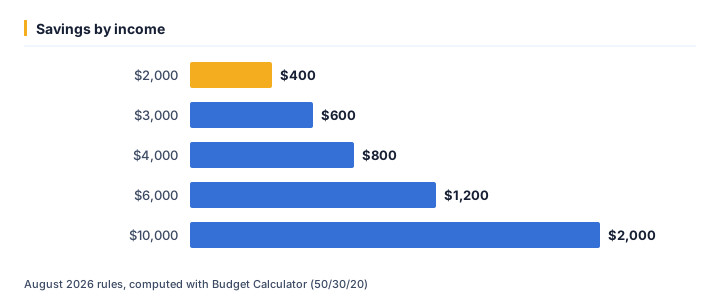
We ran 5 values of income through the calculator and left every other input at its default. As of August 2026, the output was:
| Income ($) | Savings ($) | Needs ($) | Wants ($) |
|---|---|---|---|
| 2,000 | 400 | 1,000 | 600 |
| 3,000 | 600 | 1,500 | 900 |
| 4,000 | 800 | 2,000 | 1,200 |
| 6,000 | 1,200 | 3,000 | 1,800 |
| 10,000 | 2,000 | 5,000 | 3,000 |
Running income from $2,000 up to $10,000 moves savings from $400 to $2,000 — a spread of $1,600. That gap is the part a single headline rate never shows.
The same runs seen through needs
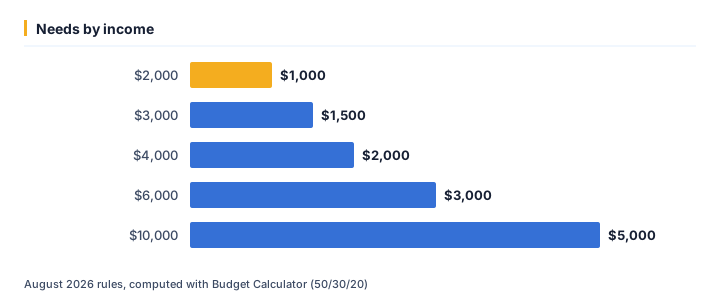
At $2,000, needs works out to $1,000; at $10,000 it is $5,000. Looking only at savings tends to understate how much the outcome shifts across that range.
One example, straight from the API
The middle row above (income = $4,000) is not a rounded illustration — it is exactly what /api/v1/tools/budget-calculator/calculate returns for that input, August 2026 rules:
{
    "tool": "budget-calculator",
    "inputs": {
        "income": 4000
    },
    "result": {
        "needs": 2000,
        "wants": 1200,
        "savings": 800
    }
}
Assumptions behind these figures
| Input | Value |
|---|---|
| Income | $4,000 |
| As of | August 2026 |
| Method | identical to /tools/budget-calculator |
Rates, thresholds and typical costs change over time; the numbers above are accurate as of August 2026, not a permanent guarantee. For your own situation, open the Budget Calculator (50/30/20) and enter your real numbers — the calculator runs the same code that produced every figure on this page.
Ready to crunch your numbers?
Open the Budget Calculator (50/30/20) and get an answer in seconds.
Editorial Team
We write plain-English money guides and build the free calculators behind them.