A neutral head-to-head comparison of the 50/30/20 rule and zero-based budgeting — time cost, accuracy, irregular-income fit, and how to decide which one suits your life.
Most arguments about budgeting are not really arguments about money. They are arguments about temperament. One person hears "every dollar gets a job before the month starts" and feels relief — finally, a system that respects how detail-oriented they are. Another hears the same sentence and feels claustrophobic, and wants a budget they can run in their head, not a spreadsheet that demands a Sunday-night session.
Both reactions are reasonable. Budgeting is budgeting — used consistently, either popular framework will get you out of debt and build savings. But the day-to-day mechanics differ, and the difference matters because the best budget is the one you will actually keep running.
This article compares the 50/30/20 rule and zero-based budgeting across eight practical criteria, runs the same fictional household through both, and ends with a clear decision guide.
What Is 50/30/20
The 50/30/20 rule is a percentage-based framework. You take your monthly take-home pay (income after taxes and pre-tax deductions like 401(k) and health insurance) and sort every dollar into one of three buckets:
- 50% to needs — rent or mortgage, groceries, utilities, insurance, minimum debt payments, transportation, basic phone, childcare.
- 30% to wants — restaurants, streaming, hobbies, travel, gym, the upgraded phone plan.
- 20% to savings and debt payoff — emergency fund, retirement contributions, brokerage investing, extra principal above the minimum on debt.
The appeal is that 50/30/20 gives your finances a shape without forcing you to itemize every transaction. You do not decide in advance whether this month's fun money goes to burritos or board games — as long as total wants stays under 30%, you are inside the lines.
It is also forgiving by design. The percentages are guardrails, not exact targets — a 47/33/20 month is fine, and a 55/25/20 month after a car repair is fine too. The rule is a long-run shape, not a daily report card. For a deeper walkthrough, see our guide to the 50/30/20 budget rule, and use the Budget Calculator to see your own dollar splits in seconds.
What Is Zero-Based Budgeting
Zero-based budgeting is a different philosophy. Instead of sorting dollars into three big buckets, you assign every single dollar of expected income a specific job before the month begins. Income minus assignments must equal exactly zero — your unassigned balance is zero because every dollar already has somewhere to go.
A zero-based budget for one month might list twenty or thirty line items: rent, electricity, internet, "groceries — staples" and "groceries — weekly," gas, monthly auto insurance accrual, specific dollar amounts for restaurants and clothing, a Roth IRA contribution, an emergency fund transfer, a sinking fund for the next car repair, and so on. If $7,200 comes in, then $7,200 is allocated — not "roughly 50% to needs" but exactly $3,400 across nine line items.
The discipline is in the planning. You write the budget at the start of the month, shift dollars between categories mid-month when reality diverges, and reconcile at month-end. Most zero-based budgeters use a dedicated app — YNAB and EveryDollar are the two best-known — because tracking dozens of category balances by hand is tedious. The payoff is precision: at any moment, you know exactly how much you have left in every category.
Comparison: Eight Criteria, Side by Side
Time Cost Per Month
50/30/20 is cheap. After a thirty-minute setup, ongoing time is roughly zero — a weekly glance at the wants bucket and you are done. Zero-based takes 20–60 minutes at the start of each month plus 5–15 minutes per week to reconcile. Annualized: 10–30 hours per year. For people who enjoy planning it is satisfying time; for everyone else, friction.
Mental Load
50/30/20 has very low overhead — three buckets fit in working memory. Standing in a store, you can ask "is this a need or a want, and how is my wants bucket doing" and answer in five seconds. Zero-based has higher overhead in week one and lower overhead afterward, because the app tells you exactly what each category has left. People who hate the planning often love the result.
Accuracy
This is where zero-based clearly wins. A 50/30/20 budget cannot tell you whether you are overspending on restaurants versus subscriptions — both live inside "wants." Zero-based can. Conceded tradeoff: a 50/30/20 user who pays attention will eventually notice the restaurant creep — the signal is just slower and coarser.
Irregular-Income Fit
If your income is steady, both methods work fine. If your income is irregular — freelance, commission, tipped, seasonal — zero-based handles it better, but only when used with a one-month buffer (you budget last month's actual income, not this month's expected income). 50/30/20 can be adapted to irregular income too, but the percentages get rough when "the income" is a moving target.
Savings-Rate Accuracy
Zero-based gives you a precise savings rate every month because you wrote it down. 50/30/20 gives you an intended 20% rate, but actual outcomes depend on whether you hit the bucket targets. In practice, 50/30/20 users often save somewhat less in expensive months and somewhat more in cheap ones. Across a year it usually averages out, but if you want a specific number hit reliably, zero-based wins.
Tooling Needs
50/30/20 needs almost nothing — a bank account, a monthly glance, and ideally the Budget Calculator once a year. Zero-based effectively needs software: YNAB is about $109/year, EveryDollar has a free tier plus a paid tier around $80/year. You can DIY in a spreadsheet, but the friction is real.
Partner-Friendliness
50/30/20 is easier to share when one partner is interested in the details and the other is not — the non-engaged partner only needs three numbers. Zero-based works best when both partners participate in the monthly planning session. When only one does the work, the other can feel surveilled rather than collaborative.
Beginner Curve
50/30/20 is easier to start — you can be running it tonight after a fifteen-minute setup. Zero-based has a steeper curve: most newcomers under-budget for clothing, gifts, and car repairs in month one and recalibrate by month three or four. The first ninety days are the hard part.
Summary Table
| Criterion | 50/30/20 | Zero-Based |
|---|---|---|
| Time cost / month | ~0 minutes | 30–60 minutes |
| Mental load | Low | Low (after setup) |
| Accuracy | Coarse (3 buckets) | High (line-item) |
| Irregular income | Workable | Better, with buffer |
| Savings-rate precision | Approximate 20% | Exact, by line |
| Tooling needed | None to minimal | App strongly recommended |
| Partner-friendliness | Easy if one partner leads | Best when both engaged |
| Beginner curve | Very gentle | Steeper, ~3 months |
Neither method dominates. Zero-based wins on accuracy and savings-rate precision. 50/30/20 wins on time cost, tooling, and beginner curve. The right choice depends on which column matters most for your life right now.
Worked Example: Same Household, Both Methods
Meet Maya and Devon. A dual-income couple in their early thirties, no kids yet, renting a two-bedroom in a mid-cost US city. Combined monthly take-home pay — after taxes, 401(k), and health insurance — is $7,200. One car payment, a small student loan, and they are building a $25,000 emergency fund while also saving for a down payment.
Method A: 50/30/20
Applying the rule directly to their $7,200 take-home:
- Needs (50%): $3,600
- Wants (30%): $2,160
- Savings (20%): $1,440
They do not plan the dollars inside each bucket in advance — they just keep total spending roughly within the caps. Needs cover rent ($2,100), utilities and internet ($220), groceries ($550), gas ($180), minimum student loan ($150), car insurance ($165), phone ($85), and pet expenses ($150) — about $3,600. Wants cover restaurants, streaming, hobbies, gym, travel, and date nights; some months $1,900, some $2,400, averaging near $2,160. The $1,440 savings bucket splits into $900 emergency fund, $400 down payment, and $140 extra student loan principal. Setup: 20 minutes. Ongoing: a five-minute weekly glance.
Method B: Zero-Based Budgeting
Same household, same $7,200. Now they sit down on the last Sunday of the previous month and assign every dollar:
| Category | Amount | Type |
|---|---|---|
| Rent | $2,100 | Need |
| Utilities + internet | $220 | Need |
| Groceries — staples | $400 | Need |
| Groceries — weekly | $150 | Need |
| Gas (car) | $180 | Need |
| Auto insurance | $165 | Need |
| Student loan minimum | $150 | Need |
| Phone | $85 | Need |
| Pet — food + insurance | $150 | Need |
| Restaurants | $400 | Want |
| Streaming + subscriptions | $60 | Want |
| Gym (both) | $90 | Want |
| Hobbies | $120 | Want |
| Personal — Maya | $200 | Want |
| Personal — Devon | $200 | Want |
| Date nights | $150 | Want |
| Travel fund | $300 | Want |
| Phone upgrade plan | $40 | Want |
| Clothing (sinking) | $80 | Want |
| Gift fund (sinking) | $50 | Want |
| Car repair (sinking) | $100 | Want |
| Emergency fund | $900 | Savings |
| House down payment | $400 | Savings |
| Extra student loan | $140 | Savings |
| Roth IRA | $300 | Savings |
| Total | $7,200 |
The bucket totals come out close to the 50/30/20 version, but the mechanics are completely different. Maya and Devon now know they have exactly $400 for restaurants this month, not "roughly $2,160 of fun money." They have a $100 sinking fund for the next car repair — a line item that did not exist explicitly in their 50/30/20 setup, even though it was lurking inside "needs." First-month setup: about 90 minutes. By month four they can write the budget in twenty.
Both budgets are honest. Both will work. The zero-based version simply asks more upfront in exchange for tighter control later.
Which One Fits You
Some quick decision rules from the comparison:
- Irregular income (freelance, commission, tips, seasonal) — lean zero-based, with a one-month buffer. Precision matters more when input is bumpy.
- You hate budgeting apps and won't pay for software — lean 50/30/20. Run it on paper and the Budget Calculator once a year.
- Specific large goal with a hard date (wedding, down payment in two years) — lean zero-based. Sinking funds are easier when categories are explicit.
- Coming out of debt and need behavior change, not just bookkeeping — lean zero-based for the first 12–18 months. Line-item visibility creates accountability that the three-bucket method does not.
- Already saving 20%+ and finances are calm — lean 50/30/20. A system requiring no maintenance is the one you will still be running in ten years.
- Only one partner is interested in the details — lean 50/30/20. Asymmetric engagement is fine here; with zero-based it can quietly turn into resentment.
These are leans, not laws. The honest question is: which version of "checking in on the budget" would actually happen in your life — a five-minute weekly glance or a thirty-minute monthly sit-down? Pick the cadence you will keep, then pick the method that matches it.
Can You Combine Them?
Yes — and many of the most durable household budgets are hybrids.
The most common combination is "50/30/20 frame, zero-based inside the wants bucket." Needs and savings stay simple — pay the rent, transfer 20% to savings on payday — but you run a tighter zero-based split inside wants. Each month you assign your $2,160 of wants to named categories: $500 restaurants, $300 travel, $400 hobbies. This catches almost all the lifestyle creep pure 50/30/20 misses, without itemizing the rent that does not vary anyway.
Another hybrid: "zero-based plus sinking funds, validated against 50/30/20 percentages." Write a normal zero-based budget, then check what percentage landed in needs, wants, and savings. If wants are at 38%, that is a flag. The percentages become a sanity check rather than a hard rule.
A third option is the "envelope-on-top-of-percentages" approach: compute your 50/30/20 splits with the Budget Calculator, then subdivide wants into three or four envelopes (restaurants, entertainment, personal) without going to twenty-plus categories. Low mental load, but enough granularity to catch the common runaway categories.
The percentage frame and the line-item frame are not mutually exclusive. Use percentages as a target shape and line items as the means of hitting that shape.
YMYL Note: When Either Method Stops Being Enough
If your finances have material complexity — self-employment income with quarterly estimated taxes, multiple W-2s with potential overwithholding, equity compensation (RSUs, ISOs, NSOs), or near-term retirement planning — neither method, on its own, substitutes for professional advice. A budget tells you where dollars go each month; it does not optimize taxes on a vested equity grant or structure quarterly estimates against fluctuating self-employment income. Keep the budget, but pair it with a fee-only Certified Financial Planner who can look at your full picture. You can find one through letsmakeaplan.org.
Frequently Asked Questions
Which method saves more money? Neither, intrinsically. Both can hit any savings rate you choose. The difference is how the rate is enforced: 50/30/20 sets it as a percentage target; zero-based sets it as a specific dollar line item. The actual outcome depends on whether you stick to the plan.
Can I switch between methods? Yes. Many people start with 50/30/20 for the first year because the curve is gentle, then graduate to zero-based once they want more precision. Others run zero-based for a few years to break a debt cycle, then relax into 50/30/20 once the behavior is internalized. Switching does not undo prior progress.
Does either method work with variable income? 50/30/20 works as a long-run average — you might be at 60/20/20 in a lean month and 40/30/30 in a fat one, and that is acceptable if the year averages out. Zero-based works better in the short run for variable income, especially with a one-month buffer where you budget last month's actual income rather than this month's expected income.
Where do extra debt payments go? Minimum debt payments are needs in both systems. Extra principal above the minimum is savings — the 20% bucket in 50/30/20 explicitly includes debt payoff. If you are aggressively attacking high-interest debt, the extra payments belong in the 20% bucket.
Do I really need an app for zero-based budgeting? Strongly recommended, not strictly required. A well-organized spreadsheet works for the patient and disciplined. For everyone else, a dedicated app removes enough friction to keep the system alive past month three.
What if my "needs" bucket is already over 50%? Common in high-cost-of-living cities. The percentages are guidance, not law. A reasonable adaptation is 60/20/20 or 65/20/15 in HCOL areas; the more important number is that the savings bucket stays at 15–20%. Below that, you are treading water rather than building wealth.
Next Steps
- Run your real numbers through the Budget Calculator. Use your actual take-home pay to see what 50/30/20 looks like for your household before you decide. Seeing the dollar amounts often resolves the choice for you.
- Try the method you picked for ninety days. Both methods need three months of running time before you can fairly judge them. Quitting at week three is not a verdict on the method — it is a verdict on the first month, which is always the hardest.
- Pair your budget with a concrete savings target. A budget without a goal is just bookkeeping. Use the Savings Goal Calculator to translate your monthly savings bucket into a real timeline so the dollars you save have a name and a finish line.
Budgeting is not a personality test, but the method you pick is. The right one is the one you will still be running in five years.
Run the numbers
Everything below came out of this site's own Budget Calculator (50/30/20). The figures are not quoted from anywhere else: each row is one run of the same calculation the tool page performs, using August 2026 rules. Put the same inputs in and you will get the same output.
How the result moves with income
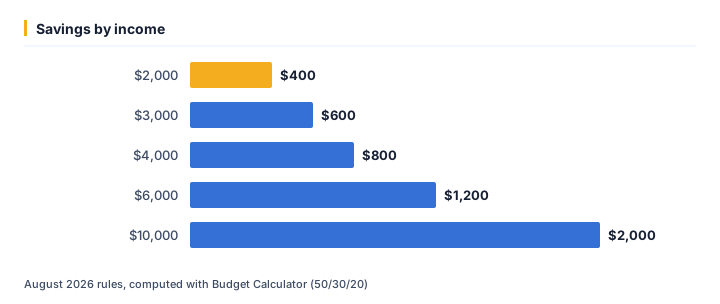
We ran 5 values of income through the calculator and left every other input at its default. As of August 2026, the output was:
| Income ($) | Savings ($) | Needs ($) | Wants ($) |
|---|---|---|---|
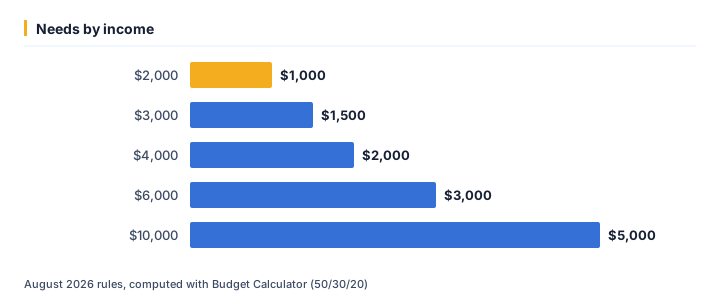
| 2,000 | 400 | 1,000 | 600 |
| 3,000 | 600 | 1,500 | 900 |
| 4,000 | 800 | 2,000 | 1,200 |
| 6,000 | 1,200 | 3,000 | 1,800 |
| 10,000 | 2,000 | 5,000 | 3,000 |
Running income from $2,000 up to $10,000 moves savings from $400 to $2,000 — a spread of $1,600. That gap is the part a single headline rate never shows.
The same runs seen through needs
At $2,000, needs works out to $1,000; at $10,000 it is $5,000. Looking only at savings tends to understate how much the outcome shifts across that range.
One example, straight from the API
The middle row above (income = $4,000) is not a rounded illustration — it is exactly what /api/v1/tools/budget-calculator/calculate returns for that input, August 2026 rules:
{
    "tool": "budget-calculator",
    "inputs": {
        "income": 4000
    },
    "result": {
        "needs": 2000,
        "wants": 1200,
        "savings": 800
    }
}
Assumptions behind these figures
| Input | Value |
|---|---|
| Income | $4,000 |
| As of | August 2026 |
| Method | identical to /tools/budget-calculator |
Rates, thresholds and typical costs change over time; the numbers above are accurate as of August 2026, not a permanent guarantee. For your own situation, open the Budget Calculator (50/30/20) and enter your real numbers — the calculator runs the same code that produced every figure on this page.
Ready to crunch your numbers?
Open the Budget Calculator (50/30/20) and get an answer in seconds.
Editorial Team
We write plain-English money guides and build the free calculators behind them.