Emergency funds protect you from the unexpected; sinking funds protect you from the predictable. Conflating the two is one of the most common reasons emergency funds get raided for things that aren't actually emergencies.
The most common reason households deplete their emergency fund is not actually an emergency. It is a predictable expense — annual car insurance, a holiday season, a back-to-school season, a wedding the household has known about for 14 months — that arrives without a dedicated savings bucket attached to it. The household reaches for the only liquid savings they have, the emergency fund, and the buffer that took 18 months to build erodes in a single month.
The fix is structural, not behavioral: set up separate sinking funds for every predictable irregular expense, fund them monthly, and let the emergency fund stay reserved for actual emergencies. This guide walks through the difference between the two, why both are necessary, exactly which expenses warrant a sinking fund, how to set them up, and how to stop raiding the emergency fund for things that were never emergencies.
The Core Distinction
The two account types serve fundamentally different jobs.
Emergency fund: a cash reserve for the unexpected and infrequent — job loss, major medical bills not covered by insurance, sudden large home or vehicle repairs, true family emergencies. The defining property is unpredictability: you cannot put a calendar date next to when (or whether) the spending will occur. Target size: 3–6 months of essential expenses. See How Much Emergency Fund Do You Really Need?.
Sinking fund: a cash reserve for a predictable, irregular expense. You know it is coming. You know roughly when. You know roughly how much. You just spread the saving across the months between events so the bill, when it arrives, doesn't disrupt the monthly budget. Examples: annual car insurance, holiday gifts, property tax bills, anniversary trip, planned home repairs.
The wrong framing is "sinking funds vs emergency funds — which one do I need?" The right framing is "I need both, in different accounts, for different purposes." Healthy household finances run multiple sinking funds in parallel with one emergency fund.
Why Conflating Them Costs You
Consider a household with a $20,000 emergency fund (good!) but no sinking funds. Over the course of a year, predictable irregular expenses arrive:
- Annual car insurance: $1,400 (March)
- Holiday gifts and travel: $1,800 (December)
- Annual property tax shortfall: $1,200 (October)
- Summer vacation: $2,500 (July)
- Christmas/New Year combined: $1,400 (December)
- Wedding gift + travel for cousin's wedding: $1,100 (May)
- Vehicle registration: $250 (April)
- Annual HOA assessment: $700 (January)
That is $10,350 across the year — none of it unexpected, all of it irregular. Without sinking funds, each one feels like a "surprise" because the monthly budget didn't accommodate it. The natural response is to pull from the emergency fund, "just this once."
Over 12 months, "just this once" happens eight times. The $20,000 emergency fund shrinks to $9,650 — not because of any actual emergency, but because of the absence of structure. The household feels like they've been hit by unexpected expenses; the data says they have been hit by predictable ones, mislabeled.
When a real emergency arrives the following year — a job loss, a medical bill, a $4,000 transmission failure — the buffer is too thin to absorb it. New debt accumulates. The whole personal finance structure gets weaker, traceable directly to the missing sinking-fund architecture.
Which Expenses Warrant a Sinking Fund
The test: is this expense (a) predictable in occurrence (you know it will happen), (b) substantial relative to a normal monthly budget (say, $200+), and (c) irregular (doesn't fit a normal monthly bill rhythm)? If yes to all three, build a sinking fund.
Annual expenses
- Vehicle insurance (if paid annually or semi-annually rather than monthly).
- Property tax (if your mortgage doesn't escrow it).
- Homeowner's or renter's insurance (if paid annually).
- Umbrella liability insurance (if applicable).
- HOA assessments (annual, semi-annual, or special).
- Professional licensing or certification fees.
- Tax preparation fees.
- Annual subscriptions that would otherwise spike a single month (Costco, Amazon Prime, some software).
- Annual physical/dental deductibles (the recurring out-of-pocket portion).
Seasonal and lifestyle expenses
- Holiday gifts (combined cumulative spend: $400–$2,000+ for most households).
- Holiday travel (Thanksgiving, December, family visits).
- Summer vacation.
- Back-to-school season (clothing, supplies, fees — substantial for school-age children).
- Birthday gifts for immediate family, including major-milestone birthdays.
- Holiday entertaining (food, decorations, hosting costs).
Predictable irregular events
- Vehicle maintenance reserve — oil changes, tires, brakes, scheduled major service. A useful rule: $40–$80/month per vehicle as a maintenance sinking fund.
- Home repair reserve — for the homes you own. A useful rule: 1% of home value per year for ongoing repairs and replacement (roof, HVAC, water heater, appliances). A $400,000 home → ~$4,000/year = $335/month into a "house" sinking fund.
- Pet expenses — annual vet visits, vaccinations, occasional larger issues.
- Major-purchase replacement — anticipated replacement of a vehicle, appliance, or significant household item within 2–5 years.
Goal-style sinking funds
- Specific anniversary trip in 14 months.
- Down payment on next car within 2 years.
- Wedding savings (a related but goal-specific sinking pattern).
- Children's activities that come in lumps (camps, sports seasons).
If you have more than 8 sinking funds running, consolidate the smaller ones into a single "irregular expenses" fund. Most households run 4–6 active sinking funds plus the emergency fund.
How to Set Up Sinking Funds
The mechanics are straightforward. Most online banks (Ally, Capital One, Marcus, SoFi) support multiple sub-accounts or "buckets" within a single HYSA — perfect for sinking funds. If your bank doesn't, you can open multiple HYSAs at a single online bank, each named for one purpose.
Step 1: List every predictable irregular expense
Pull your last 12 months of statements. Identify every expense over $200 that doesn't appear monthly. Sum them by category and frequency.
Step 2: Compute the monthly contribution
For each sinking-fund category:
Monthly contribution = annual cost ÷ 12 (or by the number of months until the next occurrence).
Example: annual car insurance of $1,400. Monthly sinking-fund contribution: $1,400 / 12 ≈ $117. When the bill arrives, the money is already there.
Step 3: Create the buckets and label them
Within your online bank's interface, create named sub-accounts:
- "Car Insurance"
- "Holiday Gifts"
- "Vacation 2027"
- "Home Maintenance"
- "Vehicle Maintenance"
- "Annual Subscriptions"
- (etc.)
Step 4: Automate the monthly transfer
Set up a recurring transfer the day after each paycheck. The total of all sinking-fund contributions becomes a single line item in your monthly budget — manageable, predictable, automatic.
Step 5: Spend from the appropriate bucket when bills arrive
When the car insurance bill arrives in March, transfer the funds from the "Car Insurance" bucket to checking, pay the bill, and continue contributing to the now-empty bucket for the next cycle.
A Realistic Sinking-Fund Schedule
For a typical US household with one car, no kids, modest home ownership:
| Bucket | Annual cost | Monthly contribution |
|---|---|---|
| Car Insurance | $1,400 | $117 |
| Property Tax (above escrow) | $1,200 | $100 |
| Holiday Gifts + Travel | $1,800 | $150 |
| Summer Vacation | $2,500 | $208 |
| Vehicle Maintenance | $600 | $50 |
| Home Maintenance | $4,000 | $333 |
| Annual Subscriptions | $360 | $30 |
| Other/Misc (gifts, events) | $1,200 | $100 |
| Total | $13,060 | $1,088 |
A monthly contribution of ~$1,090 to sinking funds across these eight buckets fully absorbs all predictable irregular spending. The household's monthly cash flow becomes smooth. Annual expense surprises disappear, because none of them were actually surprises.
For households just getting started, this number can be intimidating. The right tactic: start with the two largest categories (often vacation and home maintenance), build those sinking funds to half-target levels, then add the others over time. Within 18 months, the full schedule can be in place.
How Sinking Funds Interact with Other Saving
Sinking funds are part of the savings bucket in 50/30/20 budgeting — but they are conceptually different from emergency-fund contributions and from long-term investments.
The order, for a household running through the savings priority list:
- $1,000 emergency starter buffer — before sinking funds, before anything else.
- Employer 401(k) match captured.
- High-interest debt paydown to zero.
- Full emergency fund to 3–6 months of expenses.
- Begin sinking funds for the top 2–3 categories.
- Retirement contributions to 15% of gross.
- Complete sinking-fund coverage for all predictable irregular expenses.
- Additional long-term investment (taxable brokerage, additional retirement).
Sinking funds and retirement contributions can run in parallel from step 5 onward. The order matters less than the structure: don't skip sinking funds entirely just because retirement feels more important. Without sinking funds, the next predictable irregular expense will deplete the emergency fund, undoing months of progress.
Where to Keep Sinking Funds
The right home is the same place as the emergency fund: a high-yield savings account (HYSA) at an online bank, with separate sub-accounts or buckets per fund. Reasons:
- Liquid. The money needs to be available when the bill arrives.
- Earning interest. At 2026 HYSA rates, the cumulative interest on $13,000 of sinking funds is roughly $400–$500 per year — modest but real.
- Separated from checking. Mental accounting works. Funds in a labeled bucket are far less likely to be casually spent than funds in checking.
- No volatility risk. A 12-month sinking fund cannot survive a 30% equity market drop. Cash equivalents only.
Avoid putting sinking funds in checking accounts (too easy to spend), brokerage accounts (volatility risk), or long-duration CDs (lock-up incompatible with the regular spending pattern).
Common Mistakes
- Raiding the emergency fund instead of building sinking funds. The most expensive error. Track what you actually spend the emergency fund on; if it's predictable expenses, the structure is wrong, not the household discipline.
- Combining all sinking funds into one bucket. Loses the mental-accounting benefit. The dollars in "Holiday Gifts" feel different from the dollars in "Summer Vacation" only because they're labeled and tracked separately. Combine and the labels disappear.
- Setting up too many sinking funds. More than 8–10 active buckets becomes hard to maintain. Consolidate smaller categories into "Other Annual Expenses."
- Underfunding the home maintenance bucket. Most homeowners underestimate by 50–75%. The 1%-of-home-value rule is realistic; ignoring it means a major roof or HVAC failure will eventually wreck the emergency fund.
- Treating a sinking fund as savings goal money. A sinking fund is for recurring irregular expenses. A savings goal (down payment, wedding) is for a one-time event with a deadline. Keep them in separate buckets.
- Forgetting to refill after a withdrawal. Once a bucket empties (e.g., paying the car insurance bill), the monthly contribution must continue — the bucket needs to refill for next year. Stop the contribution and the next cycle's bill will hit a depleted fund.
Sinking Funds in Practice: A Three-Year Pattern
A useful way to internalize the structure: watch a single sinking fund operate over multiple cycles.
Year 1, Month 1: Open "Car Insurance" sinking fund, $0 starting balance. Auto-transfer $117/month.
Year 1, Month 11: Balance = $1,287. Car insurance renewal arrives ($1,400). Pay from checking (using sinking fund + a small top-up of $113). Balance now $0.
Year 1, Month 12: Auto-transfer continues: $117. Balance: $117.
Year 2, Month 11: Balance = $1,404. Car insurance renewal: $1,420 (with 1.5% increase). Pay from checking using sinking fund (covers it almost entirely; need only $16 from checking). Balance: $0.
Year 2, Month 12: Auto-transfer continues. $117 balance.
Year 3, Month 11: Balance = $1,404. Car insurance: $1,440. Bucket covers nearly entirely. Top-up: $36.
The system stabilizes within 12 months. The household never feels the insurance bill as a budget shock again. Multiply across 5–8 sinking funds and the entire "irregular expense surprise" category of stress simply disappears from financial life.
Frequently Asked Questions
Should I use the same account for emergency fund and sinking funds? You can — most online banks support unlimited sub-accounts within one HYSA. But the mental separation matters. Either use a bank that supports labeled buckets (Ally, Capital One, SoFi, Wealthfront, Marcus), or open multiple HYSAs at the same institution. Both work; what doesn't work is mingling sinking funds and emergency fund balances into one undifferentiated pile.
Is it OK to borrow from a sinking fund for an emergency? Yes, in a real emergency. The sinking fund is yours, after all. The rule: if the emergency exhausts the actual emergency fund first, borrowing from sinking funds is acceptable as a secondary backstop. But the borrowed amount needs to be repaid before the corresponding bill comes due, or the household is just deferring a different shortage.
How do I handle a sinking fund for a goal that gets canceled? The vacation you were saving for got canceled. Redirect the accumulated balance: top up the emergency fund, accelerate a debt payoff, or contribute to retirement. The dollars are yours; the sinking-fund label was for behavioral purposes.
Can I invest sinking-fund money for higher returns? No, for the same reason the emergency fund stays in cash. The money is needed within 12 months; equity volatility makes it inappropriate. The 4% HYSA yield is the right yield for this money.
Do I need a separate sinking fund for every irregular expense? No — categories matter more than line items. "Holiday Gifts" covers gifts to all family members. "Vehicle Maintenance" covers oil, tires, brakes, and incidental repairs. Group similar predictable expenses into single buckets.
What if my budget can't absorb all the sinking-fund contributions? Start with the top 2–3 categories (often vacation, home maintenance, holiday season). Build those first; add others over 12–18 months. The system doesn't have to arrive complete; it arrives incrementally, like every other piece of personal finance infrastructure.
Next Steps
- List every predictable irregular expense from the last 12 months. Group them into 4–6 sinking-fund categories.
- Compute the monthly contribution required to fully fund each category. Total the contributions.
- Open sinking-fund buckets at your online bank this week. Set up the auto-transfers for the day after your next paycheck. Start with two buckets if the full schedule isn't yet feasible.
The emergency fund is the buffer that absorbs the unexpected. Sinking funds are the structure that absorbs the expected-but-irregular. Together, they leave only normal monthly spending exposed to active management — which is exactly the design that lets a budget actually work, month after month, year after year.
Run the numbers
Everything below came out of this site's own Budget Calculator (50/30/20). The figures are not quoted from anywhere else: each row is one run of the same calculation the tool page performs, using August 2026 rules. Put the same inputs in and you will get the same output.
How the result moves with income
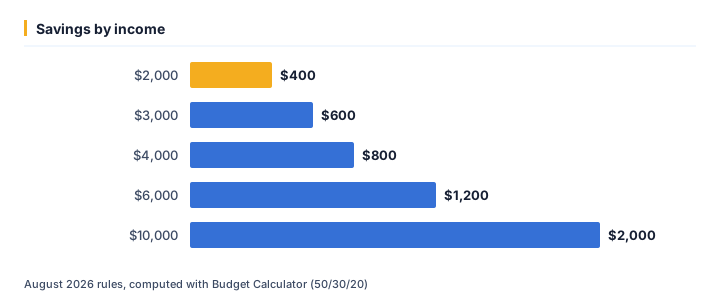
We ran 5 values of income through the calculator and left every other input at its default. As of August 2026, the output was:
| Income ($) | Savings ($) | Needs ($) | Wants ($) |
|---|---|---|---|
| 2,000 | 400 | 1,000 | 600 |
| 3,000 | 600 | 1,500 | 900 |
| 4,000 | 800 | 2,000 | 1,200 |
| 6,000 | 1,200 | 3,000 | 1,800 |
| 10,000 | 2,000 | 5,000 | 3,000 |
Running income from $2,000 up to $10,000 moves savings from $400 to $2,000 — a spread of $1,600. That gap is the part a single headline rate never shows.
The same runs seen through needs
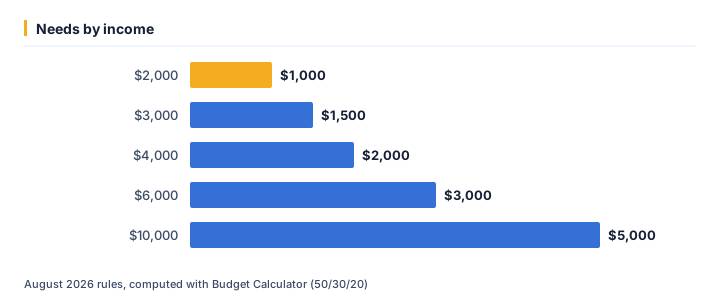
At $2,000, needs works out to $1,000; at $10,000 it is $5,000. Looking only at savings tends to understate how much the outcome shifts across that range.
One example, straight from the API
The middle row above (income = $4,000) is not a rounded illustration — it is exactly what /api/v1/tools/budget-calculator/calculate returns for that input, August 2026 rules:
{
    "tool": "budget-calculator",
    "inputs": {
        "income": 4000
    },
    "result": {
        "needs": 2000,
        "wants": 1200,
        "savings": 800
    }
}
Assumptions behind these figures
| Input | Value |
|---|---|
| Income | $4,000 |
| As of | August 2026 |
| Method | identical to /tools/budget-calculator |
Rates, thresholds and typical costs change over time; the numbers above are accurate as of August 2026, not a permanent guarantee. For your own situation, open the Budget Calculator (50/30/20) and enter your real numbers — the calculator runs the same code that produced every figure on this page.
Ready to crunch your numbers?
Open the Budget Calculator (50/30/20) and get an answer in seconds.
Editorial Team
We write plain-English money guides and build the free calculators behind them.