Building a 6-month emergency fund from zero takes 18–30 months for most households — and that is mathematically sound. Here is the phased playbook that actually finishes.
Building a 6-month emergency fund from zero usually takes 18 to 30 months. That feels slow when you first see the number — most households read "six months of expenses" and assume they will knock it out in a year through sheer willpower. The data does not agree. Households that aim to build a full emergency fund inside 12 months almost universally fail. They either run out of stamina, raid the partial fund for a non-emergency, or starve other priorities (employer match, high-interest debt payoff) so badly that they end up worse off than when they started.
The slower 18–30 month plan finishes. It finishes because it accounts for life — for the surprise dental bill in month four, the car repair in month nine, the layoff scare in month fourteen. It finishes because it sequences priorities correctly: the small starter buffer comes first, the employer match and toxic debt come next, the 3-month milestone is treated as the durable resting point, and the full 6-month target is the long pull at the end.
This is the phased playbook. It is not glamorous. It will not promise a six-month buffer by Christmas. But it is the version that works for normal households on normal incomes — and it is the one you can actually finish.
First, Compute Your Target Number
Before you can build a 6-month emergency fund, you need a target dollar figure — and the figure most people pick is wrong because they use the wrong baseline.
The target is six months of essential monthly expenses, not six months of total spending. Essential expenses are the bills you would still have to pay during a layoff: housing, utilities, groceries, insurance, transportation to job interviews, minimum debt payments, basic phone and internet. Streaming services, dining out, vacations, gym memberships, and discretionary shopping do not count — during a real emergency, those get cut on day one.
Use the Emergency Fund Calculator to compute your number cleanly. The tool walks you through each essential category so you do not double-count or accidentally include lifestyle spending.
Worked example. A household with the following essentials:
- Rent: $1,800
- Utilities and internet: $250
- Groceries: $750
- Auto (insurance, gas, basic maintenance): $400
- Health insurance premium: $450
- Minimum debt payments: $300
- Phone and basic services: $100
- Buffer for incidentals: $150
Essential monthly total: $4,200. Six-month target: $25,200.
Write that number down. It is going to anchor every decision in the next two years.
Phase 1: The $1,000 Starter Buffer (Weeks 1–10)
Before you do anything else — before you optimize your 401(k), before you attack credit card debt, before you even think about the full $25,200 target — get $1,000 in a separate savings account.
The starter buffer exists for one reason: to stop the next surprise from becoming new credit card debt. If you start an aggressive debt payoff plan with $14 in savings, the next $600 car repair undoes three months of progress and demoralizes you out of the plan entirely. The $1,000 starter is the firebreak.
It does not need to be in a high-yield account yet. It just needs to be separated from your checking account so you do not casually spend it. A free online savings account that takes 1–2 business days to transfer is ideal — fast enough for real emergencies, slow enough that you cannot impulse-buy with it.
Tactics to hit $1,000 fast:
- Sell stuff. Facebook Marketplace, Craigslist, OfferUp. Most households have $300–$800 sitting in closets, garages, and storage units. One focused weekend of listing and meeting buyers can clear half the target.
- Run one no-spend month. Groceries and bills only. No restaurants, no Amazon, no coffee out, no convenience purchases. The typical no-spend month frees up $400–$1,200.
- Add side gig hours. DoorDash, Instacart, Uber, freelance work on weekends. Twelve to fifteen hours over three weekends will usually clear $400+.
- Dedicate the next paycheck overflow. Whatever is left over after fixed bills goes straight to the starter — not into checking where it disappears.
- Apply windfalls. Tax refund, work bonus, birthday cash, rebate checks — 100% to the starter until you hit $1,000.
Most households with focused effort hit the $1,000 mark in 6 to 10 weeks. Some hit it in three. The exact speed matters less than building the habit of paying the savings account before the spending account.
Phase 2: Capture Match + Eliminate Toxic Debt (Months 3–12+)
Once the $1,000 starter is in place, stop adding to the emergency fund for a stretch. This sounds wrong — you just promised yourself a 6-month buffer — but the math is clear.
Capture the full employer 401(k) match first. If your employer matches 100% of contributions up to 4% of salary, that is a guaranteed 100% return on the money. No emergency fund on the planet earns 100%. Skipping the match to build savings faster is mathematically the same as setting money on fire. Contribute at least up to the full match before you do anything else with new income.
Then eliminate high-interest debt. Anything over roughly 7% APR — credit cards, payday loans, personal loans, predatory auto debt — gets attacked next. Credit card balances at 22% APR are growing faster than any emergency fund could ever earn. Carrying the balance while building savings is paying 22% to earn 4%. You are losing 18 cents on every dollar.
The debt avalanche method (highest APR first) saves the most money; the snowball method (smallest balance first) builds the most momentum. Pick whichever you will actually finish.
This phase takes anywhere from 3 to 12+ months depending on debt load. It is not a digression from the emergency fund plan — it is the foundation. Without the match captured and the toxic debt cleared, your household stays one bad month away from backsliding into the cycle of borrowing-to-survive that the emergency fund was supposed to break.
Keep the $1,000 starter untouched the entire time.
Phase 3: The 3-Month Milestone (Months 12–20)
With toxic debt gone and the 401(k) match flowing, return your attention to the emergency fund — but aim for the 3-month milestone first, not the full six.
For a household with $4,200 in essential expenses, the 3-month target is $12,600. Subtract the $1,000 starter that is already in place: you need $11,600 more.
To hit it in 16 months, divide: $11,600 ÷ 16 = $725/month. Round to $720/month for clean automation. Set the transfer on payday, the day before bills hit, into a high-yield savings account.
The math is intentionally rounded. A $25 swing in the monthly transfer does not change your life. The discipline of the recurring transfer does.
Why pause at three months and not push straight to six? Because three months is durable enough for most households. Three months of expenses is enough cash to survive a typical layoff (US average unemployment duration is roughly 5 months but most people find work in 2–4), a major medical event, or a serious home repair. It is not "minimum viable" — it is genuinely protective.
Many households consciously pause here for a year or two, ramp up retirement contributions beyond the match, and only later return to push toward the full 6-month target. That sequence is fine. The 3-month buffer plus increased retirement contributions often delivers better long-term outcomes than racing to 6 months at the expense of compounding investment time.
Use the Emergency Fund Calculator to track progress and the Savings Goal Calculator to model how changes to the monthly contribution shift the timeline.
Phase 4: The 6-Month Milestone (Months 18–30)
If you choose to continue all the way to six months — and for self-employed households, single-income households, or anyone with variable income, you probably should — you extend the contribution timeline by another 12 to 18 months.
By this point your household has stable habits, a real savings rate, and the muscle memory of automated transfers. Continuing is much easier than starting was.
Worked example. From the 3-month buffer of $12,600, you need another $12,600 to hit $25,200. Over 18 months that is $700/month. Over 12 months it is $1,050. Pick the pace that fits your income and other priorities. Retirement contributions should continue throughout — never pause those to finish the emergency fund faster.
Some households reach the full 6-month target by month 24; others by month 30. Both are fine. The household that lands at $25,200 in month 28 with a healthy 401(k) is in dramatically better shape than the household that hit it in month 14 by skipping the match.
Where to Keep the Money
The account matters almost as much as the saving habit. The right home for an emergency fund is a high-yield savings account (HYSA) at an online bank.
Reputable options include Ally, Marcus by Goldman Sachs, Capital One 360, SoFi, and Wealthfront Cash. All are FDIC-insured (or partner-bank FDIC-insured), all pay competitive interest rates that adjust with the Fed, and all transfer to your checking account in 1–3 business days. Rates change frequently — compare current APYs before opening.
Why HYSA and nothing else:
- Liquid. Instant or 1-day transfer to checking. Real emergencies do not wait two weeks for a CD to mature.
- FDIC insured. Up to $250,000 per depositor per bank. Your principal does not disappear.
- Competitive rate. Online banks consistently pay 10–20× what brick-and-mortar checking pays. The money grows quietly while it sits.
- No market risk. The balance does not drop 30% in a recession — which, statistically, is exactly when you will need it.
Avoid:
- Checking accounts. Too easy to spend by accident.
- Brokerage / index funds. Market volatility means the worst-case scenario for stocks (a recession) is the same scenario that triggers job losses. You cannot hold an emergency fund in something that goes down when emergencies hit.
- Long-duration CDs. The lock-up defeats the purpose. A short laddered CD strategy is acceptable for a portion of a very large fund, but not the bulk.
- 401(k) or IRA. Withdrawals are taxable, often penalized, and slow.
Acceleration Tactics
If 24 months feels too long, you can compress the timeline meaningfully — usually down to 14–18 months — by stacking several tactics. None individually transforms the plan; together they cut months off the back end.
- Direct deposit split. Most US employers let you split direct deposit between two accounts. Send the emergency fund contribution directly from payroll to the HYSA — never to checking. Money you never see in checking is money you never spend.
- Windfalls go straight to the fund. Tax refund, year-end bonus, gift money, rebate checks, side income — 100% to the fund until the target is hit. The IRS refunds the average household around $2,800 each spring. Routing that single check pulls a month or more off the timeline.
- No-spend months. Run one per quarter. A focused no-spend month typically frees up $400–$1,500 depending on household size. Four per year is $1,600–$6,000 in extra contributions.
- Side income earmarked. Every dollar from a side gig, freelance project, or seasonal work goes directly to the fund. Do not let it leak into lifestyle spending. Side income is bonus fuel.
- One big stuff-selling weekend. Marketplace, Craigslist, consignment, garage sale. Most households can clear $500–$2,000 in one focused weekend. Schedule it.
- Bank every raise. When your salary goes up by $200/month, increase the HYSA transfer by $200/month before lifestyle expands. The household never feels the raise — but the timeline contracts significantly.
Stacked, these tactics regularly compress a 24-month build into 14 to 18 months without feeling brutal.
When to Pause Building
Pausing the contribution is sometimes the right call. Pausing is not abandoning — there is a difference, and it matters.
Three legitimate reasons to pause:
- High-interest debt accumulated again. A medical bill, an emergency that you covered partly with the card — whatever caused new toxic debt, eliminate it before resuming heavy emergency fund contributions. Carrying 22% APR debt while saving at 4% APY is a guaranteed loss.
- Major life event imminent. New baby in three months, home purchase closing in six, a planned career change. Temporarily redirect the contribution toward whichever immediate need is most pressing. Just put a date on the calendar when the emergency fund transfer resumes.
- 3-month milestone reached and other priorities matter more. Once you have three months of essentials in cash, increasing retirement contributions, paying down a mortgage, or funding a child's 529 may produce more long-term wealth than racing to month six.
Pausing is fine. Abandoning is not. Re-establish the recurring transfer the moment the immediate priority is handled. Set a calendar reminder for the date.
What Counts as a Real Emergency
The fund only works if you actually leave it alone. A simple decision rule:
Yes — use the fund for:
- Job loss or sudden major income reduction
- Major medical bill not covered by insurance
- Major home repair (HVAC failure, roof damage, plumbing flood)
- Major vehicle repair when the vehicle is needed for work
- Family emergency requiring travel or unplanned support
- A genuine, unforeseeable shock that you cannot defer
No — do not use the fund for:
- Planned vacations or holiday travel
- Holiday gifts
- Annual car insurance premium, annual subscriptions, or other predictable irregular expenses — those belong in sinking funds, not the emergency reserve. See Sinking Funds vs Emergency Funds for the distinction.
- Normal monthly bills (those come out of normal income, not savings)
- Lifestyle upgrades, "deals," or impulse purchases
- Lending money to family or friends
If you do tap the fund for a real emergency, the next financial priority — even before resuming brokerage contributions or extra debt payments — becomes refilling the fund back to its prior level.
Common Mistakes
- Skipping the $1,000 starter buffer and jumping straight to "six months from zero." Almost always ends in burnout.
- Keeping it in checking. It will be gone by month four.
- Investing it for higher returns. When the market drops, your emergency arrives the same week.
- Including future expected income in the target. Plan with the income you have now, not the raise you hope to get.
- Counting credit card availability as "the buffer." Available credit is debt waiting to happen, not savings.
- Pausing 401(k) match contributions to build the fund faster. You are giving up a guaranteed 100% return to chase a 4% return.
- Raiding the fund for sinking-fund-category expenses. Annual insurance, holidays, and vacations need their own buckets.
- Forgetting to refill after a real emergency. Tapping the fund is fine. Leaving it depleted is not.
Frequently Asked Questions
Should I pay off credit card debt before building the fund?
Get the $1,000 starter buffer in place first, then attack credit card debt aggressively before resuming the larger build. Carrying a 22% APR balance while saving at 4% APY loses money every month. Knock out the toxic debt, then return to the emergency fund.
Can I keep it in a Roth IRA as backup?
Roth IRA contributions (not earnings) can be withdrawn at any time without tax or penalty, so some households treat the Roth as an emergency-fund-of-last-resort. The downside: once you pull contributions out, the contribution room is gone forever. Treat the Roth as a true last resort, not the primary fund. Keep most of your emergency cash in an HYSA.
How much should I actually have if I'm self-employed?
Self-employed households typically aim for 9 to 12 months of essential expenses, not six. Variable income, gap risk, and the absence of employer-sponsored unemployment benefits all justify a larger buffer. See How much emergency fund you really need for the deeper analysis.
What if my essential expenses change?
Recompute the target whenever a major expense shifts — rent change, new baby, new car payment, paid-off mortgage. Rerun the Emergency Fund Calculator and adjust the contribution amount. Annual check-ins are reasonable for stable households.
Can I have too much in an emergency fund?
Yes. Beyond 9–12 months of expenses for most households, additional cash earns less than it would in retirement accounts or taxable investments. Once you are well past the target, redirect future savings to higher-return destinations.
Where does the emergency fund fit alongside retirement savings?
Order: $1,000 starter → 401(k) match → toxic debt payoff → 3-month emergency fund → ramp retirement contributions → 6-month emergency fund → broader investing. Match contributions never pause. For a personalized plan, consider a fee-only CFP through letsmakeaplan.org.
Next Steps
Three actions for this week:
- Run your target number. Use the Emergency Fund Calculator to compute your 3-month and 6-month targets based on actual essential expenses — not generic rules.
- Open the HYSA. Pick one of Ally, Marcus, Capital One 360, SoFi, or Wealthfront. Fund it with whatever you can spare today, even if it is $50. The account has to exist before the habit can.
- Automate the first transfer. Use the Savings Goal Calculator to set a monthly contribution amount, then schedule a recurring transfer on payday. Tune your spending with the Budget Calculator so the contribution actually clears.
For the deeper theory on how much you really need before you start building, read the companion guide: How much emergency fund do you really need.
Build is slow. Finished is fast. Start the transfer this week.
Run the numbers
Everything below came out of this site's own Budget Calculator (50/30/20). The figures are not quoted from anywhere else: each row is one run of the same calculation the tool page performs, using August 2026 rules. Put the same inputs in and you will get the same output.
How the result moves with income
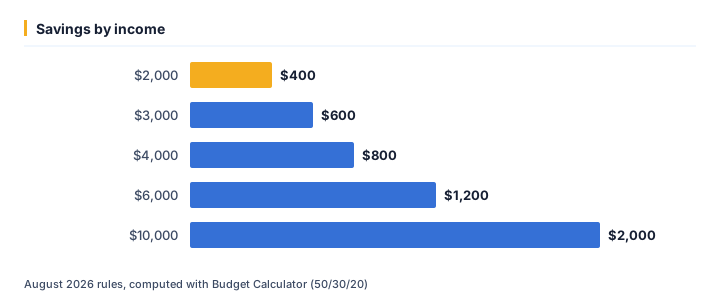
We ran 5 values of income through the calculator and left every other input at its default. As of August 2026, the output was:
| Income ($) | Savings ($) | Needs ($) | Wants ($) |
|---|---|---|---|
| 2,000 | 400 | 1,000 | 600 |
| 3,000 | 600 | 1,500 | 900 |
| 4,000 | 800 | 2,000 | 1,200 |
| 6,000 | 1,200 | 3,000 | 1,800 |
| 10,000 | 2,000 | 5,000 | 3,000 |
Running income from $2,000 up to $10,000 moves savings from $400 to $2,000 — a spread of $1,600. That gap is the part a single headline rate never shows.
The same runs seen through needs
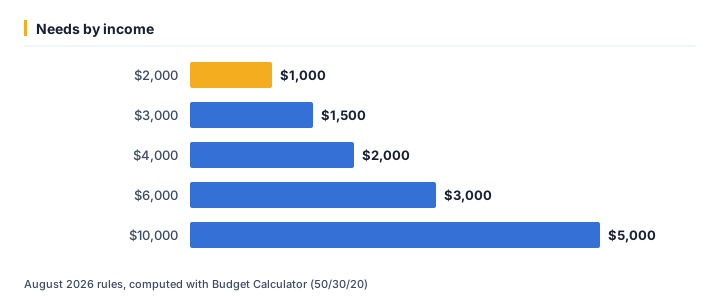
At $2,000, needs works out to $1,000; at $10,000 it is $5,000. Looking only at savings tends to understate how much the outcome shifts across that range.
One example, straight from the API
The middle row above (income = $4,000) is not a rounded illustration — it is exactly what /api/v1/tools/budget-calculator/calculate returns for that input, August 2026 rules:
{
    "tool": "budget-calculator",
    "inputs": {
        "income": 4000
    },
    "result": {
        "needs": 2000,
        "wants": 1200,
        "savings": 800
    }
}
Assumptions behind these figures
| Input | Value |
|---|---|
| Income | $4,000 |
| As of | August 2026 |
| Method | identical to /tools/budget-calculator |
Rates, thresholds and typical costs change over time; the numbers above are accurate as of August 2026, not a permanent guarantee. For your own situation, open the Budget Calculator (50/30/20) and enter your real numbers — the calculator runs the same code that produced every figure on this page.
Ready to crunch your numbers?
Open the Budget Calculator (50/30/20) and get an answer in seconds.
Editorial Team
We write plain-English money guides and build the free calculators behind them.