A practical step-by-step guide to negotiating salary — research, anchoring, scripts, total compensation, handling pushback, and the lifetime-compounding math behind a single raise.
A single salary negotiation conversation, conducted well, is probably the highest hourly wage you will ever earn. An hour of preparation and a fifteen-minute conversation can move your starting salary by $5,000 or more, and that delta does not just show up once — it rides forward on every future percentage raise, every bonus tied to base, every retirement match, for the rest of your career.
By the end of this tutorial, you will know how to research your market value, set anchor and walk-away numbers, deliver a calm script, negotiate the entire compensation package, and handle the standard pushback.
This is the "how-to" companion to our deeper guide on maximizing your worth at work. That one focuses on the why. This one focuses on the how.
Why a Single Conversation Compounds for Decades
Before the mechanics, see the math — it is what gives you the resolve to ask. Imagine you accept an offer of $85,000 without negotiating. Now imagine an alternate version where you negotiate and get $90,000 — a $5,000 bump. Sounds modest. It is not.
Assume both versions get the same 3% annual raise for 30 years:
| Year | No negotiation ($85K start) | Negotiated ($90K start) | Annual gap |
|---|---|---|---|
| Year 1 | $85,000 | $90,000 | $5,000 |
| Year 5 | $95,664 | $101,288 | $5,624 |
| Year 10 | $110,902 | $117,422 | $6,520 |
| Year 20 | $149,022 | $157,786 | $8,764 |
| Year 30 | $200,254 | $212,033 | $11,779 |
| Lifetime total | ~$4.04M | ~$4.28M | ~$240,000 |
That is roughly a quarter-million dollars of lifetime earnings from one conversation. If you invest the difference at a 7% real return, the Salary Negotiation Calculator shows the invested gap grows to well over $500,000 by retirement. Plug your own numbers into the Compound Interest Calculator to confirm — same math behind every retirement projection, applied to the gap between two starting salaries.
You are not haggling over a five-thousand-dollar bonus. You are setting the floor of a multi-decade compounding curve.
Step 1: Research the Market Before You Open Your Mouth
The single biggest predictor of whether a negotiation succeeds is how prepared you are with credible market data. Walking in with a vague feeling that you "deserve more" is a losing strategy. Walking in with three specific data points for your role, location, and years of experience changes the dynamic.
There are roughly three categories of sources, and you want at least one data point from each:
Government data. The US Bureau of Labor Statistics (BLS.gov) publishes occupational wage data by metro area, updated annually. It gives you a credible, neutral median and percentile range for your occupation and city — the data point hardest for an employer to dispute.
Crowdsourced compensation databases. Sites like Glassdoor, Levels.fyi (especially for tech), and Payscale aggregate self-reported numbers from employees and offer letters. Accuracy varies, but for common roles the medians are usually in a reasonable band. Cross-check at least two against each other and against the BLS number.
Your own network. The most accurate source is people doing the same job at peer companies. Awkward to ask directly, but warmer than you think when framed well: "I'm considering an offer and want to make sure my range is realistic — would you be open to sharing what bands you've seen for [role] at companies our size?" Recruiters who reach out to you are also a free source — ask the band before anything else.
You are looking for three numbers: the 25th percentile, the median, and the 75th percentile. You will use these in Step 2 to set your anchor.
Step 2: Set Your Anchor and Your Walk-Away
Before any conversation about money happens, you need two numbers written down.
Your anchor number is the figure you will open with. Negotiation research is consistent: whichever side names a number first sets the gravitational center of the conversation. Your anchor should be at or slightly above the 75th percentile of your market research — high enough to leave room to come down, low enough that it does not sound delusional.
Your walk-away number is the floor below which you will politely decline. This is the harder number, because it requires honesty about your alternatives. If you have a current job paying $95,000, your walk-away for a comparable new role probably is not less than $100,000 — otherwise you would just stay. If you are unemployed and rent is due in six weeks, your walk-away is lower, and you should know that going in.
Write both numbers down. Do not change them mid-negotiation under emotional pressure. That is what they exist to prevent.
A worked example
You are interviewing for a marketing manager role in a mid-sized US metro. BLS data says the median for your occupation and city is $78,000. Glassdoor median at companies your target's size is $82,000. Two people in your network say their offers were $85K and $90K.
You synthesize that as roughly $75K (25th), $82K (median), $92K (75th). You set your anchor at $95,000 (slightly above 75th, with room to come down) and your walk-away at $80,000 (around median, given your three years of experience).
Step 3: Use a Range, Not a Single Number — and Know When to Flip
When the recruiter asks "What are your salary expectations?", the default best answer is a range, not a single number. A range gives you a polite anchor without sounding rigid, and signals that you have done your research.
The range should put your true target at the bottom of what you say. If you would actually be happy at $95K, your range should be "$95,000 to $110,000, depending on the total package." People hear ranges and gravitate toward the middle or bottom; you do not want the bottom to be a number you would resent.
There is one situation where you flip to a single number: when the employer has already named theirs and you are countering. At that point ranges become hedging. If they have offered $85K and you want $95K, do not say "I was thinking $90K to $100K" — say "I was hoping we could get to $95,000 base." A specific number signals seriousness and gives them a clean target to hit.
Step 4: Practice the Script Out Loud
The biggest reason negotiations go badly is that the candidate has never actually said the words out loud before. The first time you ever hear yourself ask for more money is in the actual conversation, and it comes out shaky and apologetic. The fix is just practice — five minutes in front of a mirror will do more than any amount of reading.
Three short scripts to memorize and adapt. Long explanations weaken negotiation; brevity signals confidence.
Script 1: The initial counter
"Thanks so much for the offer — I'm really excited about the role and the team. Based on the research I've done on the market and my experience with [specific skill], I was hoping we could get the base to $95,000. Is there flexibility there?"
Thirty-five words. It does not apologize, over-explain, or threaten. It states a specific number, gives a one-line justification, and asks a closed question. Then you stop talking and let the silence sit.
Script 2: The counter to a counter
"I appreciate you taking that back to the team. I understand $90,000 is the limit on base — could we close the gap with a one-time signing bonus, or with an earlier performance review at six months?"
When base is stuck, pivot to other levers. Specific alternatives are much easier to say yes to than open-ended asks.
Script 3: The walk-away
"Thank you for the offer and the conversations — I've enjoyed getting to know the team. Unfortunately, the package as it stands is below where I need to be for this move to make sense. I'd love to stay in touch if anything changes on the budget side."
Hard to deliver, and you should hope you never need it. But knowing the script exists, with the door left open politely, lets you actually use your walk-away number rather than caving at the last moment.
Step 5: Negotiate the Whole Package, Not Just Base
Base salary is the headline number and the one that compounds through future raises, so it matters most. But it is not the only lever, and when base is genuinely capped, the other levers add up to real money.
Negotiable items in most US offers:
- Signing bonus. Often the easiest lever because it does not affect the salary band. A $10,000 sign-on is regularly available even when base is fixed.
- Equity grant. Especially at startups and public tech companies — often negotiable by 10–25%.
- Annual bonus target. Some companies have flexibility on the target percentage; ask.
- Paid time off. An extra week of PTO is roughly 2% of your salary, and costs the employer no cash.
- Remote-work flexibility or home-office stipend. Some employers will trade a few thousand here in lieu of base.
- Earlier performance review. A written agreement to revisit in 6 months rather than 12 can be worth thousands.
- Relocation package, if relevant.
- Professional development budget — courses, conferences, certifications.
- Title. Not money, but it affects your next job's anchor.
Total compensation is the number to optimize. Run your offer through the Salary Negotiation Calculator with and without each lever and you will see which ones move the needle for your situation.
Step 6: Internal Negotiation Is Different (But Still Works)
Most of this guide is framed around new offers, but the same principles apply to negotiating a raise inside a job you already have. Three things shift:
You usually do not have a competing offer. That is fine — most internal raises happen without one. What you do have is a documented record of your contributions over the past six to twelve months. Walk in with a one-page list: projects delivered, metrics moved, scope expanded.
Timing matters more. Internal raises are easiest right after a clear win — a successful launch, a promotion-adjacent project. They are easier in the lead-up to a formal review cycle than mid-cycle.
The anchor is smaller but the conversation is similar. A 10–15% internal raise is on the realistic end; 20%+ usually requires a title change. The Step 4 script still works almost verbatim — you are just asking your manager instead of a recruiter. Avoid framing it as a binary ultimatum; "give me X or I leave" sometimes works but permanently changes the relationship even when it succeeds.
Step 7: Handle the Standard Pushback
Four pieces of pushback to expect, with an answer ready for each.
"We don't have the budget for that." Sometimes true, sometimes a tactic. Pivot to other levers rather than fold: "I understand the base might be capped — could we close the gap with sign-on, or with an earlier review?" You have just turned a "no" into a menu.
"That's above our band for this level." If you genuinely think you should be hired at a higher level, ask: "Would it be possible to revisit the level, given [specific scope of past work]?" Otherwise pivot to total compensation.
"We'll revisit at your annual review." A soft promise that costs them nothing today. Make it concrete: "I'd be more comfortable with that if we could put a six-month checkpoint in writing, with specific milestones." If they refuse to put anything in writing, that tells you how the next review will go.
"This is our final offer." Maybe it is, maybe not. Test it calmly: "I understand. Let me think it over tonight and get back to you tomorrow." That overnight pause is often enough for "final" offers to become slightly less final. If they really are final and below your walk-away, you walk.
Mistakes That Quietly Cost You Money
A short list of own-goals:
- Apologizing for asking. The negotiation is a normal business conversation. Treat it like one.
- Naming the first number when you do not have to. Try to get the employer to name their range first.
- Lying about a competing offer. Recruiting communities are smaller than you think, and getting caught nukes the offer and your reputation.
- Accepting on the spot. Always sleep on it. Nothing legitimate gets rescinded over twenty-four hours.
- Negotiating verbally only. Get the final number in writing before you give notice anywhere.
- Anchoring on your current salary. Your old salary is not your market value.
- Going in cold. Five minutes of preparation prevents most of the worst outcomes.
A Note on the Bigger Compensation Picture
Salary is the input, but not the whole financial picture. How you allocate it — between retirement contributions, taxable investing, debt payoff, and quality-of-life spending — often matters more than the headline number ten years out. Sketch a rough monthly plan with the Budget Calculator once you have a working offer.
For more complex packages — meaningful equity grants, deferred bonuses, or stock options with tax implications — the analysis outgrows back-of-the-envelope math. A fee-only Certified Financial Planner can help you weigh the offer against your full retirement and tax picture. You can find one near you through letsmakeaplan.org.
Frequently Asked Questions
What if the employer asks for my current salary? In many US states this question is now illegal, and even where it is legal you do not have to answer it. Polite redirect: "I'd prefer to focus on what the role is worth in the market. My expectations are in the $X to $Y range."
How much higher than my target should I anchor? A reasonable rule is 10–20% above your actual target. Any higher and you risk being dismissed as unserious; any lower and you have no room to "come down" to a satisfying compromise.
Can I negotiate every offer, or are some really fixed? Almost every private-sector US offer has some flexibility — if not on base, then on sign-on, equity, PTO, or start date. Exceptions are union-scale roles, some entry-level rotational programs, and certain government positions.
Is it OK to negotiate by email instead of a call? Either works. Email has advantages: time to draft the words carefully and a written record. A short, polite email with a specific counter is often more effective than a tense phone call.
How long should I take to respond to an offer? Twenty-four to forty-eight hours is standard. Anything beyond a week without a clear reason starts to look like you are shopping the offer.
What if I genuinely have no other options? Your walk-away number is lower, and you should be honest about that going in. But "no other options today" does not mean you cannot negotiate — your anchor is just more modest. Even a $2,000 bump compounds for the rest of your career.
Next Steps
- Run your specific offer through the Salary Negotiation Calculator. Plug in your offer, your target, your expected raise rate, and your years to retirement. Seeing the lifetime gap in dollars is often the push people need to actually ask.
- Pull three market data points before your next compensation conversation — one from BLS, one from a crowdsourced site, one from your network. Write them down.
- Practice the Step 4 scripts out loud, three times, before any real conversation. Awkward in the mirror beats shaky in the meeting.
The numbers in this guide are illustrative — your industry, region, and seniority will move them around. But the structure is the same everywhere: research, anchor, range, script, total package, pushback, walk-away. Done once well, the conversation pays for itself many times over.
Run the numbers
Everything below came out of this site's own Budget Calculator (50/30/20). The figures are not quoted from anywhere else: each row is one run of the same calculation the tool page performs, using August 2026 rules. Put the same inputs in and you will get the same output.
How the result moves with income
We ran 5 values of income through the calculator and left every other input at its default. As of August 2026, the output was:
| Income ($) | Savings ($) | Needs ($) | Wants ($) |
|---|---|---|---|
| 2,000 | 400 | 1,000 | 600 |
| 3,000 | 600 | 1,500 | 900 |
| 4,000 | 800 | 2,000 | 1,200 |
| 6,000 | 1,200 | 3,000 | 1,800 |
| 10,000 | 2,000 | 5,000 | 3,000 |
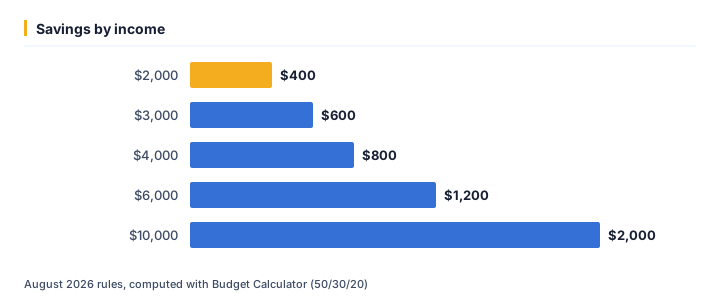
Running income from $2,000 up to $10,000 moves savings from $400 to $2,000 — a spread of $1,600. That gap is the part a single headline rate never shows.
The same runs seen through needs
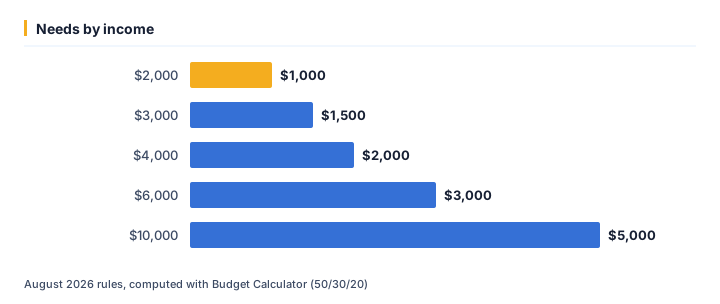
At $2,000, needs works out to $1,000; at $10,000 it is $5,000. Looking only at savings tends to understate how much the outcome shifts across that range.
One example, straight from the API
The middle row above (income = $4,000) is not a rounded illustration — it is exactly what /api/v1/tools/budget-calculator/calculate returns for that input, August 2026 rules:
{
    "tool": "budget-calculator",
    "inputs": {
        "income": 4000
    },
    "result": {
        "needs": 2000,
        "wants": 1200,
        "savings": 800
    }
}
Assumptions behind these figures
| Input | Value |
|---|---|
| Income | $4,000 |
| As of | August 2026 |
| Method | identical to /tools/budget-calculator |
Rates, thresholds and typical costs change over time; the numbers above are accurate as of August 2026, not a permanent guarantee. For your own situation, open the Budget Calculator (50/30/20) and enter your real numbers — the calculator runs the same code that produced every figure on this page.
Ready to crunch your numbers?
Open the Budget Calculator (50/30/20) and get an answer in seconds.
Editorial Team
We write plain-English money guides and build the free calculators behind them.