A step-by-step walkthrough for paying off debt faster, with US-dollar worked examples, payoff timeline tables, and where the extra dollars actually come from.
Paying off debt faster is rarely a question of willpower. It is a question of arithmetic. Every month your balance sits, the lender is charging you a percentage of it. The faster you reduce the balance, the less you pay in interest, and the sooner the payment frees up for something else.
This tutorial walks you through it end to end: inventory what you owe, pick a method, find the extra dollars, and run the math.
For the deeper why behind the major repayment strategies, see our companion piece, debt payoff strategies. This article is the how.
Why "Faster" Is Mostly About Interest Math
When you make only the minimum payment on a credit card, most of that payment is interest. The principal barely moves. Credit card minimums are typically about 1% of the balance plus the month's interest, which means a card at 22% APR with an $8,400 balance takes over 20 years to pay off at the minimum, with roughly $11,000 in interest along the way. The original $8,400 ends up costing nearly $19,400.
Add just $100 extra per month to that same card and the payoff drops to about 5 years, with total interest near $3,400. That is over $7,500 saved for a hundred dollars a month — money that was otherwise scheduled to flow to the lender as pure interest.
This is the engine of every fast-payoff strategy. Nothing else you do moves the needle as much as putting one additional dollar against principal. The rest of this guide is about finding those dollars and pointing them at the right balance. You can replicate any of the numbers above using the loan payoff calculator.
Step 1: List Every Debt You Owe
Before you optimize anything, you need an honest inventory. Open a spreadsheet and write down every debt with four columns: lender, balance, APR, and minimum monthly payment. A common list looks like this:
| Debt | Balance | APR | Minimum Payment |
|---|---|---|---|
| Credit card A | $8,400 | 22.0% | $210 |
| Credit card B | $2,150 | 18.9% | $55 |
| Auto loan | $14,300 | 7.2% | $385 |
| Student loan | $24,000 | 6.5% | $275 |
| Personal loan | $4,800 | 11.5% | $145 |
| Total | $53,650 | — | $1,070 |
A few things jump out: the two credit cards probably cost more in interest than the larger student loan because their APRs are 3–4× higher, and the total minimum — $1,070 per month here — is already leaving your account no matter what.
What to Include and What to Skip
Include any debt with a fixed monthly payment and a balance: credit cards, store cards, auto loans, student loans, personal loans, medical bills on a payment plan, "buy now, pay later" balances, and money owed to family you intend to repay.
Skip your mortgage for this exercise unless paying it off early is a specific goal. Mortgage rates are usually low relative to other debt and the tax treatment is different. Most people leave the mortgage on its normal schedule and focus the accelerated payoff on higher-interest balances first.
Step 2: Pick a Method (Snowball vs Avalanche)
There are two well-known methods for ordering your payoff. Both work; they optimize for different things.
The debt avalanche orders debts from highest APR to lowest. You pay the minimum on everything, then put every extra dollar against the highest-rate debt. When that one is gone, you roll its full payment onto the next-highest rate. This is mathematically optimal — it minimizes total interest paid.
The debt snowball orders debts from smallest balance to largest, ignoring APR. You knock out the smallest first for the psychological win, then roll its payment onto the next-smallest. Research has consistently shown that snowball users finish more often than avalanche users, even though they pay slightly more interest, because the early wins build momentum.
Neither is wrong. A common approach is to use avalanche if your highest-APR debt is also a manageable balance, and snowball if your highest-APR debt is a giant balance that will demoralize you for years. See snowball vs avalanche debt methods for a full side-by-side comparison.
For the inventory above, the avalanche order is Credit card A → B → Personal loan → Auto → Student. The snowball order is Credit card B → Personal loan → Credit card A → Auto → Student. Pick one and commit.
Step 3: Find the Extra Dollars
Every dollar of accelerated payoff has to come from somewhere — either a cut in spending, an increase in income, or a structural change in the debt itself. Most people end up using a combination. Here are six places to look.
Trim Recurring Costs
Recurring monthly charges are the easiest place to find money because cutting them once keeps paying you every month. Pull your last two months of statements and look at every subscription, streaming service, software trial, gym membership, and app charge. A common find is $80–$150 per month of services that are easy to pause, cancel, or downgrade — that alone can become an extra credit card payment.
Refinance or Consolidate at a Lower Rate
If your credit score has improved since you took out a loan, refinancing the same balance at a lower APR is the most efficient dollar you will find, because you do not have to change your behavior. A $14,300 auto loan at 7.2% refinanced to 5.2% saves roughly $30 per month on the same schedule, or finishes about 6 months early at the same payment.
Balance-Transfer Cards (Carefully)
A 0% balance-transfer card can work if you treat it as a deadline rather than a vacation. The structure: 0% APR on transferred balances for 12 to 21 months, in exchange for a transfer fee of 3% to 5%.
Transferring an $8,400 credit card balance to a 0% card with a 3% fee costs you $252 up front. If the original card was charging 22% APR, you would have paid roughly $1,800 in interest over the next 12 months at your current payment — so you save about $1,500, if you actually pay it off before the promo ends. If you do not, the card snaps back to a regular APR (often 20%+) and you have paid a 3% fee for a temporary reprieve.
Negotiate Your APR
Many people find that simply calling their credit card issuer and asking for a lower APR works. The script is short: "I have been a customer for X years, I am working on paying down my balance, and I would like to request a lower interest rate." Issuers approve these requests more often than expected, particularly for customers with a clean payment history. Even a 4-point drop on an $8,400 balance saves several hundred dollars over a multi-year payoff.
Add Side Income
Cutting spending has a floor. Earning more does not. A side income of $200–$500 per month translates directly into an extra principal payment if you route it straight to the debt before it touches your regular checking account. Many people find side income psychologically easier to put toward debt than money from their day job, because it never felt like part of the budget.
Build the Payoff Into the Budget
Whichever combination you choose, the extra dollars need a home in your monthly budget so they are not quietly absorbed by lifestyle expenses. Treat the accelerated payoff like a fixed bill — same priority as rent. Build the line item in the budget calculator so it is visible every month.
Step 4: The Math of One Extra Payment Per Year
Here is one of the most useful single moves in debt payoff: make one extra payment per year, applied entirely to principal. It sounds modest. The effect is not.
Take the $24,000 student loan at 6.5% with the $275 minimum payment from the inventory above. On the normal schedule, the loan takes about 120 months (10 years) and costs roughly $8,800 in interest.
Add one $275 payment per year applied to principal — about $23 per month if smoothed out — and the picture shifts:
| Scenario | Months to Payoff | Total Interest | Total Paid |
|---|---|---|---|
| Minimum only | 120 | $8,800 | $32,800 |
| One extra payment/year | 105 | $7,650 | $31,650 |
| Plus $100/month extra | 67 | $4,750 | $28,750 |
One extra annual payment cuts more than a year off and saves over $1,100 in interest — for $275 of extra cash flow you can often find inside a modest tax refund. Adding $100/month on top nearly halves the timeline and saves around $4,000 total. Plug your own numbers into the loan payoff calculator and try this on your largest balance.
Why It Works
Every dollar of extra principal stops accruing interest for the entire remaining life of the loan. A $275 extra payment in year 1 of a 10-year loan saves interest in years 1 through 10; the same payment in year 9 saves interest only in years 9 and 10. Front-loading your extra payments matters more than the size of any single one.
Step 5: Avoid the Common Traps
Most accelerated payoff plans fail in predictable ways.
Lifestyle creep mid-payoff. Six months in, the cards feel "under control" and you let one new monthly expense slide in — a streaming bundle, a gym upgrade, a slightly nicer phone plan. Re-pull your statements every 90 days to look for new recurring charges.
Raiding the emergency fund. It is tempting to throw every available dollar at debt, including the cushion. A common approach is to keep a starter emergency fund of $1,000 to $2,000 during the payoff phase so the next car repair does not land back on a credit card. The emergency fund calculator can size a starter cushion.
Balance-transfer fees that do not save money. Always run the math: transfer fee versus interest avoided. If your remaining balance is small or your existing APR is already moderate, the 3%–5% fee may not pencil out.
Closing paid-off credit cards. Closing a card reduces your total available credit and can hurt your credit utilization ratio short term. Many people leave a paid-off card open with one small recurring charge on it so the account stays active.
Paying down debt while taking on more. If you are still using a credit card for everyday spending while paying down its balance, the principal you reduce is just being replaced. Pause new charges on any card actively in the payoff plan.
Refinancing into a longer term. Refinancing at a lower rate is great. Refinancing at a lower monthly payment by extending the term is often a step backwards — you pay more total interest even at a lower rate. Compare total interest paid, not monthly payment.
Step 6: Stay With It Through the Long Middle
The first three months of any payoff plan feel productive. The last three feel inevitable. The middle is where most plans quietly fall apart.
A few patterns that help:
- Track progress visually. A simple line graph of total debt by month, updated monthly, makes the slow grind feel real.
- Roll forward freed-up minimums. When you finish one debt, immediately redirect its full payment to the next one. The monthly amount going toward principal accelerates even though your total payment stays flat.
- Celebrate finishes, not balances. Plan small, non-financial celebrations at each finish — a nice dinner, a day off, a long walk.
- Re-pull the inventory every 6 months. Watching the total balance shrink is the single best motivator most people have.
- Expect a setback. Almost every multi-year payoff has at least one bad month. A setback is not a failure. Resume next month.
When to Consider Professional Help
Some debt situations are larger than a budget spreadsheet can solve. If your minimum payments alone exceed what you can sustain, if you are using one credit card to pay another, or if you are receiving collections calls, the right next step is usually a conversation with a nonprofit credit counselor — not a for-profit "debt settlement" company.
The National Foundation for Credit Counseling (NFCC.org) maintains a directory of nonprofit member agencies that offer free or low-cost budget reviews and, where appropriate, structured debt management plans negotiated with creditors. This is more conservative than debt settlement, which has significant credit-score consequences and can come with high fees.
For broader financial planning beyond the debt itself, many people find it useful to work with a fee-only Certified Financial Planner. You can locate one through letsmakeaplan.org, which lists CFP professionals who follow a fiduciary standard. This article is illustrative, not personalized — numbers are rounded and your individual situation may differ in ways that matter.
FAQ
Should I pay off debt or build an emergency fund first?
Many people find a hybrid works best: build a starter emergency fund of $1,000 to $2,000 first, attack debt aggressively, then build the full 3–6 month fund after the high-interest debt is gone. The starter fund prevents a single car repair from undoing months of progress.
Does paying off debt early hurt my credit score?
Short term it can dip slightly — closing a paid-off account or installment loan reduces your credit mix. Medium and long term, lower balances and on-time payments are strongly positive. Most people see their score recover and improve within a few months.
Is it better to invest or pay off debt?
A common rule of thumb: pay off any debt with an APR above what you reasonably expect to earn investing (often cited as 6–8%). For credit cards in the 18%–25% range, the answer is almost always pay the debt first — you will not reliably earn 22% in any investment. For low-rate student loans or mortgages, the math is closer.
Should I use savings to pay off a credit card in one shot?
If you have savings in a 4–5% account and a credit card at 22%, the math strongly favors paying off the card — you are losing roughly 17 percentage points per year by not doing it. The caveat is leaving enough cash for emergencies so you do not land back on the card a month later.
How long should it realistically take?
For typical US households with several thousand to several tens of thousands in non-mortgage debt, a focused payoff plan often takes 18 to 48 months. The loan payoff calculator gives an exact answer for your own balances and payment.
What if my income drops mid-payoff?
Drop accelerated payments back to the minimums, keep current, and resume the extras when income recovers. Staying current matters far more than staying fast — a missed payment can do more damage to your credit score than a year of slow progress.
Next Steps
- Build your inventory table today. Lender, balance, APR, minimum payment, sorted by your chosen method (avalanche or snowball). Twenty minutes of work, total clarity on what you actually owe.
- Run your numbers in the loan payoff calculator for your highest-APR debt. Try the current minimum, then try adding $50, $100, and $200 per month. Pick the extra payment you can actually sustain.
- Schedule the extra payment as automatic on the day after your paycheck lands, so it leaves the account before any other discretionary spending. Automation is what carries you through the long middle.
Debt is arithmetic that compounds against you. The same arithmetic, run in reverse, is what gets you out. Start the table, run the numbers, and pick one extra dollar this month.
Run the numbers
Everything below came out of this site's own Budget Calculator (50/30/20). The figures are not quoted from anywhere else: each row is one run of the same calculation the tool page performs, using August 2026 rules. Put the same inputs in and you will get the same output.
How the result moves with income
We ran 5 values of income through the calculator and left every other input at its default. As of August 2026, the output was:
| Income ($) | Savings ($) | Needs ($) | Wants ($) |
|---|---|---|---|
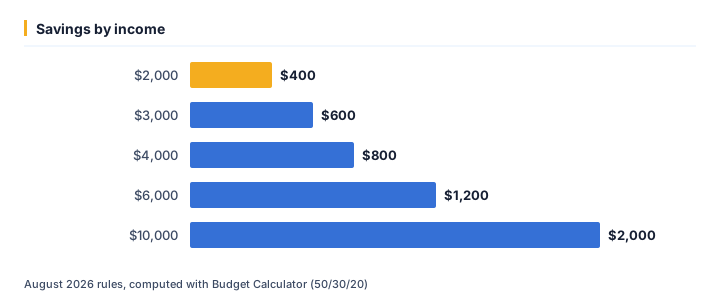
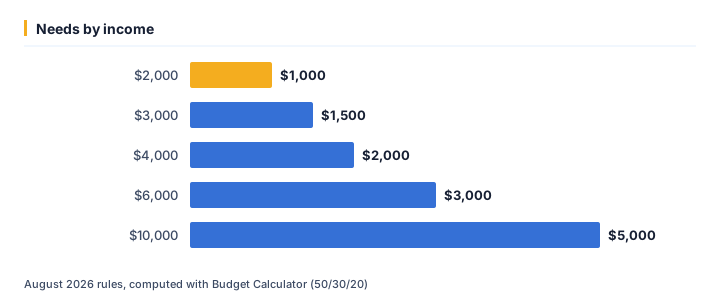
| 2,000 | 400 | 1,000 | 600 |
| 3,000 | 600 | 1,500 | 900 |
| 4,000 | 800 | 2,000 | 1,200 |
| 6,000 | 1,200 | 3,000 | 1,800 |
| 10,000 | 2,000 | 5,000 | 3,000 |
Running income from $2,000 up to $10,000 moves savings from $400 to $2,000 — a spread of $1,600. That gap is the part a single headline rate never shows.
The same runs seen through needs
At $2,000, needs works out to $1,000; at $10,000 it is $5,000. Looking only at savings tends to understate how much the outcome shifts across that range.
One example, straight from the API
The middle row above (income = $4,000) is not a rounded illustration — it is exactly what /api/v1/tools/budget-calculator/calculate returns for that input, August 2026 rules:
{
    "tool": "budget-calculator",
    "inputs": {
        "income": 4000
    },
    "result": {
        "needs": 2000,
        "wants": 1200,
        "savings": 800
    }
}
Assumptions behind these figures
| Input | Value |
|---|---|
| Income | $4,000 |
| As of | August 2026 |
| Method | identical to /tools/budget-calculator |
Rates, thresholds and typical costs change over time; the numbers above are accurate as of August 2026, not a permanent guarantee. For your own situation, open the Budget Calculator (50/30/20) and enter your real numbers — the calculator runs the same code that produced every figure on this page.
Ready to crunch your numbers?
Open the Budget Calculator (50/30/20) and get an answer in seconds.
Editorial Team
We write plain-English money guides and build the free calculators behind them.