There is no single 'best' way to pay off debt — but there is a best way for your specific debt mix, interest rates, and personality. Here is how to choose between the methods that actually work.
Debt is rarely a math problem in isolation. It is a math problem tangled together with psychology, life events, and inherited financial patterns. That is why the question "what is the best way to pay off debt" has at least four legitimate answers, depending on your debt mix, your income, and your honest relationship with money.
This guide walks through every strategy that actually works in the real US debt landscape — the two main acceleration methods (avalanche and snowball), the consolidation and refinance levers, the right order to attack different debt types, and the specific moves that keep most households from sliding back into balances once they finally get to zero.
Before Any Strategy: Map Every Debt
Most households underestimate their total debt by 15–30%. The numbers feel different when written down. Step one of any payoff strategy is to make every dollar visible in one place.
Open a spreadsheet or a notes app and list every debt with five columns:
| Lender | Current balance | APR | Minimum payment | Type |
|---|---|---|---|---|
| Chase Sapphire | $4,200 | 22.99% | $105 | Credit card |
| Citi Double Cash | $2,800 | 24.49% | $70 | Credit card |
| Toyota Financial | $14,500 | 6.4% | $310 | Auto loan |
| Nelnet | $22,000 | 5.8% | $185 | Federal student loan |
| Mortgage | $245,000 | 4.5% | $1,750 | Mortgage |
The act of writing it down does three things: it surfaces small forgotten debts (the medical bill that went to collections, the buy-now-pay-later balance you forgot existed), it shows the APR landscape clearly, and it makes the total impossible to deny.
Then sum two numbers: total minimum payments per month (the hard floor — never miss this) and total debt outstanding (your starting balance for the journey).
Categorize by Interest Rate
The single most important sort is by APR, because the higher the rate, the more aggressively that debt should be attacked.
A practical rule:
- >15% APR — toxic debt. Almost always credit cards and payday loans. Pay off as fast as humanly possible.
- 7%–15% APR — high-priority debt. Most personal loans, some auto loans, some private student loans. Aggressive paydown still wins versus investing.
- 4%–7% APR — moderate debt. Most current auto loans, federal student loans, some mortgages. Pay minimums while building investments; consider extra payments after the high-interest debt is gone.
- <4% APR — low-priority debt. Some older mortgages, some federal student loans, 0% promotional financing. Minimum payments are usually mathematically correct; investing extra dollars outperforms paydown.
The 7% line is rough but useful. Below it, the long-run real return of a diversified equity portfolio (~7%) generally beats the guaranteed "return" of debt paydown. Above it, paydown is almost always mathematically optimal because no investment reliably beats a guaranteed 15%+ rate.
The Avalanche Method
The avalanche method pays off debts in order of highest interest rate first, regardless of balance. Pay minimums on every debt; throw every extra dollar at the highest-APR balance. When it hits zero, redirect that payment to the next-highest APR. Repeat.
Mathematical advantage: the avalanche minimizes total interest paid over the life of the payoff. For a household with mixed debt — say, $7,000 in credit cards at 22–24% APR, $14,500 in an auto loan at 6.4%, $22,000 in student loans at 5.8% — the avalanche typically saves $1,500–$4,000 in interest versus the snowball method over a 3–5 year payoff window.
Best fit for: households comfortable with a longer wait between visible "wins." The first card may take 18 months to eliminate; that is a long psychological run without a celebration.
Implementation:
- List debts by APR, highest first.
- Pay minimums on all.
- Apply every extra dollar (after minimums, after the budget surplus) to the top-APR debt.
- When the top debt hits $0, roll its minimum payment into the next debt's extra payment.
- Continue until all debts are gone.
The Loan Payoff Calculator projects the exact payoff date and total interest for an avalanche schedule. Run it once at the start; rerun every 6 months to see the trajectory.
The Snowball Method
The snowball method pays off debts in order of smallest balance first, regardless of interest rate. Pay minimums on every debt; throw every extra dollar at the smallest balance. When it hits zero, redirect that payment to the next-smallest.
Behavioral advantage: the smallest debt disappears first, often within weeks. That visible "win" is psychologically powerful — published research by Northwestern Kellogg professor Scott Rick (and others) has shown households following the snowball method are more likely to complete the full debt payoff than households on the avalanche, despite the avalanche being mathematically superior on paper.
Mathematical cost: the snowball pays slightly more total interest than the avalanche. In our example mix, the snowball might cost ~$1,500–$4,000 more in interest over the full payoff.
Best fit for: households where motivation is the real constraint — repeated past starts and stops, or a long-standing feeling of being overwhelmed by debt. The early wins keep the system running.
Implementation:
- List debts by current balance, smallest first.
- Pay minimums on all.
- Apply every extra dollar to the smallest-balance debt.
- When it hits zero, redirect its minimum + extra into the next debt.
- Continue.
There is a useful hybrid: sort debts by balance ascending, but bump any credit card balance with an APR above 22% to the top of the list regardless of size. This captures most of the snowball's psychological lift while removing the worst toxic-debt outliers immediately.
See Snowball vs Avalanche Debt Methods for a head-to-head comparison with full numerical examples.
Debt Consolidation
Consolidation combines multiple debts into a single new loan, ideally at a lower interest rate. The mechanics matter.
Balance transfer credit cards
A balance transfer card lets you move existing credit card balances to a new card with a promotional 0% APR period, typically 12–21 months. The transfer fee is usually 3–5%.
Best fit for: households with strong credit (typically 700+ FICO) and credit card debt they can realistically pay off within the promotional period.
Math example: moving $8,000 from a 24% APR card to a 0% balance transfer card for 18 months (with a 3% transfer fee of $240) saves roughly $1,800 in interest over the 18 months — a strong win, provided the household actually retires the debt before the promotional rate ends.
Pitfall: if the balance is not paid off by the end of the promo period, the rate typically jumps to 19–29%, and any deferred interest may apply retroactively. Treat the promo period as a hard deadline, not a guideline.
Personal loans (debt consolidation loans)
A fixed-rate personal loan from a bank, credit union, or online lender (LightStream, SoFi, Marcus, etc.), used to pay off multiple higher-rate debts.
Best fit for: households with credit good enough to get a personal loan rate (typically 8–14% APR for prime credit) meaningfully below their existing average debt APR (typically 18–25% on credit cards).
Math example: consolidating $15,000 of credit card debt at 22% APR into a 5-year personal loan at 11% APR drops the monthly payment from ~$425 (minimum) to ~$326, and the total interest paid from ~$10,800 (under minimum-payment dynamics) to ~$4,580. A ~$6,200 savings over the life of the loan.
Pitfall: the freed-up credit card limits often get re-spent. Without a behavioral change, the household ends up with both the consolidation loan and re-accumulated card balances — strictly worse than the original situation. Close or freeze the credit cards as part of the consolidation move.
Home equity loans / HELOCs
Using home equity to pay off unsecured debt at much lower rates (typically 7–9% as of 2026).
Best fit for: homeowners with substantial equity, stable income, and high confidence they will not re-accumulate card debt.
Pitfall: this converts unsecured debt (which discharges in bankruptcy and cannot take the house) into secured debt against the home. If income disappears or the housing market drops, the same debt now threatens the residence. The math is appealing; the risk profile is materially worse. Most personal finance educators advise against using home equity to pay off credit card debt for this reason.
401(k) loans
Borrowing from your own 401(k) at a low interest rate (typically prime + 1%).
Best fit for: essentially nobody, in practice. The mechanics look attractive on paper. The reality includes substantial hidden costs: you forfeit market gains on the loaned dollars while they are out of the account, the loan must be repaid in full (often with penalties) if you leave the job, and double-taxation issues apply on traditional 401(k) loan repayments.
The simple rule: 401(k) loans are not a debt-payoff strategy. They are a last-resort emergency tool.
Refinancing
Refinancing replaces an existing loan with a new loan at a better rate. The three common targets:
Student loan refinancing
Refinancing federal student loans into a private loan can lower the APR, but it forfeits federal protections — income-driven repayment plans, deferment options, and any potential forgiveness programs (PSLF, IDR forgiveness, etc.). Only refinance federal loans if (a) you are confident you will never need those protections, (b) the new rate is materially lower than your existing federal rate, and (c) your employment is stable.
Refinancing private student loans is almost always low-risk; the federal protections that are being lost do not exist on private loans anyway.
Mortgage refinancing
Worth running the numbers anytime current market rates drop by 0.75 percentage points or more below your existing rate, and you plan to stay in the home long enough to recoup closing costs (typically $3,000–$8,000). Break-even calculator: closing costs ÷ monthly savings = months to break even.
Auto loan refinancing
The most overlooked refinance opportunity. Many households were sold high-rate auto financing at the dealer (often 8–12% APR) and never look at it again. If your credit has improved since purchase, refinancing with an online lender or local credit union can drop the rate by 2–5 percentage points and save $500–$2,000 over the loan life. The process takes 30 minutes; the savings are real.
A Working Debt-Payoff Sequence
The full ordered playbook for most US households with mixed debt:
- Build a $1,000 emergency starter fund. Before any extra debt payment, get $1,000 in a separate savings account. This is the buffer that stops the next surprise from generating new debt — which would undo months of paydown progress.
- Capture the employer 401(k) match. Even mid-debt-payoff. The 50–100% instant return is not replicated anywhere else; skipping the match to make extra debt payments is mathematically wrong.
- Cancel or freeze credit card limits. Cards with carried balances should be closed (after the balance is moved or paid). Cards without balances can stay open but should be frozen — physically locked away, removed from saved-card lists in browsers and apps. The credit-utilization ratio matters for your FICO score; keep cards open but unused.
- Eliminate >15% APR debt aggressively using the avalanche or snowball method based on your honest psychology.
- Once toxic debt is gone, complete the emergency fund to 3–6 months of essential expenses. See How Much Emergency Fund Do You Really Need?.
- Begin or resume 15% retirement contributions.
- Pay down moderate-APR debt (7–15%) while investments continue.
- Hold low-APR debt (<7%) on minimum payments — the math favors continuing to invest rather than accelerating paydown.
The sequence is deliberately ordered. Households who skip step 1 (no starter fund) reliably re-accumulate debt within 12 months. Households who skip step 2 (no match capture) leave thousands of dollars of free money on the table over the payoff period. Households who skip step 3 (cards untouched) often quietly re-fill the balances they just paid down.
Common Mistakes
- Treating credit cards as flexible income. Once a balance is paid off, treat the card as a payment tool only: full statement balance, every month, no exceptions. The moment a balance carries over, the household is in a different situation.
- Paying the mortgage extra while carrying credit card debt. A 4.5% mortgage and a 24% credit card balance both exist in the same household; the mortgage extra payment is the wrong target by ~20 percentage points.
- Closing all credit cards at once. Closing accounts can ding the FICO score by reducing average account age and credit utilization headroom. Better: close the highest-fee cards or the cards most likely to retempt you; keep one or two old, no-fee cards open and unused to preserve average account age.
- Stopping retirement contributions to accelerate debt payoff. Above the employer match, the math sometimes favors all-in debt focus — but never below the match. The free-money calculation is unambiguous.
- Negotiating with debt collectors over a debt you can pay. Negotiation is for genuinely distressed debt heading to collections or already in collections. For current credit card balances, just pay them down.
- Ignoring the role of income. A debt-payoff plan with a $200/month extra payment requires 7 years to clear $15,000 of credit card debt. The same household with a $400/month extra payment clears it in 3.5 years. Earning $200 more per month — through a raise, a side gig, or one-time windfalls — is often a faster lever than spending less.
When to Consider Bankruptcy
The standard payoff strategies assume the household has enough income to service the debt over time. There is a real threshold beyond which that assumption fails.
If total unsecured debt exceeds roughly 50% of annual income, and the household genuinely cannot make minimum payments while covering essential living costs, a consultation with a non-profit credit counselor (NFCC-accredited) and possibly a bankruptcy attorney is the right next step. Chapter 7 bankruptcy discharges most unsecured debt; Chapter 13 reorganizes payments over 3–5 years.
Bankruptcy carries real long-term consequences (10-year credit report mark for Chapter 7, 7 years for Chapter 13). But for households whose situation is genuinely unsustainable, it is a recovery mechanism rather than a moral failure. The framing that matters: bankruptcy is a financial reset for a household that cannot reach the other side of the debt by any realistic payoff plan.
Frequently Asked Questions
Avalanche or snowball — which one is actually better? Avalanche is mathematically better; snowball is behaviorally better. The decisive question is whether you are likely to finish the plan. If you have started debt payoff plans before and stopped, the snowball's frequent visible wins are worth the slight extra interest. If you can stay disciplined for 2–3 years without obvious milestones, avalanche minimizes total interest. The hybrid (snowball with high-APR cards bumped to the top) captures most of both advantages.
Should I keep saving while paying off debt? Yes — at minimum, the $1,000 starter buffer and the employer 401(k) match. These are non-negotiable. Beyond those two, additional savings can pause during aggressive toxic-debt paydown.
Does paying off a credit card hurt my credit score? No — paying off balances generally improves credit score by lowering utilization. Closing the account after payoff can have a modest negative effect on score (closing can reduce average account age and total credit limit). Keep the card open and unused if you can resist using it.
What about debt settlement companies? Generally avoid for-profit debt settlement. They typically charge 15–25% of the settled debt, often advise you to stop paying creditors (which crushes your credit), and the settlement process can take 2–4 years. Non-profit credit counselors (search for NFCC-member agencies) are a much better starting point for households genuinely overwhelmed.
How do I avoid getting into debt again? Three structural changes: (1) automate savings transfers on payday, so 15–20% of income is moved before any spending decision happens; (2) maintain a 3–6 month emergency fund so surprises stop generating new debt; (3) live below your means with intent — every raise should fund savings before lifestyle. The debts that re-accumulate fastest are the ones where the underlying spending pattern was never addressed.
Next Steps
- Map every debt in one spreadsheet — lender, balance, APR, minimum, type. Total it. The starting line.
- Decide on avalanche or snowball based on honest self-knowledge. Use the Loan Payoff Calculator to project the timeline for each.
- Pick one specific debt to attack first. Set a calendar reminder for the day after each paycheck to send the extra payment. Begin this week, not next month.
Debt payoff is not glamorous. It is months and years of slightly-bigger-than-minimum payments, applied with patience, against balances that took years to accumulate. The households who finish are the ones who treated the plan as a system rather than a sprint — and who never, ever stopped paying themselves first.
Run the numbers
Everything below came out of this site's own Budget Calculator (50/30/20). The figures are not quoted from anywhere else: each row is one run of the same calculation the tool page performs, using August 2026 rules. Put the same inputs in and you will get the same output.
How the result moves with income
We ran 5 values of income through the calculator and left every other input at its default. As of August 2026, the output was:
| Income ($) | Savings ($) | Needs ($) | Wants ($) |
|---|---|---|---|
| 2,000 | 400 | 1,000 | 600 |
| 3,000 | 600 | 1,500 | 900 |
| 4,000 | 800 | 2,000 | 1,200 |
| 6,000 | 1,200 | 3,000 | 1,800 |
| 10,000 | 2,000 | 5,000 | 3,000 |
Running income from $2,000 up to $10,000 moves savings from $400 to $2,000 — a spread of $1,600. That gap is the part a single headline rate never shows.
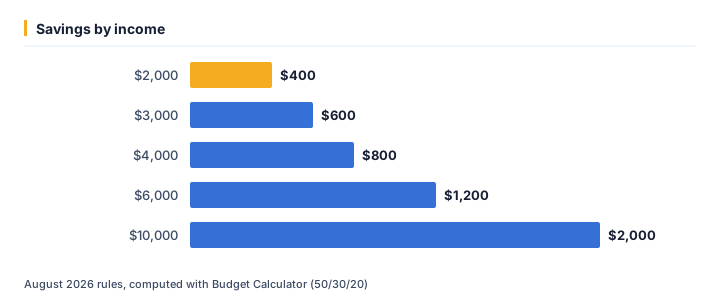
The same runs seen through needs
At $2,000, needs works out to $1,000; at $10,000 it is $5,000. Looking only at savings tends to understate how much the outcome shifts across that range.
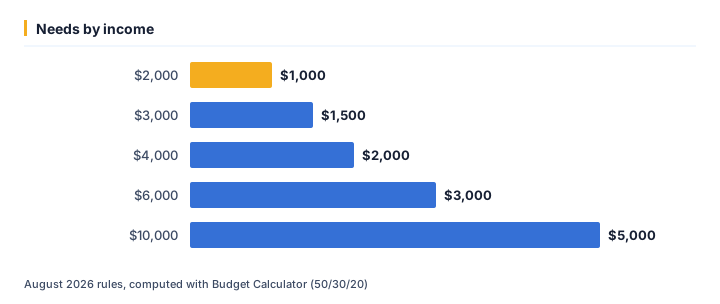
One example, straight from the API
The middle row above (income = $4,000) is not a rounded illustration — it is exactly what /api/v1/tools/budget-calculator/calculate returns for that input, August 2026 rules:
{
    "tool": "budget-calculator",
    "inputs": {
        "income": 4000
    },
    "result": {
        "needs": 2000,
        "wants": 1200,
        "savings": 800
    }
}
Assumptions behind these figures
| Input | Value |
|---|---|
| Income | $4,000 |
| As of | August 2026 |
| Method | identical to /tools/budget-calculator |
Rates, thresholds and typical costs change over time; the numbers above are accurate as of August 2026, not a permanent guarantee. For your own situation, open the Budget Calculator (50/30/20) and enter your real numbers — the calculator runs the same code that produced every figure on this page.
Ready to crunch your numbers?
Open the Budget Calculator (50/30/20) and get an answer in seconds.
Editorial Team
We write plain-English money guides and build the free calculators behind them.