A side-by-side look at the two most popular debt-payoff orderings — the snowball method and the avalanche method — with a worked four-debt example and rules for picking.
If you have more than one debt, you have a sequencing problem. You only have so many extra dollars each month, and you have to decide which balance gets the bonus payment while the others get the minimum. The two best-known answers are the snowball method, which targets the smallest balance first, and the avalanche method, which targets the highest interest rate first.
The tension between them is the classic math-versus-motivation tradeoff in personal finance. Avalanche almost always wins on dollars. Snowball almost always wins on early visible progress. Behavioral research keeps finding that people who pick snowball stay on the plan slightly longer, which can flip the result in real life. The right method is the one you will actually finish.
This article walks through what each method does, runs both on the same four debts, and ends with rules for picking. The companion tool is the Loan Payoff Calculator, which can run either ordering for your real balances in about thirty seconds.
What is the snowball method
The snowball method, popularized by Dave Ramsey in The Total Money Makeover, says you sort your debts from smallest balance to largest and attack them in that order, completely ignoring interest rates. Every debt gets its minimum payment every month. Every extra dollar you can spare goes onto the smallest debt until it is gone. Then the smallest is closed, you roll its minimum payment plus the extra into the next-smallest, and you keep going. The "snowball" rolls and grows as each balance falls.
The argument is behavioral, not mathematical. Paying off a $500 medical bill in month two feels like a win. A 2016 Journal of Marketing Research study by Gal and McShane found that closing accounts in order of smallest balance was associated with greater progress toward becoming debt-free, even when it cost slightly more in interest. The early visible wins keep people on the plan when willpower runs low in month seven.
Snowball also produces a steadily shrinking number of accounts. If you started with six debts, you will be down to five after the first payoff, then four, then three. Fewer minimum payments, fewer due dates, fewer logins. That simplification has real value, especially if your debt situation is chaotic enough that you have trouble keeping track of who you owe.
What is the avalanche method
The avalanche method sorts debts from highest interest rate to lowest. You still pay the minimum on everything, and you still funnel every extra dollar to one debt at a time, but the target is the highest-APR account regardless of how large or small its balance is. Once the highest-APR debt is gone, you redirect that payment to the next-highest rate, and so on down the stack.
The argument here is purely arithmetic. Interest accrues at the stated APR, so the dollars you "save" by killing a 24% credit card before a 6% student loan are dramatically larger than the dollars you save by killing balances in any other order. Mathematically, the avalanche method always produces the lowest total interest paid and the shortest payoff window for a given monthly budget. It is not a close call on a spreadsheet.
The catch is that the highest-APR debt is often not the smallest balance. If your worst rate sits on a $4,800 credit card alongside a $500 medical bill, the avalanche tells you to ignore the medical bill for many months while you grind on the bigger card. For people who need early visible wins to keep going, the avalanche can feel like running uphill in fog — you know you are making progress, but you cannot see it yet.
The worked example
Let's run both methods on the same household so the difference is concrete. Suppose you have four debts:
- $500 medical bill at 0% APR (hospital payment plan, $25 minimum)
- $2,200 store credit card at 24% APR ($60 minimum)
- $4,800 Visa card at 19% APR ($120 minimum)
- $14,000 federal student loan at 6.8% APR ($165 minimum)
The minimum payments total $370/month. Assume you can put $200/month extra toward debt — a total monthly budget of $570 — and that you do not add any new charges. We will run both methods through the Loan Payoff Calculator and compare.
Snowball order: $500 medical → $2,200 store card → $4,800 Visa → $14,000 student loan (sorted by balance, ignoring APR).
Avalanche order: $2,200 store card (24%) → $4,800 Visa (19%) → $14,000 student loan (6.8%) → $500 medical (0%) (sorted by APR, ignoring balance).
Here is what each method produces:
| Metric | Snowball | Avalanche |
|---|---|---|
| First debt closed | Month 3 (medical) | Month 14 (store card) |
| Number of debts closed by month 24 | 2 | 1 |
| Total months to debt-free | ~55 | ~54 |
| Total interest paid | ~$4,420 | ~$3,980 |
| Interest savings vs. snowball | — | ~$440 |
The avalanche wins on dollars — roughly $440 less in interest and a slightly shorter total payoff window — because killing the 24% store card first stops the most expensive interest from compounding. The snowball wins on early momentum: the first debt is gone in month three instead of month fourteen, and a second debt is gone before the avalanche has closed anything at all. That is the tradeoff in one table.
A few things to notice. The dollar gap is real but not enormous in this scenario — $440 over four and a half years is less than $10 per month. For a household where willpower is the bottleneck, the snowball's psychological boost is almost certainly worth the small premium. For a household with a strong commitment device, the avalanche's savings start to matter more. And the total payoff window is similar across both methods because the total monthly payment is the same — what changes is the order in which balances disappear, not how much money flows toward debt overall.
You can rerun this exercise with your actual numbers in the Loan Payoff Calculator and compare the two orderings side by side. The calculator will show you the exact month each balance disappears and the total interest paid under each plan.
When snowball is the right call
The snowball is the right tool when motivation is the binding constraint, not interest rates. In particular:
- You have at least one small debt under $1,000. The early win is the whole point of the snowball. If your smallest debt is $7,000, the psychological benefit largely disappears and you should lean avalanche.
- You have tried and failed to pay down debt before. A history of starting and stopping is the clearest signal that follow-through is the bottleneck. Pick the method that maximizes follow-through, not the one that looks best on a spreadsheet.
- Your APR spread is narrow. If all your debts are between 5% and 9%, the avalanche savings will be small and the snowball's momentum advantage dominates. The avalanche pays off most when there is a wide rate gap.
- You manage many small accounts. If you owe six or seven creditors and your monthly bills are a logistical mess, the snowball will simplify your life faster by closing accounts more quickly.
- You share finances with a partner. Visible wins are easier to celebrate together than abstract interest savings. The snowball gives you a shared milestone every few months instead of a single one at the end.
When avalanche is the right call
The avalanche is the right tool when math, not motivation, is the binding constraint. The criteria look like this:
- You have a wide APR spread. If you have a 26% store card alongside a 4% car loan, the avalanche savings can easily run into four figures over the life of the plan. That is real money.
- Your largest balances also carry the highest rates. When the math and the psychology happen to align — your $8,000 credit card is also your worst APR — there is no tradeoff. Run avalanche.
- You are confident in your follow-through. Maybe you have already paid off other debts before, or you have set up automatic transfers, or you have a long history of sticking to a budget. The avalanche rewards consistency more than the snowball does.
- You are a numbers person. If you find satisfaction in watching the total-interest-paid number drop, the avalanche will feel rewarding for its own sake. The "win" comes from the spreadsheet, not from a closed account.
- You have very few accounts to manage. With only two or three debts, the snowball's account-simplification benefit is small, and the avalanche's dollar savings stand out more.
Hybrid approaches
You do not have to commit to a pure version of either method. The two most useful hybrids look like this.
Knock out the under-$500 nuisance balances first, then go avalanche. This handles the most common real situation: one or two tiny balances (a $200 collection, a $400 medical co-pay) sitting alongside a real debt portfolio. Closing them takes one or two months, gives you the morale boost, and clears the way to run a clean avalanche on the meaningful debts.
Snowball while debt count is greater than four; switch to avalanche after. Many people get into debt with a long, ugly list — six accounts, eight, ten. The administrative overhead is itself a problem. Use the snowball to whittle the count down to three or four, then sort the remaining balances by APR and finish on the avalanche.
A third pattern: target a specific debt for tax or relationship reasons, regardless of either method's ordering. Maybe you owe your father-in-law $2,000 and it is awkward at Thanksgiving. Maybe an IRS payment plan has penalties that escalate at a specific date. These constraints can override both methods entirely. Snowball and avalanche are defaults, not commandments.
What both methods get wrong
Both methods treat the stated APR as the whole story. In practice, APR is the right metric only when all the debts are roughly the same flavor — fixed-payment, fixed-rate, unsecured consumer debt. Once you mix in different debt types, the simple "sort by APR" logic in the avalanche starts to break down, and the snowball's APR-blindness can either help or hurt depending on what you are dealing with.
A few categories where the calculation gets more interesting:
- Federal student loan interest is tax-deductible up to $2,500 per year, subject to income limits, and the deduction is "above the line" — you can take it without itemizing. If you are in the 22% federal bracket, an effective after-tax rate of
6.8% × (1 − 0.22) ≈ 5.3%can move student loans down the avalanche stack. - Medical debt is often negotiable. Hospitals routinely accept 30–70% of the billed amount as a lump-sum settlement, and newer credit reporting rules require paid medical debts to be removed. Before you put a single extra dollar on a medical bill, call the billing office and ask for the financial assistance application.
- IRS payment plans accrue interest plus penalties that can effectively run 8–10% combined. They also have non-financial consequences — wage garnishment, tax refund offset — that pure APR ignores. Tax debt often deserves higher priority than its nominal rate suggests.
- Mortgage debt is in its own category. A 4% mortgage on a primary residence with deductible interest behaves nothing like a 4% personal loan. Most planners exclude mortgages from snowball or avalanche orderings entirely.
- Car loans tied to a vehicle you cannot afford to lose carry a risk-of-repossession floor that does not show up in the APR. If missing a car payment means losing your job, the effective rate is functionally infinite.
The takeaway is not that the methods are wrong — they are excellent defaults — but that any household with mixed debt types should sanity-check the ordering against tax treatment, negotiability, and consequence-of-default before committing. If your situation involves three or more debt categories, or you are weighing bankruptcy, credit counseling, or debt settlement, this is the point to bring in a professional. A fee-only Certified Financial Planner can run the full picture; find one near you at letsmakeaplan.org. For free nonprofit credit counseling, the National Foundation for Credit Counseling at NFCC.org is the standard reference and can help with debt management plans that negotiate rates with creditors directly.
Frequently asked questions
Which method gets you out of debt faster? The avalanche, on paper, always produces the shortest total payoff time and lowest total interest paid. In practice, behavioral studies find that snowball users have slightly higher completion rates, which can flip the real-world result. The "faster" method is the one you actually finish.
Can I switch methods partway through? Yes, and many people should. A common pattern is starting on snowball to build momentum, then switching to avalanche once the easy wins are gone and the remaining debts are larger. There is no penalty for changing the ordering as long as you keep all the minimums paid.
What about debt consolidation or balance transfers? Both are tools that can sit on top of either method. A 0% balance transfer card can functionally collapse several high-APR debts into one lower-APR debt, at which point the snowball-versus-avalanche question becomes much smaller. Be careful with transfer fees (typically 3–5%) and the rate after the promotional period ends. Run the math before transferring.
Save an emergency fund first or attack debt first? Save a small starter emergency fund — usually one month of essential expenses — then attack debt aggressively, then finish funding a full three-to-six-month fund. Without any cushion, a single car repair puts you right back on the credit card. The Emergency Fund Calculator can size the starter amount.
Do these methods apply to credit cards only? No. They work on any portfolio of fixed-balance, fixed-payment debts — credit cards, personal loans, student loans, medical bills, payday loans, store cards, IRS plans. Mortgages are usually excluded from the comparison.
What if my minimum payments alone are more than my budget can handle? That is a signal you need outside help, not a sequencing strategy. Nonprofit credit counseling through NFCC.org can sometimes negotiate lower rates and consolidated payments through a debt management plan. If even that is not enough, a CFP or bankruptcy attorney can walk you through alternatives.
Does paying off debt help my credit score? Yes, especially closing revolving accounts (credit cards) and reducing your credit utilization ratio. Paying off installment loans helps less, since installment balances are weighted lower. Both methods improve credit scores; avalanche typically improves utilization faster because it kills the highest-balance revolving accounts sooner.
Next steps
- List every debt with balance, APR, and minimum payment in a single document. You cannot run either method without this. Most people are surprised at how the total looks once it is on one page.
- Run both orderings in the Loan Payoff Calculator with your real numbers and a realistic extra-payment amount. Compare the total interest and the month each debt closes. Pick the ordering whose tradeoff you can actually live with for the next two to four years.
- Build the extra payment into your budget rather than relying on willpower. Use the Budget Calculator to identify where the extra dollars come from each month, and automate the transfer so it happens before you can spend the money on anything else.
Neither method is "right." Snowball is right for households where motivation is the scarcest resource, and avalanche is right for households where dollars are. Pick the one that fits your situation honestly, write it down, and start. The math will take care of itself once you do.
Run the numbers
Everything below came out of this site's own Budget Calculator (50/30/20). The figures are not quoted from anywhere else: each row is one run of the same calculation the tool page performs, using August 2026 rules. Put the same inputs in and you will get the same output.
How the result moves with income
We ran 5 values of income through the calculator and left every other input at its default. As of August 2026, the output was:
| Income ($) | Savings ($) | Needs ($) | Wants ($) |
|---|---|---|---|
| 2,000 | 400 | 1,000 | 600 |
| 3,000 | 600 | 1,500 | 900 |
| 4,000 | 800 | 2,000 | 1,200 |
| 6,000 | 1,200 | 3,000 | 1,800 |
| 10,000 | 2,000 | 5,000 | 3,000 |
Running income from $2,000 up to $10,000 moves savings from $400 to $2,000 — a spread of $1,600. That gap is the part a single headline rate never shows.
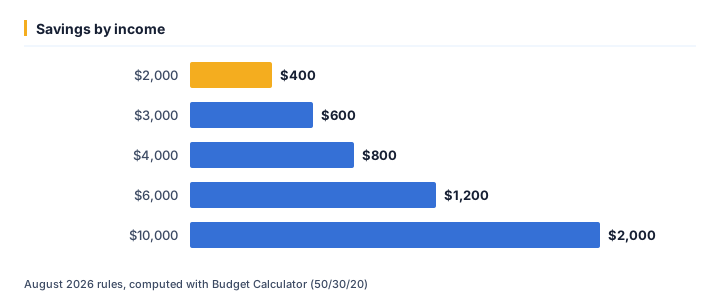
The same runs seen through needs
At $2,000, needs works out to $1,000; at $10,000 it is $5,000. Looking only at savings tends to understate how much the outcome shifts across that range.
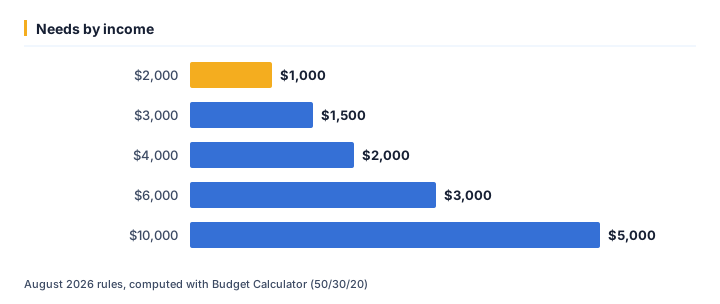
One example, straight from the API
The middle row above (income = $4,000) is not a rounded illustration — it is exactly what /api/v1/tools/budget-calculator/calculate returns for that input, August 2026 rules:
{
    "tool": "budget-calculator",
    "inputs": {
        "income": 4000
    },
    "result": {
        "needs": 2000,
        "wants": 1200,
        "savings": 800
    }
}
Assumptions behind these figures
| Input | Value |
|---|---|
| Income | $4,000 |
| As of | August 2026 |
| Method | identical to /tools/budget-calculator |
Rates, thresholds and typical costs change over time; the numbers above are accurate as of August 2026, not a permanent guarantee. For your own situation, open the Budget Calculator (50/30/20) and enter your real numbers — the calculator runs the same code that produced every figure on this page.
Ready to crunch your numbers?
Open the Budget Calculator (50/30/20) and get an answer in seconds.
Editorial Team
We write plain-English money guides and build the free calculators behind them.