The Rule of 72 is the back-of-the-envelope shortcut for compound interest — divide 72 by the return rate to estimate how long money takes to double. It is one of the most useful pieces of mental math any adult can carry.
The Rule of 72 is the closest thing personal finance has to a magic trick. It is a single piece of mental math, learnable in 30 seconds, that lets you estimate how long any compounding amount of money will take to double — without a spreadsheet, a calculator, or even a piece of paper. Once you carry it in your head, financial decisions stop feeling abstract and start having intuitive timeframes attached to them.
This guide explains exactly how the rule works, why the number 72 is the right one (and not 71 or 73), how accurate it is in the real world, when to use it (and when to use the actual compound interest formula), and several real-dollar examples that make the rule worth memorizing.
The Rule, Stated Plainly
Years to double = 72 ÷ annual interest rate (as a whole number).
That is the entire rule. Two examples to anchor it:
- Money earning 8% annually: 72 ÷ 8 = 9 years to double.
- Money earning 6% annually: 72 ÷ 6 = 12 years to double.
A $10,000 portfolio compounding at 8% will grow to roughly $20,000 in 9 years, $40,000 in 18 years, $80,000 in 27 years, and $160,000 in 36 years. Each doubling takes the same 9 years — but the absolute dollar amounts get progressively larger because the base is doubling each time. That is what the compound-interest curve looks like when expressed in human time intervals.
The rule works in the other direction too. Rate needed = 72 ÷ years to double. If you need money to double in 6 years, you need a 12% annual return (72 ÷ 6 = 12). If you have 15 years to double, you need around 4.8% (72 ÷ 15 ≈ 4.8).
Why the Number Is 72
The Rule of 72 is an approximation of the precise mathematical formula for compound growth doublings. The exact formula:
Years to double = ln(2) ÷ ln(1 + r)
Where ln is the natural logarithm and r is the rate as a decimal (0.08 for 8%). For a 10% return, the exact answer is ln(2) ÷ ln(1.10) = 0.693 ÷ 0.0953 ≈ 7.27 years. The Rule of 72 gives 72 ÷ 10 = 7.2 years — off by less than 1%.
The number 72 was chosen because it strikes the best balance between approximation accuracy across common interest rates (4–15%) and the convenience of being highly divisible. 72 is evenly divisible by 1, 2, 3, 4, 6, 8, 9, and 12 — making the mental math instant for many common rate values.
Alternative versions exist for specific accuracy bands:
- Rule of 70 — slightly more accurate at very low rates (1–4%), used in academic economics and inflation contexts.
- Rule of 69.3 — exact at infinitely small rates (continuous compounding); less useful for mental math.
- Rule of 73 or 74 — slightly more accurate at higher rates (15%+).
For personal finance use cases, 72 is the right choice. The mental simplicity outweighs the trivial accuracy gain of the alternatives.
How Accurate Is It Really?
Comparison of Rule of 72 to the exact doubling time at common rates:
| Annual Rate | Rule of 72 (years) | Exact (years) | Error |
|---|---|---|---|
| 1% | 72.0 | 69.7 | +3.3% |
| 2% | 36.0 | 35.0 | +2.9% |
| 4% | 18.0 | 17.7 | +1.7% |
| 6% | 12.0 | 11.9 | +0.8% |
| 8% | 9.0 | 9.0 | +0.0% |
| 10% | 7.2 | 7.3 | -1.4% |
| 12% | 6.0 | 6.1 | -1.6% |
| 15% | 4.8 | 5.0 | -4.0% |
The rule is essentially perfect at 8%, very close (within 2%) across 4–12%, and acceptable across 1–15%. Above 15% or below 1%, the error widens and a calculator becomes worth the effort.
For any planning math at the typical equity-portfolio range of 6–8% real return, the Rule of 72 is accurate enough that no household should bother using a calculator for "how long until this doubles" estimates. The mental shortcut is the right tool for the job.
Five Worked Examples
The rule is most useful when applied to specific real-world questions. Five common scenarios:
Example 1: The cost of cash sitting still
A household has $40,000 in a checking account earning 0.01%. The Rule of 72 says: 72 ÷ 0.01 = 7,200 years to double. Put differently, this money is going essentially nowhere. The same $40,000 in a diversified equity portfolio at 7% real return would double in 72 ÷ 7 ≈ 10 years. The difference is the entire cost of "playing it safe" with money that has no near-term purpose.
Example 2: Retirement projection without a spreadsheet
A 30-year-old has $60,000 in retirement accounts. Compounding at 7% real, they can mental-math four doublings between now and 70 years old (40 years ÷ 10 years per doubling). Four doublings of $60,000: $120,000 → $240,000 → $480,000 → $960,000. That is what their current balance will likely be at retirement without any new contributions.
When new contributions are added, the final number is much higher. But the doubling intuition alone tells the 30-year-old: even if they stopped contributing today, the existing balance compounds to nearly a million dollars. Powerful framing.
Example 3: The cost of a one-year delay
A 25-year-old considering opening a Roth IRA can mental-math the cost of waiting one year. Money compounding at 7% doubles every ~10 years. From age 25 to 65 is 40 years = 4 doublings. From age 26 to 65 is 39 years = slightly under 4 doublings.
A $5,000 contribution at 25 becomes roughly $80,000 by 65 (4 doublings). The same $5,000 contributed a year later (at 26) becomes about $74,500 by 65. The cost of waiting one year on a single $5,000 contribution is about $5,500 of future net worth — i.e., the delayed dollar produces less than the dollar contributed in time. The intuitive grasp of "wait one year, lose more than the contribution itself" is what changes behavior.
Example 4: Comparing investment options
A pre-retiree is offered two options: a CD paying 4.5% or a balanced fund expected to return 6.5%. Rule of 72: CD doubles in 16 years; fund doubles in 11 years. Over a 20-year horizon, the CD does just over one doubling; the balanced fund does nearly two doublings. The compounding advantage of the higher rate is large enough to consider, if the volatility of the balanced fund is acceptable for the time horizon.
Example 5: The inflation tax on cash
If inflation runs at 3%, a Rule-of-72 calculation tells you cash halves in purchasing power every 72 ÷ 3 = 24 years. A 40-year-old with $80,000 in checking, holding it as cash until retirement at 65 (25 years), will have roughly $80,000 / 2 = $40,000 of buying power. The nominal balance might still be $80,000, but the real value has been quietly halved.
The same calculation in 2026 dollars: dollar amounts spent in 2050 will need to be roughly double their 2026 equivalents to deliver the same lifestyle. The Rule of 72 makes inflation visceral.
When to Use the Rule (and When Not To)
The Rule of 72 is a back-of-the-envelope tool. It is brilliant for:
- Quick "is this a reasonable rate?" sanity checks.
- Mental projection of long-horizon savings outcomes.
- Comparing two investment options on the doubling axis.
- Communicating compounding to someone who doesn't think in spreadsheets.
- Estimating inflation's long-term impact on cash.
It is not the right tool when:
- You need precision better than ±5% (use the Compound Interest Calculator or the exact formula).
- You're modeling regular monthly contributions, not a single starting amount.
- You're comparing returns over time periods shorter than one full doubling.
- The interest rate exceeds 15% or falls below 1% — accuracy degrades.
- You're modeling variable-rate scenarios where the rate changes over time.
For careful planning — retirement scenarios, college savings projections, mortgage payoff comparisons — use the real calculators. For mental modeling, gut checks, and "should I be paying attention to this" filters, use the rule.
The Rule of 114 (Tripling) and Rule of 144 (Quadrupling)
Two related approximations worth knowing, derived from the same logarithmic principle:
- Rule of 114 — years to triple = 114 ÷ rate. At 7%, money triples in about 114 ÷ 7 ≈ 16.3 years.
- Rule of 144 — years to quadruple = 144 ÷ rate. At 7%, money quadruples in about 144 ÷ 7 ≈ 20.6 years.
These are less mentally elegant than 72 because the rule-of-72 is two doublings (4×) = roughly 14.4 years per quadrupling — close enough to 144/r. Most personal finance practitioners stick with the Rule of 72 alone and multiply doublings for higher targets (one doubling = 2×, two doublings = 4×, three doublings = 8×, four doublings = 16×).
This "doublings chain" is particularly useful for very long horizons. A 25-year-old investing $5,000 at 7% real return until 65 (40 years = 4 doublings) ends with $80,000 of inflation-adjusted purchasing power from that single contribution. Four doublings of $5,000 = 5 → 10 → 20 → 40 → 80, in thousands of dollars.
A Quick Mental-Math Reference
The numbers most worth memorizing for personal-finance mental math (using 7% real return, the long-run diversified-equity average):
- Money doubles in 10 years.
- Money quadruples in 20 years.
- Money 8x's in 30 years.
- Money 16x's in 40 years.
Translation: any dollar invested in your 20s and left alone until your 60s becomes roughly 16 of itself in purchasing-power terms. The 20-something who contributes $10,000 to a Roth IRA and never adds another dollar likely ends with around $160,000 in that account at 65. The 20-something who contributes $10,000 every year compounds into many multiples of that.
Carry these numbers in your head and the case for starting early becomes mathematically vivid.
Common Mistakes Using the Rule
- Confusing nominal and real returns. If you plug in 10% (nominal stock return) you get 7.2 years to double in nominal dollars — but inflation eats some of that gain. For real-purchasing-power doublings, use the real return (~7% for equities) and you get 10-year doublings of purchasing power. Be explicit about which one you're computing.
- Forgetting that ongoing contributions change the picture. The rule gives doubling time for a fixed starting amount. With regular contributions added, the effective growth is much faster than the rule alone suggests — but the rule is still a useful component of the mental model.
- Applying it to averages rather than expected long-run rates. The S&P 500 has returned 10% nominally on average, but in any specific 10-year window the actual return ranges from -5% to +20% annually. The rule is a planning approximation, not a guarantee.
- Using it for debt without accounting for payments. A 22% credit card balance doubles in 72 ÷ 22 ≈ 3.3 years if you make no payments. With minimum payments, the doubling is slower — but the math still demonstrates how aggressively high-interest debt compounds against you.
- Extending the rule beyond reasonable rate ranges. At very low rates (under 1%) or very high rates (over 20%), the approximation error grows. Either case usually warrants the exact formula or a calculator.
Frequently Asked Questions
Does the Rule of 72 work for debt as well as investments? Yes — exactly the same math runs in reverse. A debt balance compounding at 22% APR doubles in roughly 3.3 years if unpaid. This is why high-interest debt feels so impossible to escape; the compounding is fast and the household is fighting it without making minimum payments.
Can I use it to estimate retirement savings? For a rough sanity check, yes. Pick a real-return assumption (7% for diversified equities, 5% for a 60/40 portfolio), count doublings between now and your retirement date, and apply them to your current balance. Add regular contributions on top for the full picture. For real planning, use the Compound Interest Calculator.
What is the "Rule of 114" again? Years to triple = 114 ÷ rate. At 6% return, money triples in 19 years. At 9%, in just over 12.6 years. Less mentally elegant than the Rule of 72, but useful for "how long to 3x" questions.
Does the rule work with monthly compounding? The approximation assumes annual compounding. Monthly compounding produces a slightly higher effective annual rate, which makes the actual doubling time slightly faster than the rule suggests — typically by a fraction of a year. Not enough to matter for mental math.
Why not just use a calculator? For everyday personal finance intuition, the friction of opening a calculator and entering numbers exceeds the value of the precision gained. The rule lets you do the math in conversation, in meetings, in line at a coffee shop — exactly where most financial decisions are actually evaluated.
Next Steps
- Memorize the rule: 72 ÷ rate = years to double. Test it on your retirement balance and current return rate.
- Use it on a real number you carry around. Your emergency fund. Your 401(k) balance. Your credit card debt (in reverse — that's how fast it grows if untouched).
- The next time you make any compounding decision — a savings rate change, an investment vehicle choice, a debt-versus-investment tradeoff — run the rule of 72 first. The five seconds of mental math will quietly improve hundreds of household decisions over the rest of your working life.
The Rule of 72 is the most efficient piece of financial mental math any adult can learn. It costs nothing to carry, takes a minute to internalize, and quietly changes how you intuit money decisions for the rest of your life. That is a remarkable return on a 60-second investment.
Run the numbers
Everything below came out of this site's own Savings Goal Calculator. The figures are not quoted from anywhere else: each row is one run of the same calculation the tool page performs, using August 2026 rules. Put the same inputs in and you will get the same output.
How the result moves with goal
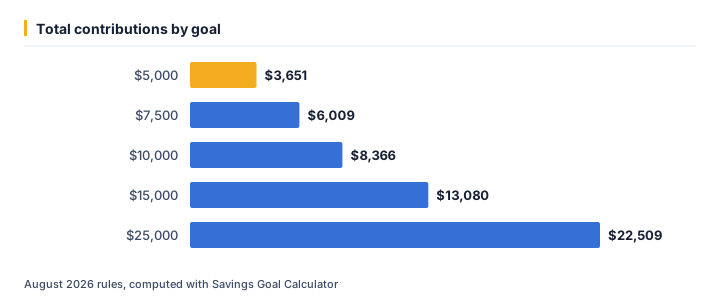
We ran 5 values of goal through the calculator and left every other input at its default. As of August 2026, the output was:
| Goal ($) | Total contributions ($) | Interest earned ($) | Needed ($) |
|---|---|---|---|
| 5,000 | 3,651.45 | 348.55 | 4,000 |
| 7,500 | 6,008.61 | 491.39 | 6,500 |
| 10,000 | 8,365.77 | 634.23 | 9,000 |
| 15,000 | 13,080.09 | 919.91 | 14,000 |
| 25,000 | 22,508.72 | 1,491.28 | 24,000 |
Running goal from $5,000 up to $25,000 moves total contributions from $3,651 to $22,509 — a spread of $18,857. That gap is the part a single headline rate never shows.
The same runs seen through interest earned
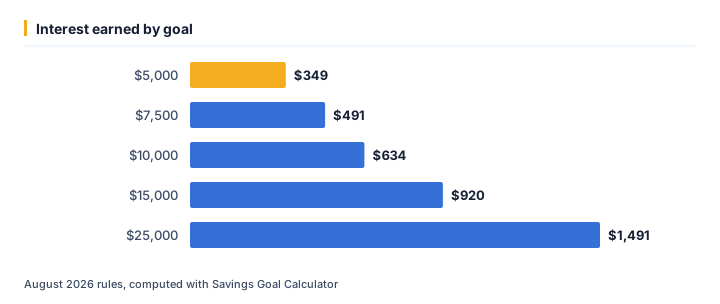
At $5,000, interest earned works out to $349; at $25,000 it is $1,491. Looking only at total contributions tends to understate how much the outcome shifts across that range.
One example, straight from the API
The middle row above (goal = $10,000) is not a rounded illustration — it is exactly what /api/v1/tools/savings-goal-calculator/calculate returns for that input, August 2026 rules:
{
    "tool": "savings-goal-calculator",
    "inputs": {
        "goal": 10000,
        "current": 1000,
        "years": 3,
        "rate": 4
    },
    "result": {
        "months": 36,
        "needed": 9000,
        "monthly_savings_required": 232.38,
        "total_contributions": 8365.77,
        "interest_earned": 634.23
    }
}
Assumptions behind these figures
| Input | Value |
|---|---|
| Goal | $10,000 |
| Current | $1,000 |
| Years | 3 years |
| Rate | 4% |
| As of | August 2026 |
| Method | identical to /tools/savings-goal-calculator |
Rates, thresholds and typical costs change over time; the numbers above are accurate as of August 2026, not a permanent guarantee. For your own situation, open the Savings Goal Calculator and enter your real numbers — the calculator runs the same code that produced every figure on this page.
Ready to crunch your numbers?
Open the Compound Interest Calculator and get an answer in seconds.
Editorial Team
We write plain-English money guides and build the free calculators behind them.