A practical walkthrough of computing compound interest on real savings — the formula, worked examples in US dollars, the future-value-of-annuity shortcut, and the Rule of 72 mental trick.
Compound interest is the single most important piece of math in your adult financial life. It is the engine behind every retirement account, every long-running savings goal, and every credit card balance that has gotten away from someone. If you can compute it on the back of a napkin, you can sanity-check almost any financial decision in under a minute.
The good news is that the formula fits on one line. By the end of this tutorial, you will be able to estimate compound growth on paper using a $10 calculator, run a more realistic monthly-contribution version, and do a credible rough estimate entirely in your head using a shortcut called the Rule of 72.
This is the "how-to" companion to our deeper theory article on compound interest. That one focuses on the why. This one focuses on the how.
The Formula You Need
Here is the compound interest formula in full:
A = P × (1 + r/n)^(nt)
That is the whole thing. Five variables, one exponent. Let's translate each piece into plain English:
- A is the final amount — the answer you want, the dollar balance at the end of the time horizon.
- P is the principal — the dollar amount you start with today.
- r is the annual interest rate expressed as a decimal. 7% is
0.07, not7. This trips people up; double-check it every single time. - n is the number of compounding periods per year. Annual compounding is
n = 1. Monthly isn = 12. Daily isn = 365. - t is the number of years the money is left to grow.
The expression (1 + r/n) is the growth factor for one compounding period. You then raise it to the power of n × t, which is the total number of compounding periods over the entire horizon.
If you are compounding annually — which is the right default for almost all personal finance estimation — then n = 1 and the formula simplifies dramatically:
A = P × (1 + r)^t
That is the version you will use 90% of the time. It is short enough to memorize today and keep with you for life. Monthly and daily compounding give slightly higher answers, but the difference is small enough at long horizons that the annual version is almost always the right tool for back-of-the-envelope work.
Step 1: Identify Your Inputs
Before you touch a calculator, gather the four variables. This sounds obvious, but mismatched units (rate quoted monthly while time is in years, or principal in thousands while contributions are in dollars) are responsible for more wrong answers than any other mistake. Slow down here.
Principal (P) — your starting balance. This is the dollar amount in the account today, or the amount you plan to invest as a lump sum. If you are starting from zero, set P to 0 and skip ahead to Step 3, which handles monthly contributions. Most realistic scenarios have both: some money already saved, plus ongoing contributions.
Annual rate (r) — the return you expect, as a decimal. For a savings account, look at the APY printed in the account terms — that is the number you want, already expressed as an annual yield. For a long-term diversified US stock portfolio, a widely cited estimate of the long-run real return (after inflation) is around 7%, so r = 0.07. Nominal returns (before inflation) have historically been higher, around 9–10%, but planning in real terms keeps you honest. For a high-yield savings account in 2026, something in the 4–5% range is a reasonable assumption. For a checking account, assume zero — those are not designed to grow money.
Compoundings per year (n). Most online savings accounts compound daily and credit interest monthly, but for projection purposes you can usually treat the APY as if it compounds annually with n = 1 because APY already bakes in the compounding effect. When in doubt, use n = 1.
Number of years (t). The time horizon. For retirement math, common values are 20, 30, or 40. For a house down payment, 3 to 7. Pick a realistic number.
Step 2: Plug In and Compute (One Time, No Contributions)
Let's do a clean worked example. Suppose you put $10,000 into a diversified investment account today, leave it there for 30 years, and earn 7% annually. No further contributions. How much will you have?
Plug into the simplified annual-compounding formula:
A = 10,000 × (1 + 0.07)^30
Step by step on a basic calculator with an exponent key (look for x^y, y^x, or ^):
- Compute
1 + 0.07 = 1.07. - Raise to the 30th power:
1.07^30 ≈ 7.6123. - Multiply by the principal:
10,000 × 7.6123 ≈ $76,123.
So $10,000 grows to roughly $76,123 over 30 years at 7%. The original principal earned $66,123 in interest — over 6× the starting balance — without you adding another dollar.
If your calculator does not have an exponent key, most smartphone calculator apps switch to scientific mode when you rotate the phone sideways, exposing the x^y button.
You can sanity-check this number with the Rule of 72 (covered below). At 7%, money doubles roughly every 72 ÷ 7 ≈ 10.3 years. Over 30 years, that is about three doublings. Starting with $10,000: $10K → $20K → $40K → $80K. The Rule of 72 estimate of $80,000 is right in the neighborhood of our exact answer of $76,123. Sanity check passed.
This is the lump-sum case — useful, but not how most people actually save.
Step 3: Add Regular Contributions (the Future Value of an Annuity)
Most real-world saving looks like this: you contribute a fixed amount every month — $200 to a Roth IRA, $500 to a brokerage account, whatever your budget allows — for many years. The formula that handles this is called the future value of an annuity, and it looks intimidating but is no harder to use than the lump-sum version:
FV = PMT × [((1 + r/n)^(nt) − 1) / (r/n)]
Where PMT is the recurring contribution per period, and the other variables match what you already know. For monthly contributions earning an annual rate, set n = 12 and convert: the per-month rate becomes r/12, and the total number of periods becomes 12 × t.
Worked example: $300/month at a 7% annual return for 30 years.
- Monthly rate:
0.07 / 12 ≈ 0.005833 - Number of months:
12 × 30 = 360 - Growth factor:
(1.005833)^360 ≈ 8.1165 - Numerator:
8.1165 − 1 = 7.1165 - Divide by monthly rate:
7.1165 / 0.005833 ≈ 1,220 - Multiply by PMT:
300 × 1,220 ≈ $366,000
So $300/month for 30 years at 7% grows to roughly $367,000. (Small rounding differences from intermediate steps; the Compound Interest Calculator returns $367,038 with full precision.)
Pause on that result for a moment. Total contributions over 30 years were $300 × 360 = $108,000. The other $259,000 is pure compounding — interest earned on interest earned on interest. This is why the annuity formula matters more for personal finance than the lump-sum version: it captures how ordinary, sustained, automatic saving turns into a meaningful number when you give it enough time.
A useful pattern to memorize: at 7% annual returns, $100/month for 30 years ≈ $122,000. Multiply your actual monthly contribution by however many hundreds and you have a quick estimate. $300/month is roughly 3× that, or $366,000 — which matches.
Step 4: Combine Both (Lump Sum + Contributions)
Real life is usually both. You have some money already saved, and you contribute monthly going forward. The good news: you do not need a new formula. You compute the two pieces separately and add them.
Worked example: you have $25,000 saved today and plan to contribute $400/month for 25 years at a 7% annual return.
Lump sum piece:
A = 25,000 × (1 + 0.07)^251.07^25 ≈ 5.427425,000 × 5.4274 ≈ $135,686
Contribution piece (monthly annuity):
- Monthly rate:
0.07 / 12 ≈ 0.005833 - Months:
12 × 25 = 300 - Growth factor:
(1.005833)^300 ≈ 5.7647 5.7647 − 1 = 4.76474.7647 / 0.005833 ≈ 816.7400 × 816.7 ≈ $326,700
Combined total: roughly $462,000.
Notice how the existing $25,000 lump grew nearly 5.5×, while the monthly contributions did the heavier lifting in absolute dollars. Both pieces matter, and both are doing the same compounding math — just on different cash flows. This is exactly what the Compound Interest Calculator computes for you in one step, but doing it by hand once or twice makes the result feel earned rather than magical.
The Rule of 72: The Mental Shortcut
The Rule of 72 is the trick that lets you do compound interest entirely in your head. The rule:
Years to double ≈ 72 ÷ annual rate (as a percent)
Some quick examples:
| Annual rate | Years to double |
|---|---|
| 3% | ~24 years |
| 6% | ~12 years |
| 7% | ~10.3 years |
| 9% | ~8 years |
| 12% | ~6 years |
The arithmetic is approximate but startlingly accurate for rates in the 4–12% range, which covers most of personal finance. Knowing this lets you do quick career-length estimates: if you expect 7% real returns and have 40 years until retirement, that is roughly four doublings. Each $1 today becomes about $16 in 40 years. A $5,000 lump sum becomes around $80,000 with no further contributions. A $50,000 lump sum becomes around $800,000.
You can also flip the rule. If you want to double your money in 8 years, you need roughly 72 ÷ 8 = 9% annual returns. If you can only earn 4%, doubling takes about 18 years. This is enormously useful for setting realistic expectations and for sanity-checking any compounding result you compute the long way.
For more on where the rule comes from and when it breaks down at extreme rates, see our Rule of 72 quick-math guide.
When to Use the Calculator Instead
The formulas above are perfect for understanding, mental estimation, and one-off sanity checks. They are not the right tool for serious planning. For anything that drives a real financial decision — how much to put in your IRA this year, whether you can retire at 62, whether a specific savings goal is realistic — use the Compound Interest Calculator instead.
The calculator handles things that are painful by hand: variable contribution amounts (a raise five years in, a lump deposit at year 10), monthly compounding precisely instead of approximated, tax treatment for taxable versus Roth versus traditional accounts, and side-by-side comparison of multiple scenarios. It also lets you stress-test results by adjusting the assumed return rate downward — always a good habit.
The mental rule of thumb: use the formula to build intuition, use the calculator to make decisions. Both have a role, and they reinforce each other.
Common Pitfalls
A short list of mistakes that quietly produce wrong answers:
- Confusing nominal and real returns. Nominal returns include inflation; real returns strip it out. A 10% nominal return with 3% inflation is roughly a 7% real return. Plan in real dollars to avoid feeling falsely rich in 30 years.
- Using arithmetic averages instead of geometric means for past returns. Geometric means are slightly lower and more honest for compounding purposes; arithmetic averages overstate growth.
- Forgetting fees and taxes. A 0.5% annual fund fee compounds against you the same way returns compound for you — it is not a small number over 30 years. Taxable account gains are taxed too.
- Assuming returns are smooth. Markets do not return exactly 7% every year. They average something like that across decades, with significant year-to-year variance. The formula gives you a long-run trajectory, not a guarantee for any specific year.
- Mixing compounding periods. A 6% annual rate compounded monthly is different from 6% per month. Always double-check the unit.
- Mixing dollar units and time units. If your contribution is monthly, your rate and time must be expressed monthly too inside the annuity formula. Stay consistent.
- Treating the output as a guarantee. It is a projection based on the inputs. Change the rate by 1% and the 30-year answer can shift by 30%. Use ranges, not single numbers.
- Ignoring sequence of returns risk near retirement — a bad year early in retirement hurts more than the same bad year early in your career. The formula does not capture this.
Frequently Asked Questions
What's the difference between APR and APY? APR (Annual Percentage Rate) is the simple annual rate without accounting for compounding. APY (Annual Percentage Yield) is the effective annual rate after compounding is included. APY is always slightly higher than APR for the same underlying rate. For savings accounts, APY is the number you want to compare across banks.
Should I use nominal or real returns? For long-term planning, use real returns (after inflation). It keeps you honest about purchasing power. A "future balance of $1,000,000 in 40 years" is impressive, but if inflation cuts that in half in real terms, your plan looks different. Around 7% real for diversified US equity is a common planning assumption.
How often does compounding actually happen? Most savings accounts compound daily but credit interest monthly. Most investment accounts compound continuously in practice (since the market is always moving). For projection purposes, treating it as annual compounding is more than precise enough. The difference between annual and daily compounding at 7% over 30 years is only about 4% on the final balance.
Does the formula work with negative rates (inflation)?
Yes. Plug in a negative r and you get the real purchasing power of a fixed dollar amount over time. $100 at −3% (inflation) over 30 years works out to about $40 in real terms. This is exactly how the Inflation Calculator computes future buying power.
Why does the result feel "too high"? Because the late-stage curve is genuinely steep, and human intuition for exponential growth is poor. Most of the dollar growth in a 30-year compounding scenario happens in the last 10 years. Trust the math — but also sanity-check with the Rule of 72 to confirm you did not mistype an input.
How can I estimate compound interest in my head? Use the Rule of 72 and count the doublings. At 7%, each ~10 years is one doubling. $5,000 over 30 years is about three doublings: $5K → $10K → $20K → $40K.
Next Steps
- Run your own scenario in the Compound Interest Calculator. Plug in your actual starting balance, monthly contribution, expected return, and time horizon. See the number for yourself.
- Memorize the Rule of 72 so you can do quick estimates without any tools at all. Practice on three real numbers this week — your savings balance, your annual contribution, your time to retirement.
- Set a concrete target with the Savings Goal Calculator. Work backward from the future-value answer to figure out exactly how much per month gets you to the goal.
The math above is illustrative — rounded numbers, simplified assumptions, no tax detail. For personalized planning that accounts for your income, taxes, debts, and risk tolerance, consider working with a fee-only Certified Financial Planner. You can find one near you through letsmakeaplan.org.
Compound interest is not a secret. It is arithmetic — patient, repetitive, and indifferent to whether you are paying attention. Now you can do the arithmetic yourself.
Run the numbers
Everything below came out of this site's own Savings Goal Calculator. The figures are not quoted from anywhere else: each row is one run of the same calculation the tool page performs, using August 2026 rules. Put the same inputs in and you will get the same output.
How the result moves with goal
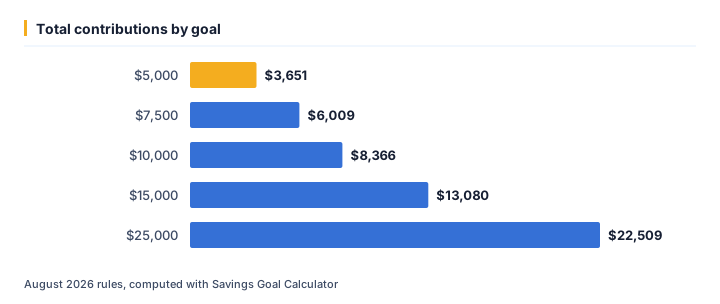
We ran 5 values of goal through the calculator and left every other input at its default. As of August 2026, the output was:
| Goal ($) | Total contributions ($) | Interest earned ($) | Needed ($) |
|---|---|---|---|
| 5,000 | 3,651.45 | 348.55 | 4,000 |
| 7,500 | 6,008.61 | 491.39 | 6,500 |
| 10,000 | 8,365.77 | 634.23 | 9,000 |
| 15,000 | 13,080.09 | 919.91 | 14,000 |
| 25,000 | 22,508.72 | 1,491.28 | 24,000 |
Running goal from $5,000 up to $25,000 moves total contributions from $3,651 to $22,509 — a spread of $18,857. That gap is the part a single headline rate never shows.
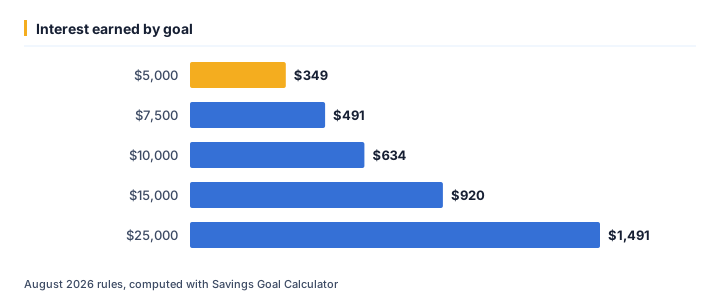
The same runs seen through interest earned
At $5,000, interest earned works out to $349; at $25,000 it is $1,491. Looking only at total contributions tends to understate how much the outcome shifts across that range.
One example, straight from the API
The middle row above (goal = $10,000) is not a rounded illustration — it is exactly what /api/v1/tools/savings-goal-calculator/calculate returns for that input, August 2026 rules:
{
    "tool": "savings-goal-calculator",
    "inputs": {
        "goal": 10000,
        "current": 1000,
        "years": 3,
        "rate": 4
    },
    "result": {
        "months": 36,
        "needed": 9000,
        "monthly_savings_required": 232.38,
        "total_contributions": 8365.77,
        "interest_earned": 634.23
    }
}
Assumptions behind these figures
| Input | Value |
|---|---|
| Goal | $10,000 |
| Current | $1,000 |
| Years | 3 years |
| Rate | 4% |
| As of | August 2026 |
| Method | identical to /tools/savings-goal-calculator |
Rates, thresholds and typical costs change over time; the numbers above are accurate as of August 2026, not a permanent guarantee. For your own situation, open the Savings Goal Calculator and enter your real numbers — the calculator runs the same code that produced every figure on this page.
Ready to crunch your numbers?
Open the Compound Interest Calculator and get an answer in seconds.
Editorial Team
We write plain-English money guides and build the free calculators behind them.