A plain-English comparison of high-yield savings, money market accounts, and CDs — what each is for, how they pay, where the gotchas hide, and which one fits your cash.
There is a strange middle zone in personal finance: money you do not need this week, but you do not want to put into the stock market either. Your emergency fund. Next year's property tax bill. The car-replacement pot. The down payment you plan to use in 18 months. This money has a job — to stay safe and roughly keep up with inflation, while staying close enough to grab on short notice.
The three most common parking spots are high-yield savings accounts (HYSAs), money market accounts (MMAs), and certificates of deposit (CDs). They all sit at federally insured banks or credit unions and they all look interchangeable in a marketing brochure. They are not. Each trades liquidity, yield, and minimums in a slightly different way, and picking the wrong one can quietly cost you a few hundred dollars a year — or worse, lock up money you need.
A note up front: interest rates change daily. Every figure in this article is illustrative, based on ranges that were reasonable as of early 2026. Confirm current APYs with your bank before you act.
What a High-Yield Savings Account Is
A high-yield savings account is exactly what the name suggests: a savings account that pays a meaningful interest rate, usually offered by an online bank or credit union. The mechanics match the savings account at your local branch — money goes in, it earns interest, and you can withdraw whenever you want. The difference is the yield. As of early 2026, ranges vary, but competitive HYSAs have been paying around 4.0–4.75% APY, while many brick-and-mortar savings accounts still pay close to 0.01%. That gap is not a typo.
Deposits are insured by the FDIC (at banks) or NCUA (at credit unions) up to $250,000 per depositor, per institution, per ownership category. For most households, that ceiling is high enough to cover an emergency fund without any planning. Larger balances may need splitting across institutions.
HYSAs are highly liquid — transfers to a linked checking account typically clear in 1–3 business days. Most have no minimum balance and no monthly fees. Common gotchas: introductory bonus APYs that drop after three months, tiered rates where the headline number only applies above a high balance, and the historical six-withdrawal-per-month limit (federally relaxed in 2020 but still enforced by some banks as house policy). Read the terms.
One more thing: HYSA rates are variable. Banks can change them at any time, and they move with the Federal Reserve's policy rate. When the Fed Funds Rate rises, HYSA yields rise — usually within a few weeks. When it falls, yields follow. That is a feature for an emergency fund: the yield floats with the broader rate environment so your cash roughly keeps pace.
What a Money Market Account Is
A money market account is a hybrid — part savings account, part checking account. Like a HYSA, it is FDIC- or NCUA-insured to $250,000 per depositor per institution. Unlike a HYSA, an MMA typically gives you check-writing privileges and sometimes a debit card, which is useful for money you will spend in occasional large chunks — quarterly estimated taxes, an annual insurance premium, a planned home repair.
As of early 2026, ranges vary, but MMA yields have generally been in the same neighborhood as HYSAs — around 3.75–4.75% APY for competitive online products. The yield differential between HYSAs and MMAs has narrowed considerably over the past decade, so the choice between them is now usually about features (check-writing, ATM access) rather than yield.
Watch the minimums. Many MMAs require a higher opening deposit than HYSAs — sometimes $1,000, $2,500, or $10,000 — and some impose a monthly maintenance fee unless you keep a minimum daily balance. Tiered APY structures are also common: the headline rate may only apply above a $10,000 or $25,000 threshold. If you are parking a smaller amount, an HYSA is often the simpler choice. One point of confusion worth clearing up: a money market account (the FDIC-insured bank product covered here) is not the same thing as a money market fund (an investment product sold by brokerages, not FDIC-insured). We'll touch on funds briefly later.
What a CD Is
A certificate of deposit is a time deposit. You agree to leave a lump sum at the bank for a fixed term — anywhere from 3 months to 5 years — and in exchange the bank gives you a fixed APY that does not change for the life of the CD. CDs are FDIC- or NCUA-insured to the same $250,000 limit.
The fixed-rate feature cuts both ways. If you open a 12-month CD at 4.5% and rates drop to 3% three months later, you are happily locked into the higher rate. If rates rise to 6% instead, you are stuck below market. As of early 2026, ranges vary, but typical online CD yields have looked something like around 4.25–5.00% for 3–12 month terms and around 3.75–4.50% for 24–60 month terms — a slightly inverted curve reflecting market expectations of rate cuts. By the time you read this, the curve may look different.
The big gotcha: early-withdrawal penalties. If you need the money before the CD matures, you pay a penalty that varies by bank and term. Commonly, the penalty is around 3 months of interest on shorter-term CDs (under 12 months) and around 6 months of interest on longer-term CDs (24 months and up). None of these are absolute rules; they are typical ranges. Read the disclosure before you commit. Two variants worth knowing: a no-penalty CD lets you withdraw once at a modestly lower headline yield, and a bump-up CD lets you request one rate increase during the term.
Head-to-Head Comparison
| Criterion | HYSA | Money Market Account | CD |
|---|---|---|---|
| Typical APY (early 2026) | ~4.0–4.75% | ~3.75–4.75% | ~3.75–5.00% (term-dependent) |
| Rate type | Variable | Variable | Fixed for term |
| FDIC/NCUA insured | Yes, to $250K | Yes, to $250K | Yes, to $250K |
| Liquidity | High — 1–3 day transfer | High — checks/debit on many | Locked for term |
| Minimum to open | Usually $0 | Often $1,000–$25,000 | Often $500–$1,000 |
| Monthly fees | Rare on online accounts | Common below minimum | None |
| Check-writing | No | Often yes | No |
| Early-withdrawal penalty | None | None | Commonly 3 months' interest (short) / 6 months' (longer) |
| Rate volatility | Floats with Fed | Floats with Fed | Locked at purchase |
| Best fit | Emergency fund, general savings | Mid-size cash with occasional checks | Money you truly won't touch |
The three products converge on the most important point — they are all federally insured to the same limit. They diverge on liquidity (CDs lock; HYSAs and MMAs don't), rate behavior (CDs fix; HYSAs and MMAs float), and operational features (MMAs offer check-writing). Yield differences are real but smaller than most people assume.
A practical rule of thumb: liquidity has a cost in basis points, not full percentage points. The gap between the best HYSA and the best 12-month CD is usually 25–75 basis points. On a $10,000 emergency fund for one year, that is the difference between roughly $400 and $450 of interest. Worth knowing about. Not worth contorting your life over.
Worked Example: $25,000 Emergency Fund for 12 Months
Let's run the numbers. You have a $25,000 emergency fund — six months of expenses at $4,200/month. You expect to leave it alone for 12 months but want access if a job loss or major repair hits. How do the three options compare?
Option A: HYSA at 4.50% APY. Using A = P × (1 + r)^t with annual compounding (APY already bakes in any intra-year compounding):
A = 25,000 × 1.045 = $26,125
Total interest: $1,125. Liquidity: full. If your car needs $4,000 in transmission work in month 7, you transfer the money and have it in a few business days.
Option B: Money Market Account at 4.25% APY.
A = 25,000 × 1.0425 = $26,062.50
Total interest: $1,062.50. Liquidity: full, plus check-writing. The HYSA wins by $62.50 over 12 months — meaningful only if check-writing has no value to you.
Option C: 12-month CD at 4.85% APY.
A = 25,000 × 1.0485 = $26,212.50
Total interest: $1,212.50 — the highest headline yield. But the money is locked. If you need to break the CD in month 7, the penalty (commonly 3 months of interest at this term length) costs roughly 25,000 × 0.0485 × (3/12) ≈ $303 — which eats most of your year's interest. The headline yield was highest, but the risk-adjusted yield — assuming any nontrivial chance of needing the money — is often the lowest.
You can run variations in the Compound Interest Calculator to see how the spread changes with balance size and term length. The pattern holds: CDs win on yield, HYSAs win on liquidity, MMAs split the difference and add check-writing. The lesson is not that CDs are bad. It is that an emergency fund is, by definition, money you might need on short notice — putting it in an instrument with a penalty defeats the purpose. CDs belong on money you genuinely will not touch.
The CD Ladder: A Quick Primer
A CD ladder is a simple way to get most of the yield advantage of CDs while preserving partial liquidity. Instead of putting one lump sum into one CD, you split it across several CDs with staggered maturities. One rung matures every few months, so cash is always freeing up.
Here is a 4-rung ladder for $20,000, with one CD maturing every 3 months:
- Rung 1: $5,000 in a 3-month CD
- Rung 2: $5,000 in a 6-month CD
- Rung 3: $5,000 in a 9-month CD
- Rung 4: $5,000 in a 12-month CD
As of early 2026, ranges vary, but short-term CDs in that band have been paying somewhere in the 4.5–5.0% area. With a blended average of 4.75%, first-year interest on $20,000 is roughly 20,000 × 0.0475 = $950 if rates hold steady.
When the 3-month rung matures, roll the proceeds into a new 12-month CD at the back of the ladder. From that point on, a CD matures every 3 months on a rolling basis — meaning a quarter of the money is always at most 90 days from being available, and the entire pot is available within a year without a single penalty.
The ladder gives you three things: a yield close to the 12-month rate, partial liquidity every quarter, and protection against locking everything in at one point in the rate cycle. The downside is operational complexity — you have to remember to roll each rung, and most banks will auto-roll into a new CD at the prevailing rate, which may not match what you'd choose. Set a calendar reminder for each maturity date. The Savings Goal Calculator can help size each rung if you are building the ladder over time rather than all at once.
Which to Pick When
The product should match the job. A short decision rubric:
Emergency fund: HYSA. Liquidity is the whole point. The yield difference vs. a CD is real but small in dollars; the cost of being locked out during a real emergency is potentially huge. Keep 3–6 months of expenses here, with no fancy ladders.
Sinking funds (annual insurance, property tax, car maintenance, holiday gifts): HYSA or MMA. Predictable lump-sum expenses with known dates. An HYSA is fine; an MMA with check-writing can be useful if you pay the bill directly from the account. Some banks let you create sub-accounts or "buckets" within a single HYSA, which is cleaner than juggling multiple accounts.
House down payment in 1–2 years: HYSA or short CD. If the timeline is firm, a 12-month CD locks in a known yield with zero market risk. If the timeline could move up, an HYSA is safer. A short CD ladder is a reasonable middle ground.
House down payment in 3–5 years: Gray territory. Pure cash earns less than inflation in many environments. Some households use Series I savings bonds or a conservative bond ETF here. This is where the Inflation Calculator becomes important — you want to understand purchasing power over a multi-year horizon.
Money you genuinely won't touch for 2+ years: Longer CD or CD ladder. If you are confident in the timeline, the locked-in rate has value. Use the Compound Interest Calculator to compare a 36-month CD against a series of rolled 12-month CDs at projected rates.
Retirement money: None of the above, mostly. Cash products historically have not kept pace with long-run inflation by enough margin to fund a 30-year retirement. Retirement belongs in a diversified mix of stocks and bonds in a tax-advantaged account. Our saving vs investing guide walks through the line between the two.
Adjacent Options Worth Knowing About
A few other places people park cash that live in the same neighborhood. Series I savings bonds (I-bonds) are inflation-indexed bonds sold by the US Treasury through TreasuryDirect; they pay a fixed rate plus a six-month inflation adjustment, but cannot be redeemed in the first 12 months at all, and the annual purchase limit is $10,000 per person. T-bills are short-term federal debt (4-week to 52-week maturities), exempt from state and local income tax — a meaningful edge in high-tax states. Brokerage money market funds hold short-term Treasury debt and commercial paper, pay a yield close to current short-term rates, and are not FDIC-insured but are typically considered very low risk. All three are worth knowing about; whether they belong in your plan depends on your tax situation and the amounts involved.
Frequently Asked Questions
Is the interest from HYSAs, MMAs, and CDs taxable? Yes. All three are taxed as ordinary income at the federal level, and at the state level in most states. Your bank sends a 1099-INT in January for any account that paid more than $10 in interest the prior year. After-tax yield can matter more than headline APY in high-tax states. T-bills, by contrast, are state-tax-free, which can change the comparison.
Can I lose money in an HYSA or CD? Not on the principal, up to the FDIC/NCUA limit of $250,000 per depositor per institution per ownership category. You can lose purchasing power if inflation runs higher than the APY — a real risk in cash, and one reason long-term money belongs somewhere other than cash. But the dollar number on the statement will not go down absent fraud or a breach of the insurance limit.
Should I keep my emergency fund in CDs to earn more? Generally, no. An emergency fund's job is to be available the moment you need it. The 25–75 basis points of extra yield you'd capture from a CD is not worth the risk of paying an early-withdrawal penalty during an actual emergency. If you want some CD-style yield on part of your reserve, a partial ladder where one rung matures every 3 months can work — but it is more complexity than most households need.
What happens to my CD when it matures? By default, most banks auto-renew your CD into a new CD of the same term at the bank's current rate, with a short grace period (typically 7–10 days) to make changes. The rate at renewal is often not competitive. Set a calendar reminder for each maturity, and either redeem, roll yourself, or transfer to a different institution. Do not let CDs auto-roll on autopilot.
Are credit union accounts as safe as bank accounts? Yes. Credit union deposits are insured by the NCUA rather than the FDIC, but the insurance limits and protections are functionally identical — $250,000 per depositor per institution per ownership category, backed by the full faith and credit of the United States. Choose between a bank and a credit union based on rates, fees, service, and access — not safety.
How do I know if a bank is actually FDIC-insured? Look for the FDIC logo on the bank's website and confirm by name in the FDIC's BankFind tool. Credit unions use the NCUA equivalent. A handful of fintech "savings" products route deposits through partner banks — the insurance is real but works differently, and the disclosure should explain the chain. If it is unclear, that is itself a signal to be cautious.
Next Steps
- Audit where your cash currently lives. Pull up your accounts and note the APY on each. If anything is paying under 1%, you almost certainly have a better option for the same federal insurance and similar liquidity.
- Run your specific numbers in the Compound Interest Calculator. Compare a year of interest in an HYSA against a year in a CD at today's rates. Then size the gap against the cost of being locked up if an emergency hits.
- Decide on a structure, then stop optimizing. Pick the simplest setup that works — most households need exactly one HYSA — and let it run. Chasing 10-basis-point bumps across multiple banks is rarely worth the friction.
Everything in this article is illustrative. Rates change daily, sometimes weekly, and yield curves rearrange themselves in response to Federal Reserve policy. The product structures (FDIC insurance, penalty conventions, ladder mechanics) are stable; the actual yields you'll see when you open accounts will be different from the ranges quoted here, and could be different again next month. Always confirm the current APY and read the disclosure before opening an account.
For households with deposit balances approaching or exceeding the $250,000 FDIC limit per institution, or for anyone designing a liquidity strategy as part of a broader retirement or estate plan, the right call is to work with a fee-only Certified Financial Planner who can look at the whole picture — taxes, beneficiaries, account titling, the works. You can find a fee-only CFP near you through letsmakeaplan.org.
Cash is the part of your financial life that should be the most boring. Pick the product that fits the job, confirm it is insured, and get back to the parts of your plan that actually need attention.
Run the numbers
Everything below came out of this site's own Savings Goal Calculator. The figures are not quoted from anywhere else: each row is one run of the same calculation the tool page performs, using August 2026 rules. Put the same inputs in and you will get the same output.
How the result moves with goal
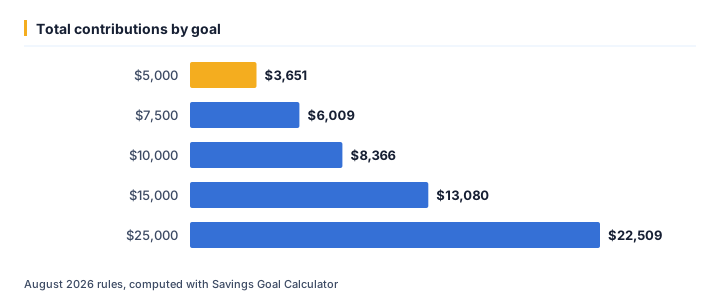
We ran 5 values of goal through the calculator and left every other input at its default. As of August 2026, the output was:
| Goal ($) | Total contributions ($) | Interest earned ($) | Needed ($) |
|---|---|---|---|
| 5,000 | 3,651.45 | 348.55 | 4,000 |
| 7,500 | 6,008.61 | 491.39 | 6,500 |
| 10,000 | 8,365.77 | 634.23 | 9,000 |
| 15,000 | 13,080.09 | 919.91 | 14,000 |
| 25,000 | 22,508.72 | 1,491.28 | 24,000 |
Running goal from $5,000 up to $25,000 moves total contributions from $3,651 to $22,509 — a spread of $18,857. That gap is the part a single headline rate never shows.
The same runs seen through interest earned
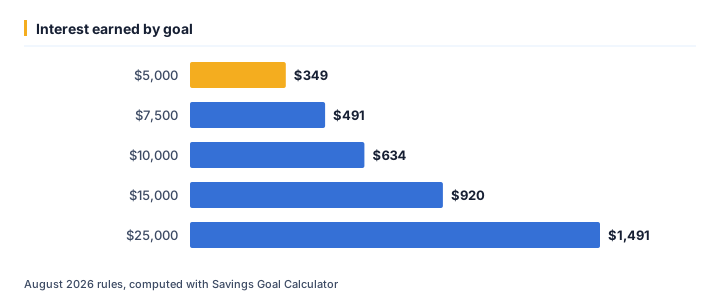
At $5,000, interest earned works out to $349; at $25,000 it is $1,491. Looking only at total contributions tends to understate how much the outcome shifts across that range.
One example, straight from the API
The middle row above (goal = $10,000) is not a rounded illustration — it is exactly what /api/v1/tools/savings-goal-calculator/calculate returns for that input, August 2026 rules:
{
    "tool": "savings-goal-calculator",
    "inputs": {
        "goal": 10000,
        "current": 1000,
        "years": 3,
        "rate": 4
    },
    "result": {
        "months": 36,
        "needed": 9000,
        "monthly_savings_required": 232.38,
        "total_contributions": 8365.77,
        "interest_earned": 634.23
    }
}
Assumptions behind these figures
| Input | Value |
|---|---|
| Goal | $10,000 |
| Current | $1,000 |
| Years | 3 years |
| Rate | 4% |
| As of | August 2026 |
| Method | identical to /tools/savings-goal-calculator |
Rates, thresholds and typical costs change over time; the numbers above are accurate as of August 2026, not a permanent guarantee. For your own situation, open the Savings Goal Calculator and enter your real numbers — the calculator runs the same code that produced every figure on this page.
Ready to crunch your numbers?
Open the Compound Interest Calculator and get an answer in seconds.
Editorial Team
We write plain-English money guides and build the free calculators behind them.