Most savings goals fail in the first 60 days because they are vague, unreasonable, or unsupported by automation. A short framework — number, deadline, monthly transfer, separation — fixes all three.
"Save more money" is the most popular financial resolution in America. It is also the one with the highest failure rate, because it is not actually a goal — it is a vague intention. Real savings goals have four specific properties: a number, a deadline, a monthly transfer that gets to the number by the deadline, and physical separation from the rest of your money so willpower stops being the load-bearing wall.
This guide walks through the framework that turns "I should save more" into a concrete plan that runs largely on autopilot, with US-dollar examples for the most common goal types — emergency fund, down payment, vacation, wedding, car, college, retirement.
Why Most Savings Goals Fail
The post-mortem of any failed savings effort almost always shows the same handful of problems.
The goal was unspecific. "Save for a house" is not a goal — it is a category. "Save $40,000 for a down payment by July 2028" is a goal. The brain treats the two completely differently. Vague goals create no urgency; specific goals create a monthly transfer.
No deadline. Without a deadline, saving is always optional and always low-priority. A goal due in 36 months has an implied monthly pace. A goal due "someday" has no pace at all.
No automation. The strongest determinant of whether a savings goal succeeds is whether the contribution happens automatically on payday or relies on a manual decision each month. Manual decisions lose to lifestyle inflation every time.
No separation. Money mingled with the checking account looks spendable, because it is spendable. A savings goal kept in a separate, named account creates psychological friction. The friction works.
Unrealistic pace. "I'll save $1,000 a month" on a budget that has historically saved $150 is not a plan — it is a wish. Six weeks in, the household discovers the math does not actually fit, gives up, and the lesson learned is "I can't save," when the real lesson is "I set an unsupportable pace."
Fix all five and savings becomes mechanical. The framework below addresses each of them.
The Four-Step Framework
Every successful savings goal follows the same four-step setup. Block 20 minutes per goal.
Step 1: Set a specific number
The goal must be a specific dollar amount. Not "enough for retirement." Not "a comfortable down payment." A specific number, in 2026 dollars.
For most goal types, the right number has a natural derivation:
- Emergency fund: target months × essential monthly expenses. See How Much Emergency Fund Do You Really Need?.
- House down payment: target purchase price × down payment percentage + estimated closing costs. A $400,000 home at 20% down with 3% closing costs ≈ $92,000.
- Wedding: budget total. The US average is around $35,000 in 2026; many households deliberately plan lower.
- Vacation: flights + lodging + meals + activities + buffer.
- Vehicle: cash purchase price or target down payment. For most beginners, 20–30% down on a 3–4 year old used vehicle is a sound target.
- Retirement: 25× annual expenses (rough rule from the 4% withdrawal rule). $50,000 annual expenses → $1.25 million target.
- College (529 plan): anticipated total cost minus expected scholarships and student contribution. Use current college cost data, then inflate at ~5% annually for years until enrollment.
A useful test: if you cannot say the number out loud in one sentence, the goal is not specific enough.
Step 2: Anchor it to a deadline
The deadline determines the monthly pace, which determines whether the goal is realistic. Both "too soon" and "too far" are common mistakes.
- Too soon is what kills the goal in week six. A 12-month deadline for a $30,000 target on a household saving $400 a month forces $2,500 monthly — almost always unsustainable, and the household abandons the project after the first miss.
- Too far kills urgency. A 15-year deadline for a $25,000 vacation goal means the contribution rate is so small ($140 a month) that any minor disruption pauses it indefinitely.
The right deadline matches the actual decision horizon. Engaged couple planning a wedding in 18 months: 18-month deadline. House purchase planned around a 2028 job relocation: target Q1 2028 deadline. New parent setting up a 529: deadline year of expected enrollment, typically 17–18 years out.
Step 3: Work backward to a monthly transfer
The arithmetic is straightforward and is exactly what the Savings Goal Calculator does in one click:
Monthly contribution = (target − current balance) ÷ months until deadline
For interest-bearing accounts (HYSA, brokerage), incorporate the expected interest growth. The calculator handles this; a manual approximation: subtract a few percent from the required monthly to account for accumulating returns over the deadline period.
Example: $20,000 vacation goal in 36 months, starting from $0, in an HYSA earning 4%. Naive monthly: $556. Interest-adjusted monthly: about $525.
Critically: if the required monthly transfer does not fit in your budget, you have two real options — extend the deadline, or reduce the target. Pretending the monthly will fit when it won't is the most common goal-killing mistake.
Step 4: Open a separate, named account
This is the simplest and most underrated step. Open a dedicated high-yield savings account at a different bank from your checking, name it for the goal ("House Down Payment," "2028 Mexico Trip," "Mira's College"), and route the monthly contribution there via direct deposit split or auto-transfer.
The friction of having to manually move money out of a separately named account, at a different institution, is what protects the savings from impulse spending. Behavioral research consistently shows mental accounting works — even when the underlying dollars are fungible, the labels and account separation change behavior.
For multiple concurrent goals, modern online banks (Ally, Capital One, Marcus, Wealthfront, and others) let you create multiple sub-accounts or "buckets" within a single login. One trip to open the account, ongoing separation for every goal.
Examples: Five Common Goals, Fully Specified
Example 1: 6-month emergency fund
- Number: essential monthly expenses × 6. For a household with $4,000/mo essentials → $24,000.
- Deadline: 18 months.
- Monthly transfer: ~$1,300 (interest-adjusted in an HYSA).
- Location: HYSA at an online bank, separate from checking.
Example 2: First home down payment
- Number: $80,000 (20% on $400,000 home + closing costs).
- Deadline: 36 months.
- Monthly transfer: ~$2,150 (HYSA, allowing for compound interest).
- Location: HYSA at an online bank. Not in a brokerage — a 3-year horizon is too short for equity exposure.
Example 3: Destination wedding
- Number: $40,000.
- Deadline: 24 months.
- Monthly transfer: ~$1,620.
- Location: HYSA or money market account.
Example 4: Used vehicle, mostly cash
- Number: $18,000 (for a 3-year-old used reliable model).
- Deadline: 14 months.
- Monthly transfer: ~$1,265.
- Location: HYSA.
Example 5: Kid's college (529 plan)
- Number: Inflation-adjusted target. Today, four years at a moderate in-state public ≈ $120,000 in 2026 dollars; inflated 5%/year over 17 years to enrollment ≈ $275,000 in 2043 nominal dollars.
- Deadline: 17 years until enrollment.
- Monthly transfer: ~$650 (with 6% real return on 529 holdings).
- Location: 529 plan in an age-based glide-path portfolio.
The pattern across every example: convert the goal into a deadline-bounded monthly transfer, automate it, and put the destination far enough away from checking to interrupt impulses.
Sequencing Multiple Goals
Most households have more than one goal at any given time. The framework above handles each individually; the trick is sequencing them so the total monthly outflow is sustainable.
A useful priority order for working-age households:
- $1,000 starter buffer (before any other goal — stops new debt from accumulating).
- Employer 401(k) match (free money — never skip).
- High-interest debt elimination (anything >7% APR).
- Full 3–6 month emergency fund.
- Retirement contributions of 15% of gross income.
- Other major goals (house, kids, large purchases) — concurrently, divided by priority.
Goal 6 is where multiple savings goals coexist. The right split depends on which deadlines are most important. A household saving for both a 2028 down payment and a 2042 college fund would typically allocate more to the down payment in the first three years (closer deadline, harder constraint), then redirect to college after the house is bought.
A common mistake: skipping straight to goal 6 (down payment savings) before goals 4 and 5 are in place. The math punishes this every time. A $40,000 down payment is exciting; missing 20 years of employer match and retirement compounding to fund it costs far more.
Tactics That Accelerate Hitting the Number
Every goal has a deadline. Some tactics tighten that deadline without changing the monthly transfer.
Direct deposit splits. Most US employers allow direct deposit to be split across two or more accounts. Route the goal-specific monthly amount to the dedicated HYSA before the rest hits checking. You never see it; you never miss it.
Windfalls, automatically directed. Tax refund, work bonus, gift, side-gig income, a tax credit — 100% to the most urgent goal until the target is hit. This single tactic compresses a typical 24-month goal to 14–18 months.
No-spend months, used surgically. A 30-day no-spend month (zero discretionary spending) typically generates $400–$1,500 of redirectable savings. Done quarterly during a goal sprint, can add a meaningful percentage to the goal timeline.
Sell one batch of stuff. Clothes, electronics, equipment, furniture you have not used in a year. A single weekend on Facebook Marketplace or local classifieds often produces $500–$2,000. Channel the proceeds straight into the goal account.
Increase contribution automatically with raises. When pay rises, increase the goal contribution by the same dollar amount (or more) before lifestyle absorbs it. Most workplace systems support this; otherwise, set a calendar reminder for the day after each pay increase.
Side income, entirely earmarked. Freelance work, a temporary side gig, returns on a small business, or proceeds from a one-time consulting project — 100% to the goal. This works precisely because the side income is incremental and the household has not learned to live on it yet.
Each of these tactics, alone, shaves weeks off the deadline. Stacked together, they can compress a 3-year goal into 2 years.
Common Mistakes
- Mixing the goal with checking. Friction is the friend of saving. Mingled money is spent money.
- Setting one mega-goal. Three concurrent $20,000 goals are far easier to track and motivate than one $60,000 catch-all.
- Borrowing from the goal account. "I'll just borrow $400 from the vacation fund to cover this bill" — almost always becomes a $400 deficit that never gets repaid. Use the emergency fund for emergencies; do not raid the goal accounts.
- No interim milestones. A 30-month goal feels endless. Mark quarterly milestones (25%, 50%, 75%) and celebrate each — keeps motivation legible.
- Quitting after one missed month. Life is variable. Missing one month is not the end of the goal; abandoning the goal after one missed month is. Resume the next month; the deadline absorbs the variance.
- Not adjusting for inflation on long-horizon goals. A retirement or college goal set 20 years out needs to be in 20-years-from-now dollars, not 2026 dollars. The Inflation Calculator converts the target.
- Holding short-term goal money in stocks. Equities are wrong for any goal under 5 years out — the volatility risk is unsupportable. HYSA or money market for sub-5-year goals.
- Holding long-term goal money in cash. Inflation eats it. Stocks (or 529 age-based portfolios) for any horizon >7 years.
Frequently Asked Questions
How do I balance savings goals with paying off debt? After the $1,000 starter buffer, high-interest debt (anything >7%) takes priority over goals other than the employer match. Below 7%, you can pursue debt payoff and goals concurrently. Anything below 4%, the mathematical case for paying minimums and investing the difference is generally strong — especially in higher-inflation periods.
Should I save in an emergency fund or invest first? Build to the $1,000 starter buffer, capture the employer match, kill high-interest debt, then complete the full emergency fund to 3–6 months. Begin discretionary investing in parallel with the emergency fund build once you are past the starter buffer and the high-interest debt.
What if I cannot afford the monthly transfer? Two options: extend the deadline, or reduce the target. Both are honest adjustments. The third option — pretend the monthly fits while reality says otherwise — is the recipe for failure. Use the Savings Goal Calculator to test what deadlines actually fit your budget.
Where do I keep a savings goal account? For goals under 5 years out: high-yield savings account (HYSA), online bank, separate from checking. For goals 5–10 years out: a conservative brokerage allocation (40/60 or 60/40 stock/bond) is reasonable. For goals 10+ years out: index funds, often in tax-advantaged accounts when the goal type allows (529, Roth IRA for retirement).
Should I invest emergency fund money for higher returns? No. The volatility risk of holding emergency-fund dollars in stocks is precisely the wrong direction — equities are most likely to be down during the recessions that cause the layoffs that trigger emergency fund withdrawals. Some loss to inflation on cash is the price of durable accessibility.
Can I have too many savings goals at once? Yes — typically more than 4–5 concurrent goals becomes hard to fund and track. If you find yourself in that territory, consolidate the smaller goals into a single "irregular expenses" sinking fund and reserve dedicated accounts for the 2–3 largest goals.
Next Steps
- Pick one goal you have been vaguely intending to save for. Specify the number and deadline using the framework above.
- Run it through the Savings Goal Calculator to find the required monthly contribution. Is the number realistic for your budget? If not, adjust the deadline (or the target).
- Open a dedicated HYSA for the goal this week. Set up the auto-transfer for the day after your next paycheck. Now the work is done by automation, not by willpower.
A specific number, a specific deadline, an automated monthly transfer, and a separate named account. Those four steps quietly outperform the most motivated household trying to save manually. Mechanical systems beat willpower every time — that is true everywhere in personal finance, and it is especially true for savings goals.
Run the numbers
Everything below came out of this site's own Budget Calculator (50/30/20). The figures are not quoted from anywhere else: each row is one run of the same calculation the tool page performs, using August 2026 rules. Put the same inputs in and you will get the same output.
How the result moves with income
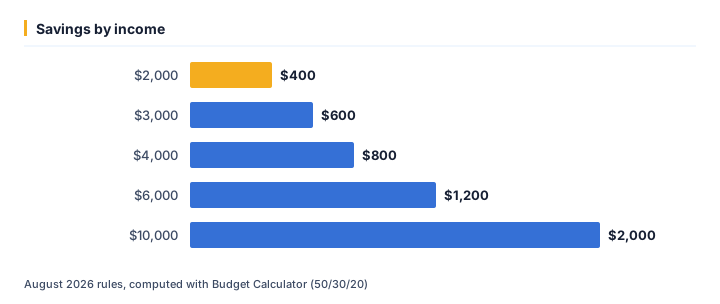
We ran 5 values of income through the calculator and left every other input at its default. As of August 2026, the output was:
| Income ($) | Savings ($) | Needs ($) | Wants ($) |
|---|---|---|---|
| 2,000 | 400 | 1,000 | 600 |
| 3,000 | 600 | 1,500 | 900 |
| 4,000 | 800 | 2,000 | 1,200 |
| 6,000 | 1,200 | 3,000 | 1,800 |
| 10,000 | 2,000 | 5,000 | 3,000 |
Running income from $2,000 up to $10,000 moves savings from $400 to $2,000 — a spread of $1,600. That gap is the part a single headline rate never shows.
The same runs seen through needs
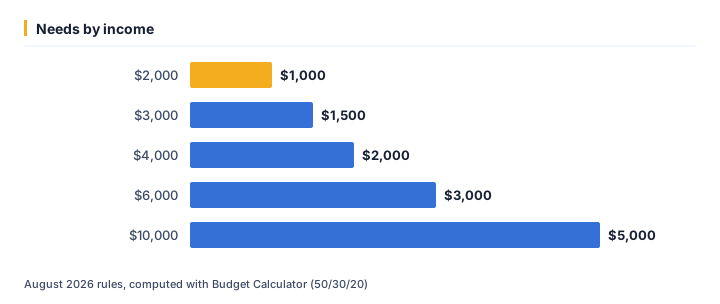
At $2,000, needs works out to $1,000; at $10,000 it is $5,000. Looking only at savings tends to understate how much the outcome shifts across that range.
One example, straight from the API
The middle row above (income = $4,000) is not a rounded illustration — it is exactly what /api/v1/tools/budget-calculator/calculate returns for that input, August 2026 rules:
{
    "tool": "budget-calculator",
    "inputs": {
        "income": 4000
    },
    "result": {
        "needs": 2000,
        "wants": 1200,
        "savings": 800
    }
}
Assumptions behind these figures
| Input | Value |
|---|---|
| Income | $4,000 |
| As of | August 2026 |
| Method | identical to /tools/budget-calculator |
Rates, thresholds and typical costs change over time; the numbers above are accurate as of August 2026, not a permanent guarantee. For your own situation, open the Budget Calculator (50/30/20) and enter your real numbers — the calculator runs the same code that produced every figure on this page.
Ready to crunch your numbers?
Open the Budget Calculator (50/30/20) and get an answer in seconds.
Editorial Team
We write plain-English money guides and build the free calculators behind them.